

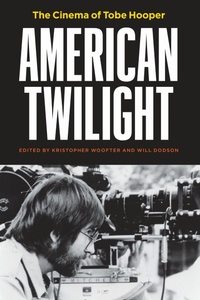
American Twilight
The Cinema of Tobe Hooper
Published on 6. February 2024
Book
Paperback/Softback
312 pages
978-1-4773-2946-7 (ISBN)
Description
A master of gritty horror, Tobe Hooper captured on-screen an America in constant crisis and upended myths of prosperity to reveal the country's internal decay.
Tobe Hooper's productions, which often trespassed upon the safety of the family unit, cast a critical eye toward an America in crisis. Often dismissed by scholars and critics as a one-hit wonder thanks to his 1974 horror classic The Texas Chain Saw Massacre, Hooper nevertheless was instrumental in the development of a robust and deeply political horror genre from the 1960s until his death in 2017. In American Twilight, the authors assert that the director was an auteur whose works featured complex monsters and disrupted America's sacrosanct perceptions of prosperity and domestic security.
American Twilight focuses on the skepticism toward American institutions and media and the articulation of uncanny spaces so integral to Hooper's vast array of feature and documentary films, made-for-television movies, television episodes, and music videos. From Egg Shells (1969) to Poltergeist (1982), Djinn (2013), and even Billy Idol's music video for "Dancing with Myself" (1985), Tobe Hooper provided a singular directorial vision that investigated masculine anxiety and subverted the idea of American exceptionalism.
Tobe Hooper's productions, which often trespassed upon the safety of the family unit, cast a critical eye toward an America in crisis. Often dismissed by scholars and critics as a one-hit wonder thanks to his 1974 horror classic The Texas Chain Saw Massacre, Hooper nevertheless was instrumental in the development of a robust and deeply political horror genre from the 1960s until his death in 2017. In American Twilight, the authors assert that the director was an auteur whose works featured complex monsters and disrupted America's sacrosanct perceptions of prosperity and domestic security.
American Twilight focuses on the skepticism toward American institutions and media and the articulation of uncanny spaces so integral to Hooper's vast array of feature and documentary films, made-for-television movies, television episodes, and music videos. From Egg Shells (1969) to Poltergeist (1982), Djinn (2013), and even Billy Idol's music video for "Dancing with Myself" (1985), Tobe Hooper provided a singular directorial vision that investigated masculine anxiety and subverted the idea of American exceptionalism.
Reviews / Votes
In American Twilight, Hooper is given the attention he deserves as a contributor to the canon of horror as a genre for his exploration of an 'America in crisis.' (No Film School) [Tobe Hooper's] subversive and fascinating body of work...is given its due in editors Kristopher Woofter and Will Dodson's American Twilight...[Hooper is] an artist who-lacking unlimited Hollywood resources-still found ways to mine his obsessions late into his fraught career...Those who agree will find American Twilight indispensable. (Film International) [A] well-edited collection of essays...[American Twilight] offers a nice mixture of close readings of individual or small groups of [Tobe Hooper's] films and discussions of the machinations of the film and television industry and its relationship to the auteur in the period from 1974 to 2006. If one of the editors' goals was to encourage readers to see Hooper's less-known works, they certainly succeed...All of the contributors elevate the director from the realm of forgotten genius...Highly recommended. (CHOICE)More details
Language
English
Place of publication
Austin, TX
United States
Target group
Professional and scholarly
Product notice
Paperback (trade)
Unsewn / adhesive bound
Dimensions
Height: 226 mm
Width: 150 mm
Thickness: 20 mm
Weight
431 gr
ISBN-13
978-1-4773-2946-7 (9781477329467)
Copyright in bibliographic data and cover images is held by Nielsen Book Services Limited or by the publishers or by their respective licensors: all rights reserved.
Schweitzer Classification
Persons
Kristopher Woofter is a faculty member in the English department at Dawson College, Montreal. He is the editor of Shirley Jackson: A Companion and coeditor of Recovering 1940s Horror Cinema: Traces of a Lost Decade.
Will Dodson is the Ashby and Strong Residential College Coordinator and an adjunct assistant professor of media studies at UNC Greensboro.
Will Dodson is the Ashby and Strong Residential College Coordinator and an adjunct assistant professor of media studies at UNC Greensboro.
Content
Acknowledgments
Introduction. "No Pleasure in Killing": The Cinema of Tobe Hooper (Kristopher Woofter and Will Dodson)
Part I. Hooper's Gothic
Chapter 1. "It's Better to Be Suggestive:" Gothic Intertextuality and Hybridity in the 1980s Films of Tobe Hooper (Brigid Cherry)
Chapter 2. Poltergeist: TV People and Suburban Rage Monsters (Joan Hawkins)
Chapter 3. Tobe Hooper's Teenage Wasteland: Youth and Disillusionment in The Funhouse, Invaders from Mars, and Mortuary (Kristopher Woofter)
Chapter 4. Salem's Lot: Tobe Hooper's Gothic Peyton Place (Tony Williams)
Chapter 5. Feeding the Industrial Monster: A Critical Reconsideration of Tobe Hooper's The Mangler (Carl H. Sederholm)
Chapter 6. Unsettled Architecture and Avant-Garde Strategies in Tobe Hooper's Down Friday Street, Toolbox Murders, and Djinn (Anne Golden and Kristopher Woofter)
Part II. Embodiment
Chapter 7. Nightmare Images: Tobe Hooper on Horror and Aging (Adam Lowenstein)
Chapter 8. Experimental Sorcery in Tobe Hooper's Eggshells (Mario DeGiglio-Bellemare)
Chapter 9. Lizard Brain Ouroboros: Human Antiexceptionalism in Tobe Hooper's Eaten Alive and Crocodile (Mike Thorn)
Chapter 10. "Sex or the Saw, Boy, What's It Gonna Be?": Tobe Hooper's Anxious Men (Will Dodson)
Chapter 11. Bad Touches: Spontaneous Combustion in the Aftermath of the Nuclear Family (Alanna Thain)
Part III. Production and Industry
Chapter 12. Can(n)onical Hooper: A Reconsideration of Tobe Hooper's Golan-Globus Films (Ian Olney)
Chapter 13. Hooper's Hollywood: Investigating Occult Spaces in Toolbox Murders (2004) (Nina K. Martin)
Chapter 14. Songs in the Key of Death: Tobe Hooper's "Dancing with Myself" and "Dance of the Dead" (Jerry D. Metz)
Chapter 15. The Past Infects the Present: Abjection and Identity in Tobe Hooper's 1990s TV and Video Productions (John Taylor)
Chapter 16. "Get Back to Work!": Critiquing the Hollywood-Industrial Complex in The Mangler (Clayton Dillard)
Part IV. The American Twilight
Chapter 17. The Texas Chain Saw Massacre Begins (J. Shea and Ned Schantz)
Chapter 18. Tobe Hooper and the American Twilight (Christopher Sharrett)
Appendix: Cross-Referenced Tobe Hooper Filmography
References
List of Contributors
Index
Introduction. "No Pleasure in Killing": The Cinema of Tobe Hooper (Kristopher Woofter and Will Dodson)
Part I. Hooper's Gothic
Chapter 1. "It's Better to Be Suggestive:" Gothic Intertextuality and Hybridity in the 1980s Films of Tobe Hooper (Brigid Cherry)
Chapter 2. Poltergeist: TV People and Suburban Rage Monsters (Joan Hawkins)
Chapter 3. Tobe Hooper's Teenage Wasteland: Youth and Disillusionment in The Funhouse, Invaders from Mars, and Mortuary (Kristopher Woofter)
Chapter 4. Salem's Lot: Tobe Hooper's Gothic Peyton Place (Tony Williams)
Chapter 5. Feeding the Industrial Monster: A Critical Reconsideration of Tobe Hooper's The Mangler (Carl H. Sederholm)
Chapter 6. Unsettled Architecture and Avant-Garde Strategies in Tobe Hooper's Down Friday Street, Toolbox Murders, and Djinn (Anne Golden and Kristopher Woofter)
Part II. Embodiment
Chapter 7. Nightmare Images: Tobe Hooper on Horror and Aging (Adam Lowenstein)
Chapter 8. Experimental Sorcery in Tobe Hooper's Eggshells (Mario DeGiglio-Bellemare)
Chapter 9. Lizard Brain Ouroboros: Human Antiexceptionalism in Tobe Hooper's Eaten Alive and Crocodile (Mike Thorn)
Chapter 10. "Sex or the Saw, Boy, What's It Gonna Be?": Tobe Hooper's Anxious Men (Will Dodson)
Chapter 11. Bad Touches: Spontaneous Combustion in the Aftermath of the Nuclear Family (Alanna Thain)
Part III. Production and Industry
Chapter 12. Can(n)onical Hooper: A Reconsideration of Tobe Hooper's Golan-Globus Films (Ian Olney)
Chapter 13. Hooper's Hollywood: Investigating Occult Spaces in Toolbox Murders (2004) (Nina K. Martin)
Chapter 14. Songs in the Key of Death: Tobe Hooper's "Dancing with Myself" and "Dance of the Dead" (Jerry D. Metz)
Chapter 15. The Past Infects the Present: Abjection and Identity in Tobe Hooper's 1990s TV and Video Productions (John Taylor)
Chapter 16. "Get Back to Work!": Critiquing the Hollywood-Industrial Complex in The Mangler (Clayton Dillard)
Part IV. The American Twilight
Chapter 17. The Texas Chain Saw Massacre Begins (J. Shea and Ned Schantz)
Chapter 18. Tobe Hooper and the American Twilight (Christopher Sharrett)
Appendix: Cross-Referenced Tobe Hooper Filmography
References
List of Contributors
Index