

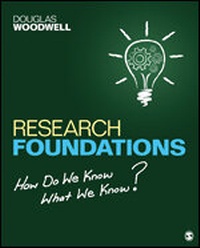
Research Foundations
How Do We Know What We Know?
1st Edition
Published on 21. January 2014
Book
Paperback/Softback
224 pages
978-1-4833-0674-2 (ISBN)
Description
Designing research can be daunting and disorienting for novices. After experiencing this first-hand, the author has written a book that shows how to mentally frame research in a way that is understandable and approachable while also discussing some of the more specific issues that will aid the reader in understanding the options available when pursuing their research. Stressing the link between research and theory-building, this concise book shows students how new knowledge is discovered through the process of research. The author presents a model that ties together research processes across the various traditions and shows how different types of research interrelate.
The book is sophisticated in its presentation, but uses plain language to provide an explanation of higher-level concepts in an engaging manner. Throughout the book, the author treats research methodologies as a blueprint for answering a wide range of interesting questions, rather than simply a set of tools to be applied. The book is an excellent guide for students who will be consumers of research and who need to understand how theory and research interrelate.
"The author did an excellent job on this text. This text is the missing link in explaining research methodologies. His comparison/contrasts are excellent. Moreover, the author provides interesting alternatives and discusses how each alternative might improve the validity of research."
-James Anthos, South University, Columbia
"...With only six chapters, the text can be covered in a short time allowing for students to spend the majority of their time investigating social issues and developing research. Students who read and understand this book will have the knowledge and resources to cover material they are unfamiliar with."
-R. David Frantzreb II, University of North Carolina - Charlotte
"I am looking for something just like this that is not overbearing for the student but will complement the supplementary material and resources that I am using with my students. I think the coverage is broad enough that I could use it with all of my groups."
-Karen Larwin, Youngstown State University
"...I think the author's emphasis on demonstrating the relationship between theory and research is terribly important and understated in so many other texts. I also think that in the hands of competent professors, it can be supplemented with other sources to help students learn while not being encumbered financially with an expensive tome for which they may only use a fraction of it."
-John R. Mitrano, Central Connecticut State University
The book is sophisticated in its presentation, but uses plain language to provide an explanation of higher-level concepts in an engaging manner. Throughout the book, the author treats research methodologies as a blueprint for answering a wide range of interesting questions, rather than simply a set of tools to be applied. The book is an excellent guide for students who will be consumers of research and who need to understand how theory and research interrelate.
"The author did an excellent job on this text. This text is the missing link in explaining research methodologies. His comparison/contrasts are excellent. Moreover, the author provides interesting alternatives and discusses how each alternative might improve the validity of research."
-James Anthos, South University, Columbia
"...With only six chapters, the text can be covered in a short time allowing for students to spend the majority of their time investigating social issues and developing research. Students who read and understand this book will have the knowledge and resources to cover material they are unfamiliar with."
-R. David Frantzreb II, University of North Carolina - Charlotte
"I am looking for something just like this that is not overbearing for the student but will complement the supplementary material and resources that I am using with my students. I think the coverage is broad enough that I could use it with all of my groups."
-Karen Larwin, Youngstown State University
"...I think the author's emphasis on demonstrating the relationship between theory and research is terribly important and understated in so many other texts. I also think that in the hands of competent professors, it can be supplemented with other sources to help students learn while not being encumbered financially with an expensive tome for which they may only use a fraction of it."
-John R. Mitrano, Central Connecticut State University
Reviews / Votes
This will be a great text for beginning master's students in research methods. I love the way the author integrates quantitative and qualitative traditions and concepts, and I appreciate tremendously the author's holistic approach. -- Elvinet S. Piard "This book is comprehensive, covering the general philosophy of research, the methodological requirements and options, and the methods for drawing conclusions. I very much appreciate the integration of the qualitative methodologies into the general conversation of knowledge creation." -- Paul C. Boyd "The author did an excellent job on this text. This text is the missing link in explaining research methodologies. His comparison/contrasts are excellent. Moreover, the author provides interesting alternatives and discusses how each alternative might improve the validity of research." -- James Anthos "...With only six chapters, the text can be covered in a short time allowing for students to spend the majority of their time investigating social issues and developing research. Students who read and understand this book will have the knowledge and resources to cover material they are unfamiliar with." -- R. David Frantzreb II "I am looking for something just like this that is not overbearing for the student but will complement the supplementary material and resources that I am using with my students.... I am very impressed with the link between research and theory building." -- Karen Larwin "I think the author's emphasis on demonstrating the relationship between theory and research is terribly important and understated in so many other texts.... His accessible writing style and use of both classic and timely examples is also a strength. He is in touch with the concerns that students typically have when taking a research methods course." -- John R. MitranoMore details
Language
English
Place of publication
Thousand Oaks
United States
Target group
College/higher education
Dimensions
Height: 229 mm
Width: 152 mm
Weight
335 gr
ISBN-13
978-1-4833-0674-2 (9781483306742)
Copyright in bibliographic data and cover images is held by Nielsen Book Services Limited or by the publishers or by their respective licensors: all rights reserved.
Schweitzer Classification
Person
Douglas Woodwell is an associate professor of international relations in the Department of History and Political Science at the University of Indianapolis. He received his BA in International Studies at American University, his MA in German and European Studies at Georgetown University, and his PhD in Political Science at Yale University. His earlier works include articles written for international relations journals and the World Bank as well as the book Nationalism in International Relations.
Content
Part I. Overview
1. Visualizing Research
Part II: Getting to Causal Theory
2. Finding and Organizing Information
3. Causal Theory
Part III. Verifying Theory
4. Preparing to Test Hypotheses
5. Testing Hypotheses
Part IV. Using Theory
6. Applying Theory and Evaluating the "Real World"
1. Visualizing Research
Part II: Getting to Causal Theory
2. Finding and Organizing Information
3. Causal Theory
Part III. Verifying Theory
4. Preparing to Test Hypotheses
5. Testing Hypotheses
Part IV. Using Theory
6. Applying Theory and Evaluating the "Real World"