

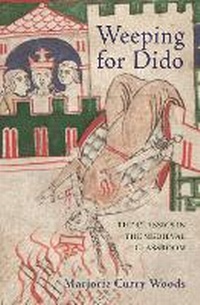
Weeping for Dido
The Classics in the Medieval Classroom
Will be published approx. on 5. February 2019
Book
Hardback
200 pages
978-0-691-17080-0 (ISBN)
Description
Saint Augustine famously "wept for Dido, who killed herself by the sword," and many later medieval schoolboys were taught to respond in similarly emotional ways to the pain of female characters in Virgil's Aeneid and other classical texts. In Weeping for Dido, Marjorie Curry Woods takes readers into the medieval classroom, where boys identified with Dido, where teachers turned an unfinished classical poem into a bildungsroman about young Achilles, and where students not only studied but performed classical works.
Woods opens the classroom door by examining teachers' notes and marginal commentary in manuscripts of the Aeneid and two short verse narratives: the Achilleid of Statius and the Ilias latina, a Latin epitome of Homer's Iliad. She focuses on interlinear glosses-individual words and short phrases written above lines of text that elucidate grammar, syntax, and vocabulary, but that also indicate how students engaged with the feelings and motivations of characters. Interlinear and marginal glosses, which were the foundation of the medieval classroom study of classical literature, reveal that in learning the Aeneid, boys studied and empathized with the feelings of female characters; that the unfinished Achilleid was restructured into a complete narrative showing young Achilles mirroring his mentors, including his mother, Thetis; and that the Ilias latina offered boys a condensed version of the Iliad focusing on the deaths of young men. Manuscript evidence even indicates how specific passages could be performed.
The result is a groundbreaking study that provides a surprising new picture of medieval education and writes a new chapter in the reception history of classical literature.
Woods opens the classroom door by examining teachers' notes and marginal commentary in manuscripts of the Aeneid and two short verse narratives: the Achilleid of Statius and the Ilias latina, a Latin epitome of Homer's Iliad. She focuses on interlinear glosses-individual words and short phrases written above lines of text that elucidate grammar, syntax, and vocabulary, but that also indicate how students engaged with the feelings and motivations of characters. Interlinear and marginal glosses, which were the foundation of the medieval classroom study of classical literature, reveal that in learning the Aeneid, boys studied and empathized with the feelings of female characters; that the unfinished Achilleid was restructured into a complete narrative showing young Achilles mirroring his mentors, including his mother, Thetis; and that the Ilias latina offered boys a condensed version of the Iliad focusing on the deaths of young men. Manuscript evidence even indicates how specific passages could be performed.
The result is a groundbreaking study that provides a surprising new picture of medieval education and writes a new chapter in the reception history of classical literature.
Reviews / Votes
"This book will be of vital interest to scholars of medieval education. Classicists interested in the medieval reception of classical texts will also find it fascinating."---Rachel Moss, Times Higher Education "[A] book that is more than a stunning work of scholarship-it is an immersive experience that transports the readeracross space and time into the sounds and fury of women in the medieval classroom.
"---Alex Mueller, Studies in the Age of Chaucer
More details
Series
Language
English
Place of publication
New Jersey
United States
Target group
College/higher education
Professional and scholarly
Product notice
Trade binding
Illustrations
2 colour + 17 b/w illus.
Dimensions
Height: 216 mm
Width: 140 mm
ISBN-13
978-0-691-17080-0 (9780691170800)
Copyright in bibliographic data and cover images is held by Nielsen Book Services Limited or by the publishers or by their respective licensors: all rights reserved.
Schweitzer Classification
Other editions
Additional editions
E-Book
04/2019
1st Edition
Princeton University Press
from
€99.95
Available for download
Person
Marjorie Curry Woods is the Jane and Roland Blumberg Centennial Professor of English, Professor of Comparative Literature, and University Distinguished Teaching Professor at the University of Texas at Austin. She is the author of An Early Commentary on the "Poetria nova" of Geoffrey of Vinsauf and Classroom Commentaries: Teaching the "Poetria nova" across Medieval and Renaissance Europe.