

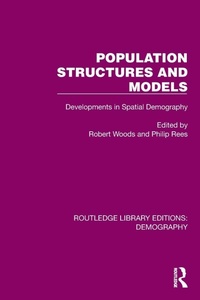
Population Structures and Models
Developments in Spatial Demography
1st Edition
Published on 1. August 2025
Book
Paperback/Softback
456 pages
978-1-032-55370-2 (ISBN)
Description
Originally published in 1986, this volume brings together geographical modelling of population change and demographic analysis of population structures and pattern. These 2 strands are interwoven in 3 key review chapters that summarize the study of spatial and temporal patterns of population, the modelling of spatial populations and the estimation of population processes. Findings reported include: An account of demographic transition; an expose of the myth of 'no fertility rises' in the developing world in the 20th Century; a theory of population accounting; predicting migration flows for a system of regions; microsimulation methods to model population change; and demographic and economic processes integrated in an urban region model.
Reviews / Votes
Review of the original edition of Population Structures and Models:'...readers should find the text well-organized and coherent, formula notations clearly defined and tables and figures quite helpful in reinforcing an understanding of the subject.' John F. Watkins, Professional Geographer, Vol 40, Issue 2.
More details
Series
Language
English
Place of publication
London
United Kingdom
Publishing group
Taylor & Francis Ltd
Target group
College/higher education
Postgraduate, Undergraduate, and Undergraduate Advanced
Dimensions
Height: 234 mm
Width: 156 mm
Thickness: 25 mm
Weight
693 gr
ISBN-13
978-1-032-55370-2 (9781032553702)
Copyright in bibliographic data and cover images is held by Nielsen Book Services Limited or by the publishers or by their respective licensors: all rights reserved.
Schweitzer Classification
Other editions
Additional editions
Book
10/2023
1st Edition
Routledge
€134.00
Shipment within 10-20 days
E-Book
10/2023
1st Edition
Routledge
€41.99
Available for download
E-Book
10/2023
1st Edition
Routledge
€41.99
Available for download
Persons
Robert (Bob) Woods was one of the most eminent historical demographers of his generation. He held the John Rankin Chair of Geography at the University of Liverpool, served as President of the British Society for Population Studies (1991), was founding co-editor (1997-92) of the International Journal of Population Geography and was a recipient of the Society's Murchison Award (1999).
Philip Rees, now an emeritus professor, has spent over half a century at the University of Leeds researching spatial population dynamics, mentoring generations of students, leading programmes for improving access to UK population data, participating in international collaborations and advising government and business. His key contribution, illustrated in the book, has been to show how spatial demographic models, especially those for projecting populations, must be founded on the proper understanding of how migration is measured."
Philip Rees, now an emeritus professor, has spent over half a century at the University of Leeds researching spatial population dynamics, mentoring generations of students, leading programmes for improving access to UK population data, participating in international collaborations and advising government and business. His key contribution, illustrated in the book, has been to show how spatial demographic models, especially those for projecting populations, must be founded on the proper understanding of how migration is measured."
Content
1.Spatial Demography: Themes, Issues and Progress Robert Woods and Philip Rees Part 1: Spatial Variations in Demographic Structures 2. Spatial and Temporal Patterns Robert Woods 3. The Spatial Dynamics of the Demographic Transition in the West Robert Woods 4. The Analysis of Regional Fertility Patterns John Coward 5. Rising Fertility in Developing Countries Tim Dyson and Mike Murphy Part 2: Modelling and Forecasting 6. Developments in the Modelling of Spatial Populations Philip Rees 7. Choices in the Construction of Regional Population Projections Philip Rees 8. The Analysis and Projection of Interregional Migration in the United Kingdom John Stillwell 9. Forecasting Place-to-Place Migration with Generalized Linear Models Frans Willekens and Nazli Baydar 10. Demographic Processes and Household Dynamics: A Microsimulation Approach Martin Clarke 11. A Demographic-Economic Model of a Metropolis Moss Madden and Peter Batey Part 3: Reconstruction, Estimation and Evaluation of Demographic Patterns 12. Demographic Estimation: Problems, Methods and Examples Philip Rees and Robert Woods 13. Regional Population Analysis in Developing Countries: The Creation of a Database for Thailand Wim Doeve 14. Assessing the United Nations Urbanization Projections for the Asian Pacific Jacques Ledent and Andrei Rogers.