

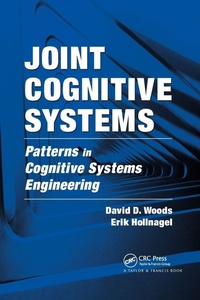
Joint Cognitive Systems
Patterns in Cognitive Systems Engineering
1st Edition
Published on 10. December 2019
Book
Paperback/Softback
232 pages
978-0-367-86415-6 (ISBN)
Description
Our fascination with new technologies is based on the assumption that more powerful automation will overcome human limitations and make our systems 'faster, better, cheaper,' resulting in simple, easy tasks for people. But how does new technology and more powerful automation change our work?
Research in Cognitive Systems Engineering (CSE) looks at the intersection of people, technology, and work. What it has found is not stories of simplification through more automation, but stories of complexity and adaptation. When work changed through new technology, practitioners had to cope with new complexities and tighter constraints. They adapted their strategies and the artifacts to work around difficulties and accomplish their goals as responsible agents. The surprise was that new powers had transformed work, creating new roles, new decisions, and new vulnerabilities. Ironically, more autonomous machines have created the requirement for more sophisticated forms of coordination across people, and across people and machines, to adapt to new demands and pressures.
This book synthesizes these emergent Patterns though stories about coordination and mis-coordination, resilience and brittleness, affordance and clumsiness in a variety of settings, from a hospital intensive care unit, to a nuclear power control room, to a space shuttle control center. The stories reveal how new demands make work difficult, how people at work adapt but get trapped by complexity, and how people at a distance from work oversimplify their perceptions of the complexities, squeezing practitioners. The authors explore how CSE observes at the intersection of people, technology, and work, how CSE abstracts patterns behind the surface details and wide variations, and how CSE discovers promising new directions to help people cope with complexities. The stories of CSE show that one key to well-adapted work is the ability to be prepared to be surprised. Are you ready?
Research in Cognitive Systems Engineering (CSE) looks at the intersection of people, technology, and work. What it has found is not stories of simplification through more automation, but stories of complexity and adaptation. When work changed through new technology, practitioners had to cope with new complexities and tighter constraints. They adapted their strategies and the artifacts to work around difficulties and accomplish their goals as responsible agents. The surprise was that new powers had transformed work, creating new roles, new decisions, and new vulnerabilities. Ironically, more autonomous machines have created the requirement for more sophisticated forms of coordination across people, and across people and machines, to adapt to new demands and pressures.
This book synthesizes these emergent Patterns though stories about coordination and mis-coordination, resilience and brittleness, affordance and clumsiness in a variety of settings, from a hospital intensive care unit, to a nuclear power control room, to a space shuttle control center. The stories reveal how new demands make work difficult, how people at work adapt but get trapped by complexity, and how people at a distance from work oversimplify their perceptions of the complexities, squeezing practitioners. The authors explore how CSE observes at the intersection of people, technology, and work, how CSE abstracts patterns behind the surface details and wide variations, and how CSE discovers promising new directions to help people cope with complexities. The stories of CSE show that one key to well-adapted work is the ability to be prepared to be surprised. Are you ready?
Reviews / Votes
". . . present an effective joint cognitive systems paradigm, make compelling arguments, and recommend a substantial advance for our field."- Doug Griffith, in Ergonomics in Design, Spring 2007
More details
Language
English
Place of publication
London
United Kingdom
Publishing group
Taylor & Francis Ltd
Target group
Professional and scholarly
Academic, Professional, and Professional Practice & Development
Dimensions
Height: 234 mm
Width: 156 mm
Thickness: 13 mm
Weight
360 gr
ISBN-13
978-0-367-86415-6 (9780367864156)
Copyright in bibliographic data and cover images is held by Nielsen Book Services Limited or by the publishers or by their respective licensors: all rights reserved.
Schweitzer Classification
Other editions
Additional editions
Book
03/2006
1st Edition
CRC Press
€192.21
Shipment within 15-20 days
E-Book
03/2006
CRC Press
€69.99
Available for download
E-Book
03/2006
1st Edition
CRC Press
€69.99
Available for download
Persons
Erik Hollnagel is presently Senior Professor of Patient Safety at the University of Jonkoping, Sweden
Content
Introduction: Basic Values in Studying and Designing Joint Cognitive Systems. Discovering Patterns in Joint Cognitive Systems at Work. Patterns in How Joint Cognitive Systems Work. Designing Joint Cognitive Systems that Work.