

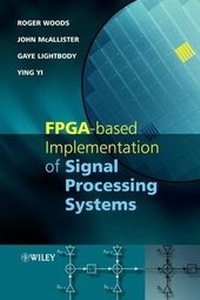
FPGA-based Implementation of Signal Processing Systems
Published on 17. October 2008
Book
Hardback
382 pages
978-0-470-03009-7 (ISBN)
Description
Field programmable gate arrays (FPGAs) are an increasingly popular technology for implementing digital signal processing (DSP) systems. By allowing designers to create circuit architectures developed for the specific applications, high levels of performance can be achieved for many DSP applications providing considerable improvements over conventional microprocessor and dedicated DSP processor solutions. The book addresses the key issue in this process specifically, the methods and tools needed for the design, optimization and implementation of DSP systems in programmable FPGA hardware. It presents a review of the leading-edge techniques in this field, analyzing advanced DSP-based design flows for both signal flow graph- (SFG-) based and dataflow-based implementation, system on chip (SoC) aspects, and future trends and challenges for FPGAs. The automation of the techniques for component architectural synthesis, computational models, and the reduction of energy consumption to help improve FPGA performance, are given in detail.
Written from a system level design perspective and with a DSP focus, the authors present many practical application examples of complex DSP implementation, involving:* high-performance computing e.g. matrix operations such as matrix multiplication;* high-speed filtering including finite impulse response (FIR) filters and wave digital filters (WDFs);* adaptive filtering e.g. recursive least squares (RLS) filtering;* transforms such as the fast Fourier transform (FFT). FPGA-based Implementation of Signal Processing Systems is an important reference for practising engineers and researchers working on the design and development of DSP systems for radio, telecommunication, information, audio-visual and security applications. Senior level electrical and computer engineering graduates taking courses in signal processing or digital signal processing shall also find this volume of interest.
Written from a system level design perspective and with a DSP focus, the authors present many practical application examples of complex DSP implementation, involving:* high-performance computing e.g. matrix operations such as matrix multiplication;* high-speed filtering including finite impulse response (FIR) filters and wave digital filters (WDFs);* adaptive filtering e.g. recursive least squares (RLS) filtering;* transforms such as the fast Fourier transform (FFT). FPGA-based Implementation of Signal Processing Systems is an important reference for practising engineers and researchers working on the design and development of DSP systems for radio, telecommunication, information, audio-visual and security applications. Senior level electrical and computer engineering graduates taking courses in signal processing or digital signal processing shall also find this volume of interest.
More details
Language
English
Place of publication
Hoboken
United Kingdom
Publishing group
John Wiley and Sons Ltd
Target group
Professional and scholarly
Illustrations
Illustrations
Dimensions
Height: 251 mm
Width: 170 mm
Thickness: 27 mm
Weight
856 gr
ISBN-13
978-0-470-03009-7 (9780470030097)
Copyright in bibliographic data and cover images is held by Nielsen Book Services Limited or by the publishers or by their respective licensors: all rights reserved.
Schweitzer Classification
Other editions
New editions
Roger Woods | John McAllister | Gaye Lightbody
FPGA-based Implementation of Signal Processing Systems
Book
04/2017
2nd Edition
Wiley
€121.50
Shipment within 15-20 days
Content
About the Authors. Preface. Chapter 1: Introduction to Field-Programmable Gate Arrays. Chapter 2: DSP Fundamentals. Chapter 3: Arithmetic Basics. Chapter 4: Technology Review. Chapter 5: Current FPGA Technologies. Chapter 6: Detailed FPGA Implementation Issues. Chapter 7: Rapid DSP System Design Tools and Processes for FPGA. Chapter 8: Architecture Derivation for FPGA-based DSP Systems. Chapter 9: The IRIS Behavioural Synthesis Tool. Chapter 10: Complex DSP Core Design for FPGA. Chapter 11: Model-Based Design for Heterogeneous FPGA. Chapter 12: Adaptive Beamformer Example. Chapter 13: Low-Power FPGA Implementation. Chapter 14: Final Statements.