

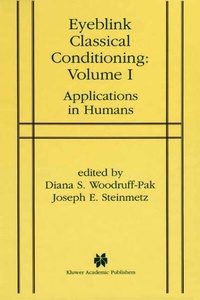
Eyeblink Classical Conditioning Volume 1
Applications in Humans
Published on 3. December 2010
Book
Paperback/Softback
VIII, 318 pages
978-1-4419-4960-8 (ISBN)
Description
The model system of eyeblink classical conditioning in humans has enormous potential for the understanding and application of fundamental principles of learning. This collection makes classical conditioning accessible to teachers and researchers in a number of ways. The first aim is to present the latest developments in theory building. Second, as background for the current directions,
Eyeblink Classical Conditioning, Volume I
presents an overview of a large body of previously published research on eyeblink classical conditioning. Last, the authors describe eyeblink classical conditioning techniques. Each chapter includes a highlighted methods section so that interested readers can replicate techniques for teaching and research.
More details
Edition
Softcover reprint of the original 1st ed. 2000
Language
English
Place of publication
New York
United States
Target group
Professional and scholarly
Research
Illustrations
VIII, 318 p.
Dimensions
Height: 235 mm
Width: 155 mm
Thickness: 18 mm
Weight
499 gr
ISBN-13
978-1-4419-4960-8 (9781441949608)
DOI
10.1007/b108229
Schweitzer Classification
Other editions
Additional editions
Diana S. Woodruff-Pak | Joseph E. Steinmetz
Eyeblink Classical Conditioning Volume 1
Applications in Humans
Book
02/2000
Kluwer Academic Publishers
€160.49
Shipment within 15-20 days
Content
Past, Present, and Future of Human Eyeblink Classical Conditioning.- Neural Network Approaches to Classical Conditioning.- Functional Nethorks Underlying Human Eyeblink Conditioning.- Functional MRI Studies of Eyeblink Classical Conditioning.- Dual-Task and Repeated Measures Designs: Utility in Assessing Timing and Neural Functions in Eyeblink Conditioning.- Using Eyeblink Conditioning to Assess Neurocognitive Development in Human Infants.- Classical Eyeblink Conditioning in Normal and Autistic Children.- Human Eyeblink Classical Conditoning in Normal Aging and Alzheimer's Disease.- Eyeblink Conditioning in Neurological Patients with Motor Impairments.- Eyeblink Classical Conditioning in Amnesia.- Awareness and the Conditioned Eyeblink Response.- Can Eyeblink Classical Conditioning Provide a Foundation for Integrating Clinical Science and Cognitive-Neuroscience in the Study of Psychopathology?.