

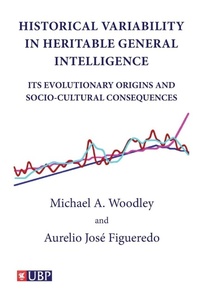
Historical Variability In Heritable General Intelligence
Its Evolutionary Origins and Socio-Cultural Consequences
Published on 14. May 2013
Book
Paperback/Softback
288 pages
978-1-908684-26-4 (ISBN)
Description
It is easy for us to believe that as a society we are getting smarter, at least as measured by IQ tests. This supposed improvement, the Flynn Effect, suggests that each generation is brighter than the last.
If this improvement in intelligence is real we should all be much, much brighter than the Victorians. However, the researchers of this ground-breaking study find the reverse to be true- the Victorians were cleverer than us! IQ tests may be effective at picking out the brightest, but they are not reliable benchmarks of performance over more than a century.
Historical Variance records the exploration of the Flyyn effect hypothesis, which included the use of high-quality instruments to measure simple reaction times (a recognised predictor of intelligence) in a meta-analytic study.
The conclusions are very sobering: far from speeding up, we are slowing down. A decline in general intelligence (a loss equivalent to about 14 IQ points) since Victorian times may have resulted from the presence of dysgenic fertility. These findings, as detailed in Historical Variance, strongly indicate that the Victorians were substantially cleverer than we are today...
More details
Language
English
Place of publication
London
United Kingdom
Publishing group
Legend Press Ltd
Target group
College/higher education
Professional and scholarly
Dimensions
Height: 234 mm
Width: 156 mm
Thickness: 7 mm
Weight
199 gr
ISBN-13
978-1-908684-26-4 (9781908684264)
Copyright in bibliographic data and cover images is held by Nielsen Book Services Limited or by the publishers or by their respective licensors: all rights reserved.
Schweitzer Classification