

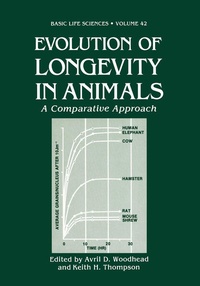
Evolution of Longevity in Animals
A Comparative Approach
Published on 11. November 2011
Book
Paperback/Softback
X, 354 pages
978-1-4612-9077-3 (ISBN)
Description
The analysis of intra-group correlations between LS and BW at representative intervals yields no consistent support for the hypothesis that lower BW is associated with longer LS. Indeed, among male Wistar rats and C57BL/6J and A/J mice followed since weaning on AL diets, the data suggested that relatively higher BW across the adult LS was generally associated with longer life. Even when the diet was restricted by EOD or RES regimens, this pattern of positive correlations between LS and BW persisted for the C57BL/6J and A/J strains when relative ages were analyzed. However, when BW at absolute ages were correlated with LS, support for the positive relationship between BW and LS was not as forthcoming. When AL groups were assessed beginning at later ages (> 10 months), the pattern of positive correlations was very evident for the Wistar rats--heavier rats tended to liver longer. This pattern was also evident among AL-fed C57BL/6J mice followed since 6 months, but was lost in the 10-month group in this strain. Among A/J mice on AL diets, the pattern became somewhat negative when followed at 6 and 10 months of age. However, among both C57BL/6J and A/J mice placed on EOD diets at 6 and 10 months of age, the pattern clearly tended toward the positive.
More details
Series
Edition
Softcover reprint of the original 1st ed. 1987
Language
English
Place of publication
New York
United States
Target group
Professional and scholarly
Research
Illustrations
X, 354 p.
Dimensions
Height: 254 mm
Width: 178 mm
Thickness: 20 mm
Weight
692 gr
ISBN-13
978-1-4612-9077-3 (9781461290773)
DOI
10.1007/978-1-4613-1939-9
Schweitzer Classification
Other editions
Additional editions
E-Book
03/2013
Springer
€53.49
Available for download

Book
11/1987
Kluwer Academic / Plenum Publishers
€109.13
Article exhausted; check different version
Content
Genetic and Environmental Determinants of Longevity in Drosophila.- Informational Structure of the Developmental Tree of Multi-Cellular Organisms.- Genetic and Environmental Manipulation of Aging in Caenorhabditis elegans.- Scaling of Maximal Lifespan in Mammals: A Review.- Why Should Senescence Evolve? An Answer Based on a Simple Demographic Model.- Mutant Genes That Extend Life Span.- Longevity in the Protozoa.- The Heredity-Environment Continuum: A Systems Analysis.- The Proximate and Ultimate Control of Aging in Drosophila and Humans.- The Many Genetics of Aging.- Lifespan Enviromental Influences on Species Typical Behavior of Meriones unguiculatus.- Longevity in Fish: Some Ecological and Evolutionary Considerations.- Evolutionary Reliability Theory.- Programmed Cell Death and Aging in Drosophila melanogaster.- Immortality of the Germ-Line Versus Disposability of the Soma.- Systems Ecology, Operations Research and Gerontology: The Making of Strange Bedfellows.- Demographic Consequences of Natural Selection.- The Relationship of Body Weight to Longevity Within Laboratory Rodent Species.- Is Cellular Senescence Genetically Programmed?.- Information Content of Biological Survival Curves Arising in Aging Experiments: Some Further Thoughts.- Symposium Debate.- The Microscope (Reductionist) or the Telescope (Holistic)?.- Round Table Discussion.- Remarks of the Moderator.- The Future of Aging Research.- Survival Analysis: Lessons from Quantitative Genetics.- Participants.