

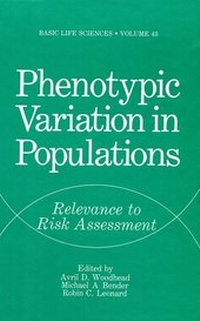
Basic Life Science
Relevance to Risk Assessment
1st Edition
Published on 1. February 1988
Book
Hardback
305 pages
978-0-306-42794-7 (ISBN)
Description
The human race has enormous he terogenei ty, founded on genetic and environmental sources. Variability, therefore, is a vital dimension in any consideration of human risk assessment. In the estimation of risks, current methods of extrapolation based upon converting the response of a median man are inadequate, as they ignore phenotypic variation and there- fore, susceptible subgroups. There is a growing literature defining the extent of human variation in normal populations; thus, the normal young adult population may have 10-20% known hyperreactors. How far can we ignore human variability in risk assessment? Should we be concerned with susceptible groups, and how can we modify the risk assessment analysis accordingly? The aim of our meeting was to bring together experts from the fields of human epidemiology, toxicology, aging, genetics, carcino- genesis and teratology, and to provide a forum in which we might assimi- late knowledge of human heterogeneity as a coherent whole. Since the resolution and obligations of risk assessment, in the last analysis, are a political process, we also involved representatives from the legal field, the unions, and the regulatory agencies.
We are most grateful for financial support from the National Institute on Aging; the u. S. Environmental Protection Agency; the U. S. Department of Energy; FDA - National Center for Toxicological Research; The Council for Tobacco Research-USA, Inc; Johnson and Johnson; Merck Sharp and Dohme Research Laboratories; and Associated Universities, Inc. We thank our Symposium Coordinator, Ms.
We are most grateful for financial support from the National Institute on Aging; the u. S. Environmental Protection Agency; the U. S. Department of Energy; FDA - National Center for Toxicological Research; The Council for Tobacco Research-USA, Inc; Johnson and Johnson; Merck Sharp and Dohme Research Laboratories; and Associated Universities, Inc. We thank our Symposium Coordinator, Ms.
More details
Series
Language
English
Place of publication
Dordrecht
Netherlands
Publishing group
Kluwer Academic Publishers Group
Target group
College/higher education
Professional and scholarly
Research
Illustrations
27 black & white illustrations, biography
Weight
750 gr
ISBN-13
978-0-306-42794-7 (9780306427947)
Copyright in bibliographic data and cover images is held by Nielsen Book Services Limited or by the publishers or by their respective licensors: all rights reserved.
Schweitzer Classification
Other editions
Additional editions
Book
03/2013
Springer
€106.99
Shipment within 15-20 days
E-Book
12/2012
Springer
€96.29
Available for download
Content
Relevance of Phenotypic Variation in Risk Assessment: The Scientific Viewpoint.- Human Genetic Individuality and Risk Assessment.- Fragile Sites, Mutagens and Genomic Rearrangements in Cancer.- Sources and Significance of Variation as Measured in Human Populations.- New Technologies for Studying Human Genetic Variation.- Genes Encoding Drug-Metabolizing Enzymes: Possible Role in Human Disease.- Epidemiologic Evidence for Genetic Variability in the Frequency of Cancer: Ethnic Differences.- Phenotypic Variation within Genetically Homogeneous Populations: Responsiveness to Toxicants.- Variability in Anthropometric Traits in Twins and Their Families.- Variation in Expression of Congenital Cardiovascular Malformations within and among Families.- The Use of Polymorphic Markers to Detect Genetic Variability.- The Arrogance of Intellectual Power.- Risk Assessment, Regulation, and the Limits of Science.- Variability in Diet and its Relation to Risk in Ethnic and Migrant Groups.- Cancer Risk and Lifestyle: Cancer among Mormons from 1967-1975.- Gene-Environmental Interaction as a Cause of Human Variation.- Risk Assessment: Short-Term Exposure at Various Ages.- Variability in Lifespan Functional Capacity.- Constitutional, Somatic Genetic and Environmental Aspects of the Phenotypic Diversity of Aging in Human Subjects.- Variability in Cognitive Function in the Elderly: Implications for Societal Participation.- A Legal Viewpoint on the Relevance of Phenotypic Variation to Risk Assessments.- Comparative Risk Measures for Heterogeneous Populations.- Risk Assessment: Extrapolation to Individual Risk.- Differential Susceptibility: Implications for Epidemiology, Risk Assessment, and Public Policy.- Efficiency, Liberty and Justice in Screening for Phenotypic Variation.- Variation in Individual Response-Will It Really Affect the Regulatory Response?.- Fear, Fiat and Fiasco: Causation in Cancer Risk Assessment.- Participants.