

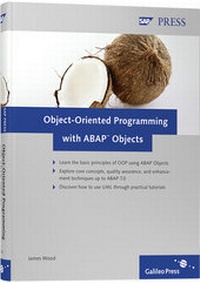
Object-Oriented Programming with ABAP Objects
1st Edition
Published on 25. February 2009
Book
Hardback
357 pages
978-1-59229-235-6 (ISBN)
Description
This book provides a gentle (and yet, comprehensive) start to programming object-oriented ABAP. What are objects? How to define and write classes? What's polymorphism all about?
The book helps you to venture the switch to object-oriented programming, and brings your skills up to date: First learn about all essential OO concepts, then see examples from daily development work. Exception handling, object debugging and unit testing are demystified here, plus, you get advice on enhanced techniques and tools in ABAP 7.0. The book will not spend time teaching basic syntax, but only concentrate on teaching object-oriented development - your chance to successfully explore ABAP OO.
Topic Highlights
Working with Objects
Encapsulation and Implementation Hiding
Object Initialization and Cleanup
Inheritance vs. Composition
Polymorphism
Component Design and Name Control
Handling Exceptions and Debugging Objects
Unit Testing with ABAP Unit
Business Add-Ins and Enhancements
Working with SAP Controls
ABAP Object Services
Using ABAP Objects with Workflow
More details
Other editions
New editions
James Wood | Joseph Rupert
Object-Oriented Programming with ABAP Objects
Book
10/2015
2nd Edition
SAP PRESS
€69.95
Shipment within 5-7 days
Person
Author
James Wood is the founder and principal consultant of Bowdark Consulting, Inc., an SAP NetWeaver consulting and training organization. With more than seven years of experience as a software engineer, James specializes in custom development in the areas of ABAP Objects, Java/J2EE, SAP NetWeaver Process Integration, and the SAP NetWeaver Portal.
Before starting Bowdark Consulting, Inc. in 2006, James was an SAP NetWeaver consultant for SAP America, Inc. and IBM Corporation where he was involved in multiple SAP implementations. He holds a master's degree in software engineering from Texas Tech University. To learn more about James and the book, please check out his website at http://www.bowdarkconsulting.com.
Content
... Introduction ... 15
1 ... Introduction to Object-Oriented Programming ... 23
... 1.1 ... The Need for a Better Abstraction ... 23
... 1.2 ... Classes and Objects ... 24
... 1.3 ... Establishing Boundaries ... 27
... 1.4 ... Reuse ... 29
... 1.5 ... Object Management ... 33
... 1.6 ... UML Tutorial: Class Diagram Basics ... 33
... 1.7 ... Summary ... 39
2 ... Working with Objects ... 41
... 2.1 ... Syntax Overview ... 41
... 2.2 ... Creating and Using Objects ... 52
... 2.3 ... Building Your First Object-Oriented Program ... 64
... 2.4 ... Getting Started with the Class Builder ... 71
... 2.5 ... Case Study: Working with Regular Expressions ... 82
... 2.6 ... UML Tutorial: Object Diagrams ... 84
... 2.7 ... Summary ... 86
3 ... Encapsulation and Implementation Hiding ... 89
... 3.1 ... Lessons Learned from the Procedural Approach ... 89
... 3.2 ... Data Abstraction with Classes ... 94
... 3.3 ... Defining Component Visibilities ... 95
... 3.4 ... Hiding the Implementation ... 101
... 3.5 ... Designing by Contract ... 102
... 3.6 ... UML Tutorial: Sequence Diagrams ... 103
... 3.7 ... Summary ... 105
4 ... Object Initialization and Cleanup ... 107
... 4.1 ... Creating Objects ... 107
... 4.2 ... Controlling Object Initialization with Constructors ... 111
... 4.3 ... Taking Control of the Instantiation Process ... 117
... 4.4 ... Garbage Collection ... 121
... 4.5 ... Tuning Performance ... 122
... 4.6 ... UML Tutorial: State Machine Diagrams ... 125
... 4.7 ... Summary ... 126
5 ... Inheritance ... 127
... 5.1 ... Generalization and Specialization ... 128
... 5.2 ... Inheriting Components ... 133
... 5.3 ... The Abstract and Final Keywords ... 140
... 5.4 ... Inheritance Versus Composition ... 145
... 5.5 ... Using the Refactoring Assistant ... 148
... 5.6 ... UML Tutorial: Advanced Class Diagrams Part I ... 150
... 5.7 ... Summary ... 153
6 ... Polymorphism ... 155
... 6.1 ... Object Reference Assignments Revisited ... 155
... 6.2 ... Dynamic Method Call Binding ... 160
... 6.3 ... Interfaces ... 163
... 6.4 ... UML Tutorial: Advanced Class Diagrams Part II ... 180
... 6.5 ... Summary ... 182
7 ... Component-Based Design Concepts ... 183
... 7.1 ... Understanding the SAP Component Model ... 183
... 7.2 ... The Package Concept ... 185
... 7.3 ... UML Tutorial: Package Diagrams ... 197
... 7.4 ... Summary ... 199
8 ... Error Handling with Exceptions ... 201
... 8.1 ... Lessons Learned from Prior Approaches ... 201
... 8.2 ... The Class-Based Exception Handling Concept ... 203
... 8.3 ... Dealing with Exceptions ... 205
... 8.4 ... Raising and Forwarding Exceptions ... 210
... 8.5 ... Creating Exception Classes ... 219
... 8.6 ... UML Tutorial: Activity Diagrams ... 229
... 8.7 ... Summary ... 231
9 ... Unit Testing with ABAP Unit ... 233
... 9.1 ... ABAP Unit Overview ... 234
... 9.2 ... Creating Unit Test Classes ... 237
... 9.3 ... Case Study: Creating a Unit Test in ABAP Unit ... 241
... 9.4 ... Executing Unit Tests ... 244
... 9.5 ... Evaluating Unit Test Results ... 246
... 9.6 ... Moving Toward Test-Driven Development ... 247
... 9.7 ... UML Tutorial: Use Case Diagrams ... 248
... 9.8 ... Summary ... 253
10 ... Working with the SAP List Viewer ... 257
... 10.1 ... Overview of the SAP Control Framework ... 257
... 10.2 ... Overview of the ALV Object Model ... 260
... 10.3 ... Getting Started with the Flight Query Report ... 261
... 10.4 ... Event Handling with the ALV Object Model ... 271
... 10.5 ... UML Tutorial: Communication Diagrams ... 275
... 10.6 ... Summary ... 277
11 ... ABAP Object Services ... 279
... 11.1 ... Object-Relational Mapping Concepts ... 280
... 11.2 ... Persistence Service Overview ... 280
... 11.3 ... Building Persistent Classes ... 286
... 11.4 ... Working with Persistent Objects ... 293
... 11.5 ... UML Tutorial: Advanced Sequence Diagrams ... 298
... 11.6 ... Summary ... 301
12 ... Working with XML ... 303
... 12.1 ... XML Overview ... 303
... 12.2 ... XML Processing Concepts ... 309
... 12.3 ... Case Study: Developing a Reading List ADT ... 311
... 12.4 ... Case Study: Building an XML Document ... 314
... 12.5 ... Case Study: Reading an XML Document ... 320
... 12.6 ... UML Tutorial: Advanced Activity Diagrams ... 325
... 12.7 ... Summary ... 327
13 ... Where to Go From Here ... 329
A ... Debugging Objects ... 333
... A.1 ... Debugging Objects Using the Classic ABAP Debugger ... 333
... A.2 ... Debugging Objects Using the New ABAP Debugger ... 340
B ... The Author ... 343