

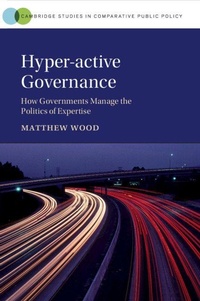
Hyper-active Governance
How Governments Manage the Politics of Expertise
Published on 8. April 2021
Book
Paperback/Softback
290 pages
978-1-009-00180-9 (ISBN)
Description
Hyper-active Governance is a new way of thinking about governing that puts debates over expertise at the heart. Contemporary governing requires delegation to experts, but also increases demands for political accountability. In this context, politicians and experts work together under political stress to adopt different governing relationships that appear more 'hands-off' or 'hands-on'. These approaches often serve to displace profound social and economic crises. Only a genuinely collaborative approach to governing, with an inclusive approach to expertise, can create democratically legitimate and effective governance in our accelerating world. Using detailed case studies and global datasets in various policy areas including medicines, flooding, water resources, central banking and electoral administration, the book develops a new typology of modes of governing. Drawing from innovative social theory, it breathes new life into debates about expert forms of governance and how to achieve real paradigm shifts in how we govern our increasingly hyper-active world.
Reviews / Votes
Advance praise: 'Hyper-active Governance makes a timely intervention in contemporary debates about the place of expertise in policy making. This book draws on detailed case studies to question assumptions about the dynamics of technocratic depoliticisation. It offers a novel framework through which to understand how knowledge and expertise are legitimated in the context of hyper-mediatisation and declining trust. It makes important reading for all scholars interested in the relationship between governance and expertise.' John Boswell, University of Southampton Advance praise: 'Experts rule! And can be ruled. Nowadays experts are intrinsic to governance when everyday publics often resent them or are sceptical of their contribution. Governments become 'hyper-active' managing this contradiction. Matthew Wood creates new concepts and builds theory to explain how and why governments seek to maintain their authority when they delegate decisions to experts yet are also compelled to interfere in experts' decisions to shield themselves from public criticism. This book is essential reading for understanding the pathologies of contemporary governance.' Diane Stone, University of CanberraMore details
Series
Language
English
Place of publication
Cambridge
United Kingdom
Target group
Professional and scholarly
Product notice
Paperback (trade)
Illustrations
Worked examples or Exercises; 15 Tables, black and white; 14 Line drawings, black and white
Dimensions
Height: 229 mm
Width: 152 mm
Thickness: 16 mm
Weight
421 gr
ISBN-13
978-1-009-00180-9 (9781009001809)
Copyright in bibliographic data and cover images is held by Nielsen Book Services Limited or by the publishers or by their respective licensors: all rights reserved.
Schweitzer Classification
Other editions
Additional editions
E-Book
06/2019
Cambridge University Press
€37.99
Available for download
Book
05/2019
Cambridge University Press
€129.30
Shipment within 15-20 days
Person
Story contributors include Abdullah Abdullah, Chris Noon, Chris Porter, Christian Mohn, Dave Cook, Doug Baer, Faisal Hasan, Graham Barker, Jason Yao, Jeffrey Kusters, Joe Clarke, John Yani Arrasjid, Matthew Wood, Mathieu Braga, Marco Lopez, Mark Gabryjelski, Michael Francis, PauL Cradduck, Phoebe Kim, Russell Pope, Sachin Dharmadhikari, Steve Kaplan, Tony Foster, Wesley Geelhoed, Yves Sandfort.
Content
Part I. Introducing Hyper-active Governance: 1. The 'cult of the expert'; 2. Managing the 'expert-politics nexus': a conceptual map; Part II. Hyper-active Governance in Practice: 3. Defence: health technology assessment; 4. Empowerment: emergency management and flooding governance; 5. Inclusion: water resource governance; 6. Defend, empower and include: hyper-active governance in monetary policy and electoral administration; Part III. Theorising Hyper-active Governance: 7. Frenetically standing still: hyper-active governance and social acceleration; 8. Experts, politics and co-production: the need to rethink political authority; Appendices; Endnotes; References; Index.