

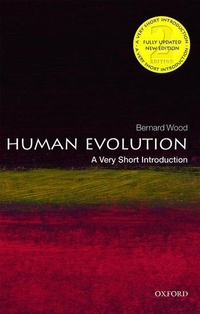
Human Evolution
A Very Short Introduction
2nd Edition
Published on 27. June 2019
Book
Paperback/Softback
160 pages
978-0-19-883174-7 (ISBN)
Description
The study of human evolution is advancing rapidly. Newly discovered fossil evidence is adding ever more pieces to the puzzle of our past, whilst revolutionary technological advances in the study of ancient DNA are completely reshaping theories of early human populations and migrations.
In this Very Short Introduction Bernard Wood traces the history of paleoanthropology from its beginnings in the eighteenth century to the very latest fossil finds. In this new edition he discusses how Ancient DNA studies have revolutionized how we view the recent (post-550 ka) human evolution, and the process of speciation. The combination of ancient and modern human DNA has contributed to discoveries of new taxa, as well as the suggestion of 'ghost' taxa whose fossil records still remain to be discovered. Considering the contributions of related sciences such as paleoclimatology, geochronology, systematics, genetics, and developmental biology, Wood explores our latest understandings of our own evolution.
ABOUT THE SERIES: The Very Short Introductions series from Oxford University Press contains hundreds of titles in almost every subject area. These pocket-sized books are the perfect way to get ahead in a new subject quickly. Our expert authors combine facts, analysis, perspective, new ideas, and enthusiasm to make interesting and challenging topics highly readable.
In this Very Short Introduction Bernard Wood traces the history of paleoanthropology from its beginnings in the eighteenth century to the very latest fossil finds. In this new edition he discusses how Ancient DNA studies have revolutionized how we view the recent (post-550 ka) human evolution, and the process of speciation. The combination of ancient and modern human DNA has contributed to discoveries of new taxa, as well as the suggestion of 'ghost' taxa whose fossil records still remain to be discovered. Considering the contributions of related sciences such as paleoclimatology, geochronology, systematics, genetics, and developmental biology, Wood explores our latest understandings of our own evolution.
ABOUT THE SERIES: The Very Short Introductions series from Oxford University Press contains hundreds of titles in almost every subject area. These pocket-sized books are the perfect way to get ahead in a new subject quickly. Our expert authors combine facts, analysis, perspective, new ideas, and enthusiasm to make interesting and challenging topics highly readable.
Reviews / Votes
Concise but with wide coverage, this is your ideal pocket guide to human evolution. * Chris Stringer, Natural History Museum * This is a well written, concise survey of research on our origins. Bernard Wood writes with an authority that few in the discipline can approach. The text is accessible, and the coverage is comprehensive. * Professor Peter Ungar, University of Arkansas * Wood presents a concise but comprehensive treatment of our own evolutionary history. Any reader interested in the topic of human origins will greatly benefit from this work. * Professor Zeray Alemseged, University of Chicago *More details
Series
Edition
2nd Revised edition
Language
English
Place of publication
Oxford
United Kingdom
Edition type
Revised edition
Illustrations
16 black and white images
Dimensions
Height: 175 mm
Width: 111 mm
Thickness: 15 mm
Weight
126 gr
ISBN-13
978-0-19-883174-7 (9780198831747)
Copyright in bibliographic data and cover images is held by Nielsen Book Services Limited or by the publishers or by their respective licensors: all rights reserved.
Schweitzer Classification
Other editions
Additional editions
E-Book
06/2019
2nd Edition
OUP eBook
€9.49
Available for download
E-Book
06/2019
2nd Edition
OUP eBook
€9.49
Available for download
Person
Bernard Wood is University Professor of Human Origins at George Washington University. He has been involved in human evolution-related research for more than thirty years, and is the author or co-author of 19 books, ranging from a 1991 major monograph on the hominid cranial remains from Koobi Fora, Kenya, to Human Evolution (Brief Insights) (Sterling Books, 2011), and more than 220 refereed scientific articles and book chapters. His research interests include taxonomy, phylogeny reconstruction, and comparative morphology.
Content
1: Introduction
2: Finding our place
3: Fossil hominins: their discovery and context
4: Fossil hominins: analysis and interpretation
5: Early hominins: possible and probable
6: Archaic and transitional hominins
7: Pre-modern Homo
8: Modern Homo
Timeline of thought and science relevant to human origins and evolution
Further reading
Index
2: Finding our place
3: Fossil hominins: their discovery and context
4: Fossil hominins: analysis and interpretation
5: Early hominins: possible and probable
6: Archaic and transitional hominins
7: Pre-modern Homo
8: Modern Homo
Timeline of thought and science relevant to human origins and evolution
Further reading
Index