

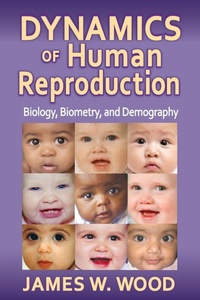
Dynamics of Human Reproduction
Biology, Biometry, Demography
1st Edition
Published on 31. December 1994
Book
Paperback/Softback
670 pages
978-0-202-01180-6 (ISBN)
Description
Awarded the W. W. Howells Award for the Outstanding Book in Biological Anthropology, this volume presents a comprehensive, integrated, and up-to-date overview of the major physiological and behavioral factors affecting human reproduction. In attempting to identify the most important causes of variation in fertility within and among human populations, Wood summarizes data from a wide range of societies. Trained as an anthropologist as well as a demographer, he devotes special attention to so-called "natural fertility" populations, in which modern contraceptives and induced abortion are not used to limit reproductive output. Such an emphasis enables him to study the interaction of biology and behavior with particular clarity.
The volume weaves together the physiological, demographic, and biometric approaches to human fertility in a way that will encourage future interdisciplinary research. Instead of offering a general overview, the focus is to answer one question: Why does fertility and the number of live births vary from couple to couple within any particular population, and from population to population across the human species as a whole?
Topics covered include ovarian function, conception and pregnancy, intrauterine mortality, reproductive maturation and senescence, coital frequency and the waiting time to conception, marriage patterns and the initiation of reproduction, the fertility-reducing effects of breastfeeding, the impact of maternal nutrition on reproduction, and reproductive seasonality. This unique combination of comprehensive subject matter and an integrated analytical approach makes the book ideally suited both as a graduate-level textbook and as a reference work.
The volume weaves together the physiological, demographic, and biometric approaches to human fertility in a way that will encourage future interdisciplinary research. Instead of offering a general overview, the focus is to answer one question: Why does fertility and the number of live births vary from couple to couple within any particular population, and from population to population across the human species as a whole?
Topics covered include ovarian function, conception and pregnancy, intrauterine mortality, reproductive maturation and senescence, coital frequency and the waiting time to conception, marriage patterns and the initiation of reproduction, the fertility-reducing effects of breastfeeding, the impact of maternal nutrition on reproduction, and reproductive seasonality. This unique combination of comprehensive subject matter and an integrated analytical approach makes the book ideally suited both as a graduate-level textbook and as a reference work.
More details
Series
Language
English
Place of publication
Somerset
United States
Publishing group
Taylor & Francis Inc
Dimensions
Height: 229 mm
Width: 152 mm
Thickness: 36 mm
Weight
954 gr
ISBN-13
978-0-202-01180-6 (9780202011806)
Copyright in bibliographic data and cover images is held by Nielsen Book Services Limited or by the publishers or by their respective licensors: all rights reserved.
Schweitzer Classification
Other editions
Additional editions
E-Book
09/2017
Routledge
€80.49
Available for download
E-Book
09/2017
Routledge
€80.49
Available for download
Book
12/1994
1st Edition
AldineTransaction
€209.40
Shipment within 10-15 days
Person
James W. Wood
Content
I: Natural Fertility; 1: Introduction; 2: Patterns of Natural Fertility; 3: Frameworks for Analyzing the Determinants of Natural Fertility; II: The Proximate Determinants of Natural Fertility; 4: Ovarian Cycles and the Fertile Period; 5: Conception, Implantation, and Pregnancy; 6: Fetal Loss; 7: Fecundability and Coital Frequency; 8: Breastfeeding and Postpartum Infecundability; 9: Menarche and Menopause; 10: The Onset of Permanent Sterility; 11: Marriage and the Male Contribution; III: Beyond the Proximate Determinants; 12: Extensions and Elaborations