

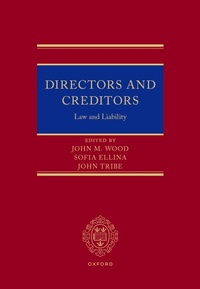
Directors and Creditors
Law and Liability
Published on 31. March 2026
Book
Hardback
656 pages
978-0-19-893277-2 (ISBN)
Description
This new work explores the evolving challenges faced by directors and creditors in both corporate and insolvency contexts. Structured in five parts, it offers a rigorous yet practical examination of key legal developments and their implications for practice and policy.
The volume opens with a foundational overview of the legal principles that shape the director-creditor relationship, before turning to the landmark Supreme Court decision in BTI 2014 LLC v Sequana SA and others [2022] UKSC 25. This pivotal case has reshaped the legal landscape, influencing how courts and practitioners approach limited liability, wrongful trading, transactional avoidance, and directors' duties—particularly the creditor duty and the definition of insolvency.
Subsequent chapters broaden the scope to address contemporary issues beyond Sequana, many of which are relevant to both solvent and insolvent companies. Topics include fiduciary duties, directors' personal liability, fraudulent and wrongful trading, corporate sustainability, creditor vulnerability, and the growing impact of climate change litigation.
The discussion then extends to a global scale, examining how Sequana has influenced legal thinking across jurisdictions including the EU, Australia, the US, Singapore, Hong Kong, and Canada. With a focus on both common law and civil law systems, the book offers a comparative perspective on global efforts to refine insolvency frameworks and harmonise corporate governance standards.
Combining detailed legal analysis with practical insights, Directors and Creditors: Law and Liability is an essential resource for legal practitioners, academics, and policymakers navigating the complexities of modern corporate and insolvency law.
The volume opens with a foundational overview of the legal principles that shape the director-creditor relationship, before turning to the landmark Supreme Court decision in BTI 2014 LLC v Sequana SA and others [2022] UKSC 25. This pivotal case has reshaped the legal landscape, influencing how courts and practitioners approach limited liability, wrongful trading, transactional avoidance, and directors' duties—particularly the creditor duty and the definition of insolvency.
Subsequent chapters broaden the scope to address contemporary issues beyond Sequana, many of which are relevant to both solvent and insolvent companies. Topics include fiduciary duties, directors' personal liability, fraudulent and wrongful trading, corporate sustainability, creditor vulnerability, and the growing impact of climate change litigation.
The discussion then extends to a global scale, examining how Sequana has influenced legal thinking across jurisdictions including the EU, Australia, the US, Singapore, Hong Kong, and Canada. With a focus on both common law and civil law systems, the book offers a comparative perspective on global efforts to refine insolvency frameworks and harmonise corporate governance standards.
Combining detailed legal analysis with practical insights, Directors and Creditors: Law and Liability is an essential resource for legal practitioners, academics, and policymakers navigating the complexities of modern corporate and insolvency law.
More details
Language
English
Place of publication
Oxford
United Kingdom
Target group
College/higher education
Product notice
sewn/stitched
Cloth over boards
Dimensions
Height: 250 mm
Width: 175 mm
Thickness: 43 mm
Weight
1270 gr
ISBN-13
978-0-19-893277-2 (9780198932772)
Copyright in bibliographic data and cover images is held by Nielsen Book Services Limited or by the publishers or by their respective licensors: all rights reserved.
Schweitzer Classification
Persons
Dr John M. Wood is Lecturer in Company and Insolvency Law at Lancaster University Law School. He is the author of The Interpretation and Value of Corporate Rescue (Edward Elgar, 2022) and co-editor of Re-examining Insolvency Law and Theory: Perspectives for the 21st Century (Edward Elgar, 2023). His work has appeared in leading journals, including the Journal of Corporate Law Studies, Journal of Business Law, Legal Studies, Northern Ireland Legal Quarterly, and Insolvency Intelligence. John is an academic member of the Insolvency Lawyers' Association and INSOL International.
Dr Sofia Ellina is Lecturer in Law at Lancaster University. She is a qualified lawyer in Cyprus and a member of the Cyprus Bar Association. Her research focuses on insolvency and financial law, and has been presented at major conferences and published in peer-reviewed journals such as the Journal of Business Law and Law and Financial Markets Review, as well as in edited volumes by Routledge and INSOL Europe. She has also contributed to the UK Insolvency Service as a Senior Research Associate. Sofia teaches a range of company and commercial law modules, including Company Law and Insolvency Law.
Dr John Tribe is Senior Lecturer in Law at the University of Liverpool and an Academic Associate at Exchange Chambers. He specialises in insolvency law and policy. His work has been cited in the UK Parliament, in judgments across common law jurisdictions, and by scholars worldwide. He is joint author of Muir Hunter on Personal Insolvency, described by Lord Millett (2015) as "the leading textbook on personal bankruptcy". John regularly contributes to policy and reform initiatives with the Insolvency Service and serves on the editorial boards of BPIR, Corporate Rescue and Insolvency, and Mithani: Directors' Disqualification.
Dr Sofia Ellina is Lecturer in Law at Lancaster University. She is a qualified lawyer in Cyprus and a member of the Cyprus Bar Association. Her research focuses on insolvency and financial law, and has been presented at major conferences and published in peer-reviewed journals such as the Journal of Business Law and Law and Financial Markets Review, as well as in edited volumes by Routledge and INSOL Europe. She has also contributed to the UK Insolvency Service as a Senior Research Associate. Sofia teaches a range of company and commercial law modules, including Company Law and Insolvency Law.
Dr John Tribe is Senior Lecturer in Law at the University of Liverpool and an Academic Associate at Exchange Chambers. He specialises in insolvency law and policy. His work has been cited in the UK Parliament, in judgments across common law jurisdictions, and by scholars worldwide. He is joint author of Muir Hunter on Personal Insolvency, described by Lord Millett (2015) as "the leading textbook on personal bankruptcy". John regularly contributes to policy and reform initiatives with the Insolvency Service and serves on the editorial boards of BPIR, Corporate Rescue and Insolvency, and Mithani: Directors' Disqualification.
Content
PART A: Introduction 1: John M. Wood, Sofia Ellina, and John Tribe: Introduction PART B: Sequana: Implications and Challenges 2: Sarah Paterson: Insolvency: What it Means and Why it Matters for Directors' Duties 3: David Milman: The Unexplored Potential of Section 423 of the Insolvency Act 1986 4: Paula Moffatt: The Interests of Creditors 5: Kayode Akintola: Oscillating between Shareholder and Creditor Interests in Limited Liability Companies 6: HHJ Mark Cawson KC and Ian Tucker: The Relationship between Shareholder Ratification and Duomatic Principles and the Creditor Interest Duty post Sequana 7: Susan Watson: The Modern Company as a Separate Legal Entity 8: Bruce Alan Markell: Shifting and Surrounding Sands: Comparative Views on Director Duties in the Zone of Insolvency 9: Joseph Curl KC: The Legacy of Sequana PART C: Broader Issues Concerning Directors and Creditors 10: Clare Stanley KC: What are the Actual Fiduciary Duties for a Director? 11: Stephen Baister: A Body to be Kicked: The Liability of a Company Director for a Company's Costs 12: John Tribe: Resolving the Stakeholder Indeterminacy Problem in the Communitarian Bankruptcy Debate: A post Sequana Analysis 13: Rebecca Parry, Alex Kastrinou, and Georgette Ellis: Addressing the Knowledge Gap in Directors' Insolvency Duties and Liabilities 14: Andrew Vinson: Director Liability: Behind the Veil and the Scope for Accessory Liability 15: Sofia Ellina: Wrongful Trading: Scope and Challenges 16: Andrew Goodson, Stephen Hunt, and Frank Turnbull: Fraudulent Trading: Considerations for Officeholders from an Insolvency Practitioner's Perspective 17: Rafael Savva: Creditor Duty and Corporate Sustainability 18: Anja Lansbergen-Mills and Eleanor Temple KC: Creditors' Redress Against Directors of Insolvent Companies 19: Jonathan Hardman: Conceptual Challenges for Creditors of Companies 20: John M. Wood: Directors' Duties in Climate Change Litigation 21: Neeti Shikha and Emily Reeve: Rethinking Directors' Liability: An Integrative 'Deepening Theory' Approach PART D: International Perspectives 22: Gerard McCormack and Oriana Casasola: The International Complexities of Section 423 of the Insolvency Act 1986 in the Sequana Case 23: Jason Harris: The Relationship between the Creditors' Duty and Other Duties of Directors 24: Akshaya Kamalnath and Preeti Nalavadi: Directors' Duties, the 'Initiation Problem', and SME Restructuring in Australia: The Law and Non-Law Factors at Play 25: Juanitta Calitz: Steering Through Storms: Directors' Duties During Business Distress 26: Philip Gavin and John Quinn: The Creditor Duty in the European Union: Insights from the Preventive Restructuring Directive PART E: Conclusion 27: John M. Wood, Sofia Ellina, and John Tribe: Conclusion