

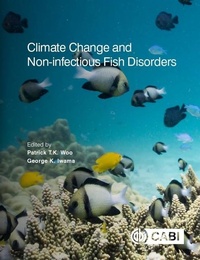
Climate Change and Non-infectious Fish Disorders
Published on 21. December 2019
Book
Hardback
258 pages
978-1-78639-398-2 (ISBN)
Description
Freshwater, brackish and marine ecosystems are particularly impacted by the effects of climate change and global warming. A global rise in water temperature and acidification of the aquatic environment will continue even if we can significantly reduce the current output of greenhouse gasses. Increases in water temperature will affect the life cycle, physiology, behaviours, distribution and community structure of aquatic organisms, especially fish. This important new text on climate change, and its effects on selected non-infectious disorders of fish, contains contributions by internationally recognized experts who have contributed significantly to our knowledge in this area. Comprehensive and thought provoking, the text details abiotic and biotic environmental changes associated with climate change and their effects on fish in tropical, subtropical and temperate waters. It proceeds to cover in detail developmental, physiological and metabolic disorders of fish. Outlining both current and expected changes in aquaculture systems due to climate change, plus suggestions for further studies, this contemporary text is key reading for biologists, aquatic ecologists, fish health consultants, veterinarians, policy makers and all those involved in fish health and the environment.
More details
Language
English
Place of publication
Wallingford
United Kingdom
Illustrations
45 line 9 photos
Dimensions
Height: 237 mm
Width: 188 mm
Thickness: 19 mm
Weight
904 gr
ISBN-13
978-1-78639-398-2 (9781786393982)
Copyright in bibliographic data and cover images is held by Nielsen Book Services Limited or by the publishers or by their respective licensors: all rights reserved.
Schweitzer Classification
Other editions
Additional editions
Patrick T. K. Woo | George K. Iwama
Climate Change and Non-infectious Fish Disorders
E-Book
01/2020
CABI Publishing
€171.99
Available for download
Persons
Patrick T K Woo (Edited By)
Patrick T K Woo (ptkw) is University Professor Emeritus, University of Guelph, and has been a faculty member since 1974. His research program focused on parasitic flagellates which included those of medical and economic importance. The program had continuous NSERC support for over 40 years, until he closed his laboratory at U of G so he could, with his co-editors, focus on formulating and editing an interdisciplinary book series on 'climate change and fish health'. Patrick's research and travels, sponsored by other agencies (e.g. FAO, United Nations; National University of Singapore; CNPq, Brazil; MEC, Spain; NEC, Cdn.; CIDA, Cdn.; IDRC, Cdn) allowed him to work with colleagues in Asia, Africa, Europe and the Americas (e.g. 'determine the toxicity of cadmium on tilapia and its effects on immune response' in Singapore; 'develop and evaluate diagnostic techniques for human trypanosomiasis' in E & W Africa; 'adapt an in vitro method to study fish innate immunity' in Spain). In addition to publishing papers and review articles in journals and books, Patrick edited a special journal issue and 14 academic books on fish health. He also founded 'The Roy C Anderson Memorial Lecture in Parasitology'. He has also consulted to industry, universities and government agencies. For further details please see: https://www.uoguelph.ca/ib/woo
George K Iwama (Edited By)
George began his academic career at the University of British Columbia (UBC) as an Assistant Professor (1987), Associate Professor (1991) and Professor (1996). He went on to serve the National Research Council of Canada as Director General of the Institute of Marine Biosciences in Halifax (2000). During his tenure there, he led the initiation of NRC's newest Institute on Prince Edward Island, the Institute of Nutrisciences and Health (2003). He returned to Academia in 2004 in senior administrative roles at Acadia University (Dean of Science, 2004; Vice President Academic 2006) and Carleton University (Dean of Science 2007). George served the University of Northern British Columbia as President and Vice-Chancellor (2009). Most recently, George was the Executive Vice President at the Okinawa Institute of Science and Technology Graduate University (2014). He has returned to Canada where he is an Adjunct Professor of Zoology at UBC and consults in tertiary education. His work has been supported by a variety of public and private funding sources. Support from the Natural Sciences and Engineering Research Council and the Killam Foundation are gratefully acknowledged. George was awarded the Queen Elizabeth II Diamond Jubilee Medal in 2013. He has published 141 papers, 1 letter, 45 conference proceedings and edited 2 books. He has applied the outcomes of this research to areas such as aquaculture and environmental issues.
Patrick T K Woo (ptkw) is University Professor Emeritus, University of Guelph, and has been a faculty member since 1974. His research program focused on parasitic flagellates which included those of medical and economic importance. The program had continuous NSERC support for over 40 years, until he closed his laboratory at U of G so he could, with his co-editors, focus on formulating and editing an interdisciplinary book series on 'climate change and fish health'. Patrick's research and travels, sponsored by other agencies (e.g. FAO, United Nations; National University of Singapore; CNPq, Brazil; MEC, Spain; NEC, Cdn.; CIDA, Cdn.; IDRC, Cdn) allowed him to work with colleagues in Asia, Africa, Europe and the Americas (e.g. 'determine the toxicity of cadmium on tilapia and its effects on immune response' in Singapore; 'develop and evaluate diagnostic techniques for human trypanosomiasis' in E & W Africa; 'adapt an in vitro method to study fish innate immunity' in Spain). In addition to publishing papers and review articles in journals and books, Patrick edited a special journal issue and 14 academic books on fish health. He also founded 'The Roy C Anderson Memorial Lecture in Parasitology'. He has also consulted to industry, universities and government agencies. For further details please see: https://www.uoguelph.ca/ib/woo
George K Iwama (Edited By)
George began his academic career at the University of British Columbia (UBC) as an Assistant Professor (1987), Associate Professor (1991) and Professor (1996). He went on to serve the National Research Council of Canada as Director General of the Institute of Marine Biosciences in Halifax (2000). During his tenure there, he led the initiation of NRC's newest Institute on Prince Edward Island, the Institute of Nutrisciences and Health (2003). He returned to Academia in 2004 in senior administrative roles at Acadia University (Dean of Science, 2004; Vice President Academic 2006) and Carleton University (Dean of Science 2007). George served the University of Northern British Columbia as President and Vice-Chancellor (2009). Most recently, George was the Executive Vice President at the Okinawa Institute of Science and Technology Graduate University (2014). He has returned to Canada where he is an Adjunct Professor of Zoology at UBC and consults in tertiary education. His work has been supported by a variety of public and private funding sources. Support from the Natural Sciences and Engineering Research Council and the Killam Foundation are gratefully acknowledged. George was awarded the Queen Elizabeth II Diamond Jubilee Medal in 2013. He has published 141 papers, 1 letter, 45 conference proceedings and edited 2 books. He has applied the outcomes of this research to areas such as aquaculture and environmental issues.
Editor
University of Guelph, Canada
University of British Columbia, Canada
Contributions
Grand Valley State University, USA
Louisiana Universities Marine Consortium, USA
Tropical Marine Science Institute, Singapore
Tropical Marine Science Institute, Singapore
National University of Singapore, Singapore
Tropical Marine Science Institute, Singapore
National University of Singapore, Singapore
National University of Singapore, Singapore
Content
Section I: Climate Change Chapter 1: An Overview with Discussions on Freshwater and Marine Ecosystems in North America Chapter 2: Tropical Marine and Brackish Ecosystems Section II: Developmental and Physiological Fish Disorders Chapter 3: Skeletal Abnormalies Chapter 4: Neoplasms Chapter 5: Feeding and its Regulation Chapter 6: Nutritional and Metabolic Disorders Chapter 7: Behaviour including Fish Migration Chapter 8: Stress in Response to Environmental Changes Chapter 9: Ionic Regulation Chapter 10: Excess Dissolved Gases and Gas Bubble Disease Chapter 11: The Immune System: Effects of Water Temperature and Acidification