

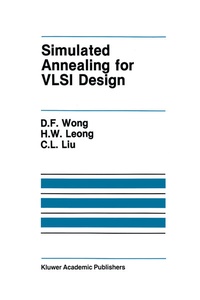
Simulated Annealing for VLSI Design
Published on 5. October 2011
Book
Paperback/Softback
XII, 202 pages
978-1-4612-8947-0 (ISBN)
Description
This monograph represents a summary of our work in the last two years in applying the method of simulated annealing to the solution of problems that arise in the physical design of VLSI circuits. Our study is experimental in nature, in that we are con cerned with issues such as solution representations, neighborhood structures, cost functions, approximation schemes, and so on, in order to obtain good design results in a reasonable amount of com putation time. We hope that our experiences with the techniques we employed, some of which indeed bear certain similarities for different problems, could be useful as hints and guides for other researchers in applying the method to the solution of other prob lems. Work reported in this monograph was partially supported by the National Science Foundation under grant MIP 87-03273, by the Semiconductor Research Corporation under contract 87-DP- 109, by a grant from the General Electric Company, and by a grant from the Sandia Laboratories.
Reviews / Votes
` Individuals interested in design automation and, in particular, VLSI design will find this monograph a useful source of information on the application of the simulated annealing method. 'Zentralblatt für Mathematik, 699 (1991)
More details
Series
Edition
Softcover reprint of the original 1st ed. 1988
Language
English
Place of publication
New York
United States
Target group
Professional and scholarly
Research
Illustrations
XII, 202 p.
Dimensions
Height: 235 mm
Width: 155 mm
Thickness: 13 mm
Weight
341 gr
ISBN-13
978-1-4612-8947-0 (9781461289470)
DOI
10.1007/978-1-4613-1677-0
Schweitzer Classification
Other editions
Additional editions
D.F. Wong | H.W. Leong | H.W. Liu
Simulated Annealing for VLSI Design
E-Book
12/2012
Springer
€96.29
Available for download
D.F. Wong | H.W. Leong | H.W. Liu
Simulated Annealing for VLSI Design
Book
03/1988
Kluwer Academic Publishers
€106.99
Shipment within 3-4 weeks
Content
1. Introduction.- 1.1. Combinatorial Optimization.- 1.2. The Method of Simulated Annealing.- 1.3. Remarks.- 2. Placement.- 2.1. Introduction.- 2.2. Gate-Array Placement.- 2.3. Standard-Cell Placement.- 2.4. Macro/Custom-Cell Placement.- 2.5. Other Stochastic Algorithms.- 2.6. Concluding Remarks.- 3. Floorplan Design.- 3.1. Introduction.- 3.2. Part 1: Rectangular Modules.- 3.3. Part 2: Rectangular and L-Shaped Modules.- 3.4. Concluding Remarks.- 4. Channel Routing.- 4.1. Introduction.- 4.2. The Channel Routing Problem.- 4.3. The Channel Router SACR.- 4.4. The Channel Router SACR2.- 4.5. Experimental Results and Discussion.- 4.6. Concluding Remarks.- 5. Permutation Channel Routing.- 5.1. Introduction.- 5.2. Motivation and Applications.- 5.3. NP-Completeness Results.- 5.4. First Method - Simulated Annealing.- 5.5. Second Method - Iterative Improvement.- 5.6. Experimental Results.- 5.7. Concluding Remarks.- 6. PLA Folding.- 6.1. Introduction.- 6.2. The PLA Folding Problem.- 6.3. The PLA Folding Algorithm.- 6.4. Multiple-Folded PLA Realization.- 6.5. Constrained Multiple Folding.- 6.6. Simple Folding.- 6.7. Experimental Results and Discussions.- 6.8. Concluding Remarks.- 7. Gate Matrix Layout.- 7.1. Introduction.- 7.2. Problem Formulation.- 7.3. Generalized Problem Formulation.- 7.4. Advantages of the Generalized Formulation.- 7.5. The Simulated Annealing Method.- 7.6. Experimental Results.- 7.7. Concluding Remarks.- 8. Array Optimization.- 8.1. Introduction.- 8.2. The Array Optimization Problem.- 8.3. Definitions.- 8.4. The Array Optimization Algorithm.- 8.5. Experimental Results.- 8.6. Concluding Remarks.- References.