

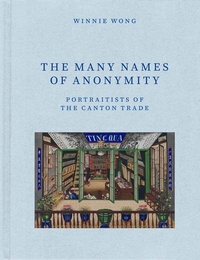
The Many Names of Anonymity
Portraitists of the Canton Trade
Will be published approx. on 19. January 2026
Book
Hardback
288 pages
978-0-226-15582-1 (ISBN)
Description
Explores how the function, norms, and meaning of artists' names in Chinese modernity have been misunderstood.
Challenging contemporary procedures for establishing attribution, chronology, and authenticity in Chinese art, Winnie Wong explores the means, methods, and stakes of recovering the names of an anonymous community of artists. To examine how Western art history has misconstrued and miscategorized names and identities in Chinese art, she looks to conflicting features of modernity: the European attachment of singular names to individuals and their works, and the Chinese use of socially contingent names that often are not attached to material labor and sometimes operate against it. Wong charts the genealogy of this naming problem by bringing to life the artists of the Qing Empire's trade with Europeans at the port of Guangzhou, centering on a group of portraitists known by names that were recorded in a pidgin language: Chin Qua, Chit Qua, Spoilum, Lam Qua, and Ting Qua.
Many of these paintings survive today, yet scholars have identified only a handful of the painters' identities. Pushing against Western norms that have shaped our understanding of authorship, Wong reveals that these artists shared names, created works in multiples, and signed their pieces with different names or none at all. This lavishly illustrated volume explores portraiture across media, including unfired clay, reverse painting on glass, watercolor on paper, oil on canvas, and the daguerreotype, to propose new ways of studying anonymity, copying, and the emergence of author names in the Sino-European visual culture of the long eighteenth century.
Challenging contemporary procedures for establishing attribution, chronology, and authenticity in Chinese art, Winnie Wong explores the means, methods, and stakes of recovering the names of an anonymous community of artists. To examine how Western art history has misconstrued and miscategorized names and identities in Chinese art, she looks to conflicting features of modernity: the European attachment of singular names to individuals and their works, and the Chinese use of socially contingent names that often are not attached to material labor and sometimes operate against it. Wong charts the genealogy of this naming problem by bringing to life the artists of the Qing Empire's trade with Europeans at the port of Guangzhou, centering on a group of portraitists known by names that were recorded in a pidgin language: Chin Qua, Chit Qua, Spoilum, Lam Qua, and Ting Qua.
Many of these paintings survive today, yet scholars have identified only a handful of the painters' identities. Pushing against Western norms that have shaped our understanding of authorship, Wong reveals that these artists shared names, created works in multiples, and signed their pieces with different names or none at all. This lavishly illustrated volume explores portraiture across media, including unfired clay, reverse painting on glass, watercolor on paper, oil on canvas, and the daguerreotype, to propose new ways of studying anonymity, copying, and the emergence of author names in the Sino-European visual culture of the long eighteenth century.
Reviews / Votes
"Engagingly written with a high degree of structural and conceptual integrity, this is a rare book that is groundbreaking while also performing the tasks of authentication and reconstruction of historical context on which the field relies. Wong tackles a subject that has long escaped consideration in art history and museum studies, taking on early modern Cantonese works that have previously eluded in-depth art historical research, while intelligently and efficiently providing necessary background information for readers unfamiliar with the subject." -- Chelsea Foxwell, University of Chicago "This highly important and original study marks a huge step change in knowledge about its subject, 'Canton trade painting.' But beyond that, its rich analysis and rigorous scholarship should prompt anyone interested in the history of art, and not only in China, to reconsider some of the boundaries we have drawn and exclusions we have enforced." -- Craig Clunas, University of Oxford "This book is a major advancement in scholarship on so-called Chinese export art, a misnomer that Wong corrects. Looking closely and carefully at a range of relevant paintings, prints, and drawings, Wong has sifted through an enormous amount of archival detail to uncover new historical materials and evidence. Her insightful and fresh analysis draws deeply on the best traditions of art historical scholarship. The result is an eye-opening study of paintings, painters, inscribers, biographies, subjects, patrons, and viewers-all coming together to produce a new and original story of Canton trade art as a compelling subject of art history." -- Stanley Abe, Duke UniversityMore details
Language
English
Place of publication
Chicago
United States
Publishing group
The University of Chicago Press
Target group
Professional and scholarly
Illustrations
133 color plates, 7 halftones
Dimensions
Height: 271 mm
Width: 207 mm
Thickness: 26 mm
Weight
1388 gr
ISBN-13
978-0-226-15582-1 (9780226155821)
Copyright in bibliographic data and cover images is held by Nielsen Book Services Limited or by the publishers or by their respective licensors: all rights reserved.
Schweitzer Classification
Person
Winnie Wong is professor of rhetoric at the University of California, Berkeley. She is the author of Van Gogh on Demand: China and the Readymade and the coeditor of Learning from Shenzhen, both also published by the University of Chicago Press.
Content
Note on Romanizations, Sinicizations, and Audio Recordings
Introduction: Names Are But the Guests of Reality
1 Ting Qua's Studio of Quiet Self-Attainment
2 Chin Qua and Chit Qua: Till You See the Original
3 From Spillem to Spoilum: Pleased with Their Own Resemblance
4 Lam Qua I, II, and III: The Instrument That Draws All by Itself
Conclusion: The Mirror and the Template
Acknowledgments
Abbreviations
Notes
Bibliography
Index
Introduction: Names Are But the Guests of Reality
1 Ting Qua's Studio of Quiet Self-Attainment
2 Chin Qua and Chit Qua: Till You See the Original
3 From Spillem to Spoilum: Pleased with Their Own Resemblance
4 Lam Qua I, II, and III: The Instrument That Draws All by Itself
Conclusion: The Mirror and the Template
Acknowledgments
Abbreviations
Notes
Bibliography
Index