

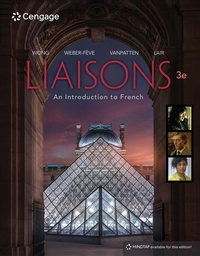
Liaisons, Student Edition
An Introduction to French
3rd Edition
Published on 4. January 2019
Book
Paperback/Softback
576 pages
978-0-357-03487-3 (ISBN)
Description
LIAISONS is an innovative beginning-level French program. Components of the program are carefully linked together, allowing you to make connections with your classmates, your instructor, your community, and the French-speaking world. With an engaging mystery film shot on location in Montreal, Quebec, and Paris, the program provides a rich array of activities designed to stimulate interaction.
More details
Edition
3rd Student edition
Language
English
Place of publication
Florence, KY
United States
Publishing group
Cengage Learning, Inc
Target group
College/higher education
Edition type
Student edition
Product notice
Paperback (trade)
Unsewn / adhesive bound
Dimensions
Height: 272 mm
Width: 216 mm
Thickness: 18 mm
Weight
1111 gr
ISBN-13
978-0-357-03487-3 (9780357034873)
Copyright in bibliographic data and cover images is held by Nielsen Book Services Limited or by the publishers or by their respective licensors: all rights reserved.
Schweitzer Classification
Persons
Wynne Wong is Professor of French and Director of French Language Instruction at the Ohio State University. She teaches undergraduate and graduate courses on second language acquisition and Quebec cultural studies, and is responsible for graduate teaching associate training. In addition to publishing in different areas of second language acquisition, she is known for her research in French on Processing Instruction and structured input, and for her award-winning article (with B. VanPatten) "The Evidence is IN: Drills are OUT" (Foreign Language Annals, 2003), winner of the 2005 Stephen A. Freeman Award. Dedicated to building bridges between theory and practice, she is also the lead author of the textbook LIAISONS (Cengage, 2013, 2017) as well as INPUT ENHANCEMENT: FROM THEORY AND RESEARCH TO THE CLASSROOM (McGraw-Hill, 2005) and FOCUSING ON FORM IN LANGUAGE INSTRUCTION (with D. Simard, Routledge, 2015). Stacey Weber-Feve is Associate Professor of French at Iowa State University. She is a specialist of French cinema and has published books and articles on women's filmmaking and life writing and is currently researching French cinematic comedy and several French stars of comedy films. An award-winning teacher dedicated to "bridging the gap" between "language teachers" and "literature professors," she has also published and presented on the teaching of the French language, culture, literature, and film through integrated approaches and input-to-output processes at all levels of the foreign language curriculum, including advanced levels. She is co-author of the textbook LIAISONS and the recipient of the Nelson Brooks award (2015) given by ACTFL for excellence in the teaching of culture. Bill VanPatten is Professor of Second Language Studies at Michigan State University where he also directs the Spanish and French language programs. An international scholar with numerous awards for research, leadership, and teaching, Professor VanPatten is known not only for his work on theory and research in second language acquisition but also for the implications of second language research for language teaching. Anne Lair directs the French Basic Language Program at the University of Utah where she also teaches undergraduate courses. In addition, she is the French Bridge Curriculum Director and State French Bridge Coordinator (continuation of the French Dual Immersion) in Utah. She has published on symbolism of food in France, and French culture, and co-authored INVITATION AU MONDE FRANCOPHONE (Heinle, 2005), and Liaisons [3rd edition (Cengage 2020)]. She is the recipient of several teaching awards including the ACTFL Nelson Brooks award (2013) for excellence in the teaching of culture. She has received the Palmes Academiques (2017), an award given by the French Government in recognition of her contribution to promoting the French language and culture. She has served as Honorary Consul to France in Utah since April 2017.
Content
PRELIMINAIRE. BIENVENUE.
PARTIE 1. Vocabulaire 1: Comment ca va? Un mot sur la culture: Monsieur, madame, mademoiselle. Un mot sur la culture: Les salutations. Liaisons avec les mots et les sons: L'alphabet et les accents. Un mot sur la langue: Francophones et francophiles. Grammaire 1: Les pronoms sujets. Le verbe etre. Les questions. PARTIE 2. Vocabulaire 2: En classe. Un mot sur la culture: La francophonie. Grammaire 2: Les articles indefinis. Le genre et le nombre. Pour aller plus loin: C'est vs. Ce sont. PARTIE 3. Vocabulaire 3: Les etudes. Pour aller plus loin: Les articles definis. Un mot sur la culture: La dictee. Grammaire 3: Les articles definis. Les adjectifs qualificatifs. PREMIERE PROJECTION: Prologue. LIAISONS CULTURELLES: Le monde parle francais... et maintenant vous aussi! RESUME DE VOCABULAIRE.
1. UNE VIE EQUILIBREE.
PARTIE 1. Vocabulaire 1: Nos activites. Un mot sur la culture: Telephoner en France. Grammaire 1: Les verbes du premier groupe en -er. Le pronom sujet on. La negation. Les pronoms disjoints. PARTIE 2. Vocabulaire 2: Les jours de la semaine. Un mot sur la culture: Le calendrier francais. Grammaire 2: Les adverbes. Les adjectifs irreguliers. Pour aller plus loin: N'est-ce pas? PARTIE 3. Vocabulaire 3: Quelle heure est-il? Un mot sur la langue: Heure ou heures? Un mot sur la culture: Le systeme des 24 heures. Liaisons avec les mots et les sons: La liaison et l'enchainement. Grammaire 3: Le verbe avoir. PREMIERE PROJECTION: L'etranger. La culture dans le film: Montreal-Ville internationale et cosmopolite. LIAISONS CULTURELLES: Entre la France, le Senegal, la Suisse et le Quebec. RESUME DE VOCABULAIRE.
2: LES PLAISIRS DE LA VIE.
PARTIE 1. Vocabulaire 1: Le climat. Un mot sur la culture: L'hiver au Quebec. Grammaire 1: Le verbe aller. La preposition a. Pour aller plus loin: Si. PARTIE 2. Vocabulaire 2: Les sports. Un mot sur la culture: Le Tournoi de Roland-Garros. Grammaire 2: Le verbe faire. L'inversion. PARTIE 3. Vocabulaire 3: Les loisirs. Pour aller plus loin: Depuis combien de temps. Un mot sur la culture: Regarder passer les gens. Liaisons avec les mots et les sons: Les consonnes finales muettes. Grammaire 3: Les verbes lire, ecrire, dire. Les adverbes. DEUXIEME PROJECTION: L'etranger. LIAISONS AVEC LA LECTURE: Le footballeur francais Paul Pogba. LIAISONS AVEC LA LECTURE ET L'ECRITURE: Une presentation personnelle. RESUME DE VOCABULAIRE.
3. NOS ORIGINES.
PARTIE 1. Vocabulaire 1: L'origine culturelle. Pour aller plus loin: C'est vs. Il/Elle est. Un mot sur la culture: Ying Chen. Grammaire 1: Les prepositions et les lieux geographiques. Les verbes venir et devenir. PARTIE 2. Vocabulaire 2: L'origine familiale. Un mot sur la culture: La famille recomposee. Grammaire 2: Les adjectifs possessifs. Les adjectifs demonstratifs. PARTIE 3. Vocabulaire 3: Les traits physiques. Un mot sur la culture: Cyrano de Bergerac. Liaisons avec les mots et les sons: Les voyelles orales et les voyelles nasales. Grammaire 3: La position des adjectifs. Les verbes sortir, partir, dormir et sentir. PREMIERE PROJECTION: La Decision. Liaisons avec la culture: La ville de Quebec. LIAISONS CULTURELLES: Entre la France et l'Amerique du Nord. RESUME DE VOCABULAIRE. DECOUVERTES CULTURELLES: La litterature dans la francophonie.
4. LES ESPACES.
PARTIE 1. Vocabulaire 1: Les espaces personnels. Un mot sur la langue: Les toilettes ou les W.-C.? Un mot sur la culture: Ou faire la lessive? Grammaire 1: Les verbes choisir, finir et obeir. Pour aller plus loin: La preposition chez. Pour aller plus loin: Il faut... PARTIE 2. Vocabulaire 2: Les espaces urbains. Un mot sur la langue: Une laverie automatique ou un Lavomatique? Un mot sur la culture: Les arrondissements de Paris. Grammaire 2: L'imperatif. Pour aller plus loin: L'ordre des evenements. PARTIE 3. Vocabulaire 3: Les espaces verts. Un mot sur la culture: Sepaq du Quebec. Liaisons avec les mots et les sons: Les voyelles nasales. Grammaire 3: Les mots d'interrogation. Pour aller plus
PARTIE 1. Vocabulaire 1: Comment ca va? Un mot sur la culture: Monsieur, madame, mademoiselle. Un mot sur la culture: Les salutations. Liaisons avec les mots et les sons: L'alphabet et les accents. Un mot sur la langue: Francophones et francophiles. Grammaire 1: Les pronoms sujets. Le verbe etre. Les questions. PARTIE 2. Vocabulaire 2: En classe. Un mot sur la culture: La francophonie. Grammaire 2: Les articles indefinis. Le genre et le nombre. Pour aller plus loin: C'est vs. Ce sont. PARTIE 3. Vocabulaire 3: Les etudes. Pour aller plus loin: Les articles definis. Un mot sur la culture: La dictee. Grammaire 3: Les articles definis. Les adjectifs qualificatifs. PREMIERE PROJECTION: Prologue. LIAISONS CULTURELLES: Le monde parle francais... et maintenant vous aussi! RESUME DE VOCABULAIRE.
1. UNE VIE EQUILIBREE.
PARTIE 1. Vocabulaire 1: Nos activites. Un mot sur la culture: Telephoner en France. Grammaire 1: Les verbes du premier groupe en -er. Le pronom sujet on. La negation. Les pronoms disjoints. PARTIE 2. Vocabulaire 2: Les jours de la semaine. Un mot sur la culture: Le calendrier francais. Grammaire 2: Les adverbes. Les adjectifs irreguliers. Pour aller plus loin: N'est-ce pas? PARTIE 3. Vocabulaire 3: Quelle heure est-il? Un mot sur la langue: Heure ou heures? Un mot sur la culture: Le systeme des 24 heures. Liaisons avec les mots et les sons: La liaison et l'enchainement. Grammaire 3: Le verbe avoir. PREMIERE PROJECTION: L'etranger. La culture dans le film: Montreal-Ville internationale et cosmopolite. LIAISONS CULTURELLES: Entre la France, le Senegal, la Suisse et le Quebec. RESUME DE VOCABULAIRE.
2: LES PLAISIRS DE LA VIE.
PARTIE 1. Vocabulaire 1: Le climat. Un mot sur la culture: L'hiver au Quebec. Grammaire 1: Le verbe aller. La preposition a. Pour aller plus loin: Si. PARTIE 2. Vocabulaire 2: Les sports. Un mot sur la culture: Le Tournoi de Roland-Garros. Grammaire 2: Le verbe faire. L'inversion. PARTIE 3. Vocabulaire 3: Les loisirs. Pour aller plus loin: Depuis combien de temps. Un mot sur la culture: Regarder passer les gens. Liaisons avec les mots et les sons: Les consonnes finales muettes. Grammaire 3: Les verbes lire, ecrire, dire. Les adverbes. DEUXIEME PROJECTION: L'etranger. LIAISONS AVEC LA LECTURE: Le footballeur francais Paul Pogba. LIAISONS AVEC LA LECTURE ET L'ECRITURE: Une presentation personnelle. RESUME DE VOCABULAIRE.
3. NOS ORIGINES.
PARTIE 1. Vocabulaire 1: L'origine culturelle. Pour aller plus loin: C'est vs. Il/Elle est. Un mot sur la culture: Ying Chen. Grammaire 1: Les prepositions et les lieux geographiques. Les verbes venir et devenir. PARTIE 2. Vocabulaire 2: L'origine familiale. Un mot sur la culture: La famille recomposee. Grammaire 2: Les adjectifs possessifs. Les adjectifs demonstratifs. PARTIE 3. Vocabulaire 3: Les traits physiques. Un mot sur la culture: Cyrano de Bergerac. Liaisons avec les mots et les sons: Les voyelles orales et les voyelles nasales. Grammaire 3: La position des adjectifs. Les verbes sortir, partir, dormir et sentir. PREMIERE PROJECTION: La Decision. Liaisons avec la culture: La ville de Quebec. LIAISONS CULTURELLES: Entre la France et l'Amerique du Nord. RESUME DE VOCABULAIRE. DECOUVERTES CULTURELLES: La litterature dans la francophonie.
4. LES ESPACES.
PARTIE 1. Vocabulaire 1: Les espaces personnels. Un mot sur la langue: Les toilettes ou les W.-C.? Un mot sur la culture: Ou faire la lessive? Grammaire 1: Les verbes choisir, finir et obeir. Pour aller plus loin: La preposition chez. Pour aller plus loin: Il faut... PARTIE 2. Vocabulaire 2: Les espaces urbains. Un mot sur la langue: Une laverie automatique ou un Lavomatique? Un mot sur la culture: Les arrondissements de Paris. Grammaire 2: L'imperatif. Pour aller plus loin: L'ordre des evenements. PARTIE 3. Vocabulaire 3: Les espaces verts. Un mot sur la culture: Sepaq du Quebec. Liaisons avec les mots et les sons: Les voyelles nasales. Grammaire 3: Les mots d'interrogation. Pour aller plus