

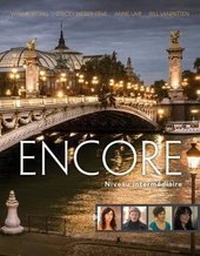
Encore Intermediate French, Student Text
Niveau intermi?1/2diaire
Will be published approx. on 1. January 2017
Book
Paperback/Softback
448 pages
978-1-305-96709-0 (ISBN)
Description
ENCORE is an exciting intermediate-level French program that uses an engaging mystery film of the same title to help you to continue to learn about and appreciate the richness and beauty of the French language, and explore the fascinating and diverse cultures of France and the French-speaking world. The textbook ENCORE will help you solidify the vocabulary and grammar you learned in your elementary French courses while at the same time helping you to develop the language skills needed to become an intermediate-level user of French.
More details
Edition
New edition
Language
English
Place of publication
Mason, OH
United States
Publishing group
Cengage Learning, Inc
Target group
College/higher education
Edition type
New edition
Dimensions
Height: 20 mm
Width: 205 mm
Thickness: 269 mm
Weight
862 gr
ISBN-13
978-1-305-96709-0 (9781305967090)
Copyright in bibliographic data and cover images is held by Nielsen Book Services Limited or by the publishers or by their respective licensors: all rights reserved.
Schweitzer Classification
Other editions
New editions
Wynne Wong | Stacey Weber-Feve | Anne Lair
Encore Intermediate French, Student Edition
Niveau intermediaire
Book
07/2019
2nd Edition
Heinle
€275.50
Article not available at the moment
Persons
Wynne Wong is Professor of French and Director of French Language Instruction at the Ohio State University. She teaches undergraduate and graduate courses on second language acquisition and Quebec cultural studies, and is responsible for graduate teaching associate training. In addition to publishing in different areas of second language acquisition, she is known for her research in French on Processing Instruction and structured input, and for her award-winning article (with B. VanPatten) "The Evidence is IN: Drills are OUT" (Foreign Language Annals, 2003), winner of the 2005 Stephen A. Freeman Award. Dedicated to building bridges between theory and practice, she is also the lead author of the textbook LIAISONS (Cengage, 2013, 2017) as well as INPUT ENHANCEMENT: FROM THEORY AND RESEARCH TO THE CLASSROOM (McGraw-Hill, 2005) and FOCUSING ON FORM IN LANGUAGE INSTRUCTION (with D. Simard, Routledge, 2015). Stacey Weber-Feve is Associate Professor of French at Iowa State University. She is a specialist of French cinema and has published books and articles on women's filmmaking and life writing and is currently researching French cinematic comedy and several French stars of comedy films. An award-winning teacher dedicated to "bridging the gap" between "language teachers" and "literature professors," she has also published and presented on the teaching of the French language, culture, literature, and film through integrated approaches and input-to-output processes at all levels of the foreign language curriculum, including advanced levels. She is co-author of the textbook LIAISONS and the recipient of the Nelson Brooks award (2015) given by ACTFL for excellence in the teaching of culture. Anne Lair directs the French Basic Language Program at the University of Utah where she also teaches undergraduate courses. In addition, she is the French Bridge Curriculum Director and State French Bridge Coordinator (continuation of the French Dual Immersion) in Utah. She has published on symbolism of food in France, and French culture, and co-authored INVITATION AU MONDE FRANCOPHONE (Heinle, 2005), and Liaisons [3rd edition (Cengage 2020)]. She is the recipient of several teaching awards including the ACTFL Nelson Brooks award (2013) for excellence in the teaching of culture. She has received the Palmes Academiques (2017), an award given by the French Government in recognition of her contribution to promoting the French language and culture. She has served as Honorary Consul to France in Utah since April 2017. Bill VanPatten is Professor of Second Language Studies at Michigan State University where he also directs the Spanish and French language programs. An international scholar with numerous awards for research, leadership, and teaching, Professor VanPatten is known not only for his work on theory and research in second language acquisition but also for the implications of second language research for language teaching.
Content
CHAPITRE PRELIMINAIRE: PREMIERES RENCONTRES.
Vocabulaire: Nos amis francophones; Premieres impressions. Grammaire: Idiomatic expressions with etre and avoir; futur proche; present tense of stem-changing verbs; depuis; the imperative.
1. LES SYMBOLES.
Vocabulaire: La fleur de lys; graffiti, tag, tatouages, henna. Grammaire: The present tense of the irregular verbs offrir, plaire, soutenir, construire, servir; Definite, indefinite, and partitive articles; Pronominal verbs: reflexive, reciprocal, and idiomatic; s'agir de. Les cultures francophones: Que signifie la Tour Eiffel?; Le tatouage des iles Marquises. Lecture: Calligrammes, Guillaume Apollinaire (poems).
2. LES VALEURS.
Vocabulaire: Quelques valeurs du monde francophone; poser des questions sur des valeurs, c'est une bonne idee? Grammaire: Prepositions of location and for modes of transportation; the pronoun y; interrogative adverbs; the interrogative adjective quel; Interrogative pronouns. Les cultures francophones: Le Quebec chante ses valeurs; Zachary Richard chante les valeurs des Ameriques. Lecture: Les filles de Caleb, Arlette Cousture (excerpt from a novel).
3. LA FAMILLE.
Vocabulaire: La famille francaise en pleine evolution; L'influence de la famille sur qui nous sommes. Grammaire: Possessive adjectives and possessive pronouns; agreement and position of irregular adjectives; pronominal adjectives; le passe compose with avoir and etre (including irregular past participles and reflexive verbs). Les cultures francophones: Vie de famille et une carriere professionnelle; l'adoption, un autre concept de la famille. Lecture: "Entretien avec Nathalie Monsaint-Baudry: L'education francaise, un modele unique et superieur?" (excerpt from a magazine interview).
4. L'IDENTITE.
Vocabulaire: Defense de l'identite culturelle; l'identite personnelle. Grammaire: Direct object pronouns with the present, the passe compose, and commands; the pronoun en; Indirect object pronouns with the present, the passe compose, and commands; The conditional: irregular verbs; double object pronouns. Les cultures francophones: Jamel Debbouze, humoriste d'identite franco-marocaine; Lalla Essaydi, photographe marocaine: L'identite de la femme. Lecture: Ru, Kim Thuy (excerpt from a novel).
5. L'AMITIE.
Vocabulaire: Et pour vous, qu'est-ce que l'amitie?; De la camaraderie a l'amitie. Grammaire: The passe compose of courir, rire, suivre, mourir, conduire, savoir, connaitre; time expressions (pendant, depuis, il y a (que), ca fait que, voila que); Adverbs: categories of; position; The imparfait and the passe compose. Les cultures francophones: L'amitie franco-quebecoise; L'amitie entre les nations. Lecture: Une si longue lettre, Mariama Ba (excerpt from a novel).
6. LES APPARENCES.
Vocabulaire: L'apparence physique dans le monde francophone; Notre apparence physique en fonction des circonstances. Grammaire: Comparatives and superlatives (nouns, adjectives, adverbs); Relative pronouns (qui, que, dont), and indefinite relative pronouns (ce qui, ce que, ce dont); Plus-que-parfait (form and use). Les cultures francophones: Chanel, symbole de l'elegance; La voile: mode (musulmane) ou religion. Lecture: La parure, Guy de Maupassant (excerpt from a short story).
7. LES DEFIS.
Vocabulaire: Quelques defis du monde francophone; La vie n'est pas un long fleuve tranquille. Grammaire: The subjunctive: expressing obligation, will, and emotion; The subjunctive and the indicative expressing: opinion, doubt, and uncertainty; The subjunctive with conjunctions; the past subjunctive. Les cultures francophones: La langue francaise et ses defis; La rage de Katrina. Lecture: Entretien avec le chanteur Corneille: Corneille raconte son drame (excerpt from an online interview).
8. LA CONFIANCE.
Vocabulaire: Confiance ou mefiance?; Faire confiance aux gens. Grammaire: Futur simple (regular, spelling-change, irregular forms; usage); Negative expressions; Demonstrative pronouns (celui, celle, ceux, celles, ceci, cela, ca); the pronou
Vocabulaire: Nos amis francophones; Premieres impressions. Grammaire: Idiomatic expressions with etre and avoir; futur proche; present tense of stem-changing verbs; depuis; the imperative.
1. LES SYMBOLES.
Vocabulaire: La fleur de lys; graffiti, tag, tatouages, henna. Grammaire: The present tense of the irregular verbs offrir, plaire, soutenir, construire, servir; Definite, indefinite, and partitive articles; Pronominal verbs: reflexive, reciprocal, and idiomatic; s'agir de. Les cultures francophones: Que signifie la Tour Eiffel?; Le tatouage des iles Marquises. Lecture: Calligrammes, Guillaume Apollinaire (poems).
2. LES VALEURS.
Vocabulaire: Quelques valeurs du monde francophone; poser des questions sur des valeurs, c'est une bonne idee? Grammaire: Prepositions of location and for modes of transportation; the pronoun y; interrogative adverbs; the interrogative adjective quel; Interrogative pronouns. Les cultures francophones: Le Quebec chante ses valeurs; Zachary Richard chante les valeurs des Ameriques. Lecture: Les filles de Caleb, Arlette Cousture (excerpt from a novel).
3. LA FAMILLE.
Vocabulaire: La famille francaise en pleine evolution; L'influence de la famille sur qui nous sommes. Grammaire: Possessive adjectives and possessive pronouns; agreement and position of irregular adjectives; pronominal adjectives; le passe compose with avoir and etre (including irregular past participles and reflexive verbs). Les cultures francophones: Vie de famille et une carriere professionnelle; l'adoption, un autre concept de la famille. Lecture: "Entretien avec Nathalie Monsaint-Baudry: L'education francaise, un modele unique et superieur?" (excerpt from a magazine interview).
4. L'IDENTITE.
Vocabulaire: Defense de l'identite culturelle; l'identite personnelle. Grammaire: Direct object pronouns with the present, the passe compose, and commands; the pronoun en; Indirect object pronouns with the present, the passe compose, and commands; The conditional: irregular verbs; double object pronouns. Les cultures francophones: Jamel Debbouze, humoriste d'identite franco-marocaine; Lalla Essaydi, photographe marocaine: L'identite de la femme. Lecture: Ru, Kim Thuy (excerpt from a novel).
5. L'AMITIE.
Vocabulaire: Et pour vous, qu'est-ce que l'amitie?; De la camaraderie a l'amitie. Grammaire: The passe compose of courir, rire, suivre, mourir, conduire, savoir, connaitre; time expressions (pendant, depuis, il y a (que), ca fait que, voila que); Adverbs: categories of; position; The imparfait and the passe compose. Les cultures francophones: L'amitie franco-quebecoise; L'amitie entre les nations. Lecture: Une si longue lettre, Mariama Ba (excerpt from a novel).
6. LES APPARENCES.
Vocabulaire: L'apparence physique dans le monde francophone; Notre apparence physique en fonction des circonstances. Grammaire: Comparatives and superlatives (nouns, adjectives, adverbs); Relative pronouns (qui, que, dont), and indefinite relative pronouns (ce qui, ce que, ce dont); Plus-que-parfait (form and use). Les cultures francophones: Chanel, symbole de l'elegance; La voile: mode (musulmane) ou religion. Lecture: La parure, Guy de Maupassant (excerpt from a short story).
7. LES DEFIS.
Vocabulaire: Quelques defis du monde francophone; La vie n'est pas un long fleuve tranquille. Grammaire: The subjunctive: expressing obligation, will, and emotion; The subjunctive and the indicative expressing: opinion, doubt, and uncertainty; The subjunctive with conjunctions; the past subjunctive. Les cultures francophones: La langue francaise et ses defis; La rage de Katrina. Lecture: Entretien avec le chanteur Corneille: Corneille raconte son drame (excerpt from an online interview).
8. LA CONFIANCE.
Vocabulaire: Confiance ou mefiance?; Faire confiance aux gens. Grammaire: Futur simple (regular, spelling-change, irregular forms; usage); Negative expressions; Demonstrative pronouns (celui, celle, ceux, celles, ceci, cela, ca); the pronou