

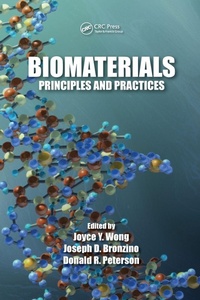
Biomaterials
Principles and Practices
1st Edition
Published on 6. December 2012
Book
Hardback
288 pages
978-1-4398-7251-2 (ISBN)
Description
Most current applications of biomaterials involve structural functions, even in those organs and systems that are not primarily structural in their nature, or very simple chemical or electrical functions. Complex chemical functions, such as those of the liver, and complex electrical or electrochemical functions, such as those of the brain and sense organs, cannot be carried out by biomaterials at this time. With these basic concepts in mind, Biomaterials: Principles and Practices focuses on biomaterials consisting of different materials such as metallic, ceramic, polymeric, and composite. It highlights the impact of recent advances in the area of nano- and microtechnology on biomaterial design.
Discusses the biocompatibility of metallic implants and corrosion in an in vivo environment
Provides a general overview of the relatively bioinert, bioactive or surface-reactive ceramics, and biodegradable or resorbable bioceramics
Reviews the basic chemical and physical properties of synthetic polymers, the sterilization of the polymeric biomaterials, the importance of the surface treatment for improving biocompatibility, and the application of the chemogradient surface for the study on cell-to-polymer interactions
Covers the fundamentals of composite materials and their applications in biomaterials
Highlights commercially significant and successful biomedical biodegradable polymers
Examines failure modes of different types of implants based on material, location, and function in the body
The book discusses the role of biomaterials as governed by the interaction between the material and the body, specifically, the effect of the body environment on the material and the effect of the material on the body.
Discusses the biocompatibility of metallic implants and corrosion in an in vivo environment
Provides a general overview of the relatively bioinert, bioactive or surface-reactive ceramics, and biodegradable or resorbable bioceramics
Reviews the basic chemical and physical properties of synthetic polymers, the sterilization of the polymeric biomaterials, the importance of the surface treatment for improving biocompatibility, and the application of the chemogradient surface for the study on cell-to-polymer interactions
Covers the fundamentals of composite materials and their applications in biomaterials
Highlights commercially significant and successful biomedical biodegradable polymers
Examines failure modes of different types of implants based on material, location, and function in the body
The book discusses the role of biomaterials as governed by the interaction between the material and the body, specifically, the effect of the body environment on the material and the effect of the material on the body.
More details
Language
English
Place of publication
Bosa Roca
United States
Publishing group
Taylor & Francis Inc
Target group
Professional and scholarly
Academic and Professional Practice & Development
Illustrations
103 s/w Abbildungen, 60 s/w Tabellen
60 Tables, black and white; 103 Illustrations, black and white
Dimensions
Height: 260 mm
Width: 183 mm
Thickness: 20 mm
Weight
730 gr
ISBN-13
978-1-4398-7251-2 (9781439872512)
Copyright in bibliographic data and cover images is held by Nielsen Book Services Limited or by the publishers or by their respective licensors: all rights reserved.
Schweitzer Classification
Other editions
Additional editions
E-Book
12/2012
1st Edition
CRC Press
€185.99
Available for download
E-Book
12/2012
1st Edition
CRC Press
€185.99
Available for download
Persons
Joyce Y. Wong, Joseph D. Bronzino, Donald R. Peterson
Content
Metallic Biomaterials. Ceramic Biomaterials. Polymeric Biomaterials. Composite Biomaterials. Biodegradable Polymeric Biomaterials: An Updated Overview. Biologic Biomaterials: Tissue-Derived Biomaterials (Collagen). Biologic Biomaterials: Silk. Biofunctional Hydrogels. Soft Tissue Replacements. Hard Tissue Replacements.