

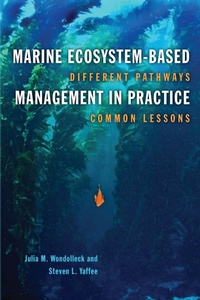
Marine Ecosystem-Based Management in Practice
Different Pathways, Common Lessons
Published on 14. February 2017
Book
Hardback
288 pages
978-1-61091-798-8 (ISBN)
Description
Julia Wondolleck and Steven Yaffee are hopeful. Rather than lamenting the persistent conflicts in global marine ecosystems, they instead sought out examples where managers were doing things differently and making progress against great odds. They interviewed planners, managers, community members, fishermen, and environmentalists throughout the world to find the best lessons for others hoping to advance marine conservation. Their surprising discovery? Successful marine management requires not only the right mix of science, law, financing, and organisational structure, but also an atmosphere of collaboration, a comfortable place for participants to learn about issues, craft solutions, and develop the interpersonal relationships, trust, and understanding needed to put plans into action. Marine Ecosystem-Based Management in Practice is the first practical guide for the marine conservation realm. In a unique collection of case studies, the authors showcase successful collaborative approaches to ecosystem-based management.The authors introduce the basic concepts of ecosystem-based management and five different pathways for making progress from community to multinational levels.
They spotlight the characteristics that are evident in all successful cases --the governance structures and social motivations that make it work. Case analyses ranging from the Gulf of Maine to the Channel Islands in Southern California comprise the bulk of the book, augmented by text boxes showcasing examples of guiding documents important to the process. They devote several ending chapters to discussion of the interpersonal relationships critical to successful implementation of marine ecosystem-based management. The book concludes with a discussion of the implications for policy and on-the-ground practice. This book offers a hopeful message to policy makers, managers, practitioners, and students who will find this an indispensable guide to field-tested, replicable marine conservation management practices that work.
They spotlight the characteristics that are evident in all successful cases --the governance structures and social motivations that make it work. Case analyses ranging from the Gulf of Maine to the Channel Islands in Southern California comprise the bulk of the book, augmented by text boxes showcasing examples of guiding documents important to the process. They devote several ending chapters to discussion of the interpersonal relationships critical to successful implementation of marine ecosystem-based management. The book concludes with a discussion of the implications for policy and on-the-ground practice. This book offers a hopeful message to policy makers, managers, practitioners, and students who will find this an indispensable guide to field-tested, replicable marine conservation management practices that work.
Reviews / Votes
"[Wondolleck and Yaffee] present detailed case studies and identify common lessons learned that can be translated into success for other EBM approaches...The case studies are well-written and worth the effort to read and absorb...After the authors clearly describe the importance of people to MBEM success, they also provide implications for policy and practice." * Environmental Practice * "Ecosystem-based approaches to management are about governance, people, and the social fabric in which they exist. The authors have superbly captured the essential approaches to ecosystem-based management in marine environments. Clear, concise, practical examples make this book an excellent reference for anyone involved in marine conservation management."---Billy D. Causey, Southeast Regional Director, NOAA, Office of National Marine Sanctuaries "Wondolleck and Yaffee bring a practiced eye, honed on the study of terrestrial ecosystem-based management and collaborative approaches to conservation, to the analysis of marine ecosystem-based management. Built around a core set of case studies, the book demonstrates that such an approach can achieve meaningful, durable conservation benefitting ecosystems and people."---Barry D. Gold, Director, Environment Program, Walton Family Foundation "This thoughtful analysis of marine ecosystem-based management offers what this field has been missing: confidence that MEBM can work, and practical guidance for scientists, practitioners, and policy wonks. The good news is that there is more than one way to successfully manage coastal systems. The fundamental element of success is people: leaders committed to working together and building the trust and common understanding to get things done."---Mary Ruckelshaus, Director, The Natural Capital ProjectMore details
Language
English
Place of publication
United States
Publishing group
Princeton University Press
Target group
College/higher education
Product notice
Trade binding
Illustrations
4 illustrations
Dimensions
Height: 234 mm
Width: 153 mm
Thickness: 15 mm
Weight
499 gr
ISBN-13
978-1-61091-798-8 (9781610917988)
Copyright in bibliographic data and cover images is held by Nielsen Book Services Limited or by the publishers or by their respective licensors: all rights reserved.
Schweitzer Classification
Other editions
Additional editions
Julia M. Wondolleck | Steven Lewis Yaffee
Marine Ecosystem-Based Management in Practice
Different Pathways, Common Lessons
E-Book
02/2017
University of Pennsylvania Press, Inc.
€43.99
Available for download
Persons
Julia M. Wondolleck is Associate Professor of Natural Resources at the University of Michigan. She is an expert in the theories and application of dispute resolution and collaborative planning processes. Steven L. Yaffee is Professor of Natural Resources and Environmental Policy at the University of Michigan. He has worked for more than forty years on federal endangered species, public lands, and ecosystem management policy.