

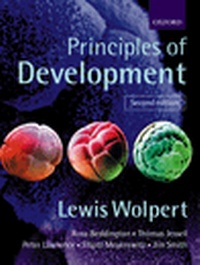
Principles of Development
2nd Edition
Published on 1. March 2002
Book
Paperback/Softback
568 pages
978-0-19-879291-8 (ISBN)
Description
"Principles of Development" is designed for undergraduates. The emphasis is on principles and key concepts. Central to the authors' approach is that development can best be understood by understanding how genes control cell behaviour. They have assumed that students have some basic familiarity with cell biology and genetics, but all key concepts, like the control of gene activity, are explained in the text, and an extensive glossary is provided too. The authors have resisted the temptation to cover every aspect of development and have instead focused on those systems that best illuminate common principles. Indeed, a theme that runs throughout the book is that there are universal principles governing development. At all stages what they have included has been guided by what they believe undergraduates should know about development. The focus of the text is on vertebrates and Drosophila, but not to the exclusion of other systems, such as the nematode and the sea urchin, where they best illustrate a concept. An important feature of the book is the inclusion of the development of plants, which is usually neglected in other textbooks, but has some unique and important features.
Principles are presented as clearly as possible and numerous summaries are provided, both in words and in pictures. The illustrations in the book are a special feature, and have been carefully designed and chosen to illustrate both experiments and mechanisms. This book includes: updated throughout with the very latest research. Includes 32 completely new figures. Improved text design makes the book easier to read. Chapter 3 is now clearer on the comparative basis of body axis specification in vertebrates. Chapter 4 contains a longer and improved explanation of somite generation and differentiation. A reorganized Chapter 9 deals with the relationship of gene expression to cell differentiation in a more simplified way. There is an important addition of material highlighting functional differentiation of a range of new vertebrate tissues and structures in Chapter 10 (the vertebrate heart and vascular system, lung and tooth, with skin development moved forward from Chapter 14), whilst more is included on arthropod neuroblast and compound eye development in Chapter 11.
In the final chapter, new pages are added to support the section on phylogeny and functional morphogenesis in evolution, including storylines on snakes and kiwis. There is also a discussion on variable growth rates in homologous structures and the evolution of the gastrula. This is all material, which increases the book's ability to enthuse students about the relationships of development to evolution - something which really does get them going!
Principles are presented as clearly as possible and numerous summaries are provided, both in words and in pictures. The illustrations in the book are a special feature, and have been carefully designed and chosen to illustrate both experiments and mechanisms. This book includes: updated throughout with the very latest research. Includes 32 completely new figures. Improved text design makes the book easier to read. Chapter 3 is now clearer on the comparative basis of body axis specification in vertebrates. Chapter 4 contains a longer and improved explanation of somite generation and differentiation. A reorganized Chapter 9 deals with the relationship of gene expression to cell differentiation in a more simplified way. There is an important addition of material highlighting functional differentiation of a range of new vertebrate tissues and structures in Chapter 10 (the vertebrate heart and vascular system, lung and tooth, with skin development moved forward from Chapter 14), whilst more is included on arthropod neuroblast and compound eye development in Chapter 11.
In the final chapter, new pages are added to support the section on phylogeny and functional morphogenesis in evolution, including storylines on snakes and kiwis. There is also a discussion on variable growth rates in homologous structures and the evolution of the gastrula. This is all material, which increases the book's ability to enthuse students about the relationships of development to evolution - something which really does get them going!
Reviews / Votes
"This book is, by far, the best introductory textbook in existence for an interesting but complex subject." Journal of Cell Science 115, 2002More details
Edition
2nd Revised edition
Language
English
Place of publication
Oxford
United Kingdom
Target group
College/higher education
Edition type
Revised edition
Illustrations
col. ill.
full colour illustrations throught
ISBN-13
978-0-19-879291-8 (9780198792918)
Copyright in bibliographic data and cover images is held by Nielsen Book Services Limited or by the publishers or by their respective licensors: all rights reserved.
Schweitzer Classification
Other editions
New editions
Lewis Wolpert | Jim Smith | Tom Jessell
Principles of Development
Book
08/2006
3rd Edition
Oxford University Press
€92.85
Article exhausted; check different version
Previous edition

L. Wolpert
Principles of Development
Book
01/1998
Oxford University Press
€37.13
Article exhausted; check for reprint
Persons
Content
1. History and basic concepts; 2. Model systems; 3. Patterning the vertebrate body plan I: axes and germ layers; 4. Patterning the vertebrate body plan II: the mesoderm and early nervous system; 5. Development of the Drosophila body plan; 6. Development of nematodes, sea urchins, ascidians, and slime molds; 7. Plant development; 8. Morphogenesis: change in form in the early embryo; 9. Cell differentiation; 10. Organogenesis; 11. Development of the nervous system; 12. Germ cells and sex; 13. Regeneration; 14. Growth and post-embryonic development; 15. Evolution and development