

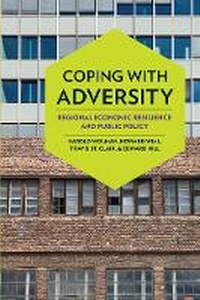
Coping with Adversity
Regional Economic Resilience and Public Policy
Published on 15. November 2017
Book
Paperback/Softback
278 pages
978-0-8014-7854-3 (ISBN)
Description
Coping with Adversity addresses the question of why some metropolitan-area regional economies are resilient in the face of economic shocks and chronic distress while others are not. It is particularly concerned with what public policies make a difference in whether a region is resilient. The authors employ a wide range of techniques to examine the experience of all metropolitan area economies from 1978-2014. They then look closely at six American metropolitan areas to determine what strategies were employed, which of these contributed to regional economic resilience, and which did not. Charlotte, North Carolina, Seattle, Washington, and Grand Forks, North Dakota, are cases of economic resilience, while Cleveland, Ohio, Hartford, Connecticut, and Detroit, Michigan, are cases of economic nonresilience. The six case studies include hard data on employment, production, and demographics, as well as material on public policies and actions.
The authors conclude that there is little that can done in the short term to counter economic shocks; most regions simply rebound naturally after a relatively short period of time. However, they do find that many regions have successfully emerged from periods of prolonged economic distress and that there are policies that can be applied to help them do so. Coping with Adversity will be important reading for all those concerned with local and regional economic development, including public officials, urban planners, and economic developers.
The authors conclude that there is little that can done in the short term to counter economic shocks; most regions simply rebound naturally after a relatively short period of time. However, they do find that many regions have successfully emerged from periods of prolonged economic distress and that there are policies that can be applied to help them do so. Coping with Adversity will be important reading for all those concerned with local and regional economic development, including public officials, urban planners, and economic developers.
Reviews / Votes
These excellent academic researchers from George Washington, New York, and Ohio State Univ. and the Univ. of Illinois at Chicago explore the critical question of why some metropolitan areas deal with economic adversity better than others.(Choice) One of this year's most important books on economic development.... Coping with Adversity offers an opportunity for economic developers to assess the factors affecting the resiliency of their region's economy. In a world where we are continuously captivated by the next big thing and quick to celebrate the groundbreaking of stadiums or factories as transformational, the findings of this book are humbling.
(State Science and Technology Institute) These findings should provoke thought, but the case studies serve to debunk (although the authors do not put it this way) many economic development cliches.
(Planning Magazine) An ambitious and sophisticated application of the concept of resilience to regional economic development.
(Journal of Urban Affairs)
More details
Language
English
Place of publication
Ithaca
United States
Product notice
Paperback (trade)
Illustrations
7 charts - 7 Charts
Dimensions
Height: 229 mm
Width: 152 mm
Thickness: 19 mm
Weight
454 gr
ISBN-13
978-0-8014-7854-3 (9780801478543)
Copyright in bibliographic data and cover images is held by Nielsen Book Services Limited or by the publishers or by their respective licensors: all rights reserved.
Schweitzer Classification
Other editions
Additional editions

Harold Wolman | Howard Wial | Travis St. Clair
Coping with Adversity
Regional Economic Resilience and Public Policy
E-Book
11/2017
Cornell University Press
€25.49
Available for download
Persons
Harold Wolman is Professor Emeritus of Political Science and Research Professor, George Washington Institute of Public Policy, The George Washington University. He is the author of The Politics of Housing and coauthor of Urban Politics and Policy. Howard Wial is the former Director of the Center for Urban Economic Development at the University of Illinois at Chicago. He is coauthor of New Rules for a New Economy, also from Cornell, and coeditor of Urban and Regional Policy and Its Effects. Travis St. Clair is assistant professor at New York University's Wagner School of Public Service. Edward Hill is Professor of Public Affairs and City and Regional Planning at The Ohio State University. He was editor of Economic Development Quarterly and Chair of the Advisory Board of the Manufacturing Extension Partnership of the National Institute of Standards and Technology.
Content
Acknowledgments
Introduction
1. Shocks and Regional Economic Resilience
2. Chronic Distress and Regional Economic Resilience
3. Regions That Lacked Resilience
4. Resilient Regions
5. Assessing the Effect of Resilience Policies Directed toward Business and Individuals
6. Assessing the Effect of Reslience Policies Directed toward Public Goods, Institutions, and Leadership
Conclusion
Appendices
Notes
References
Index
Introduction
1. Shocks and Regional Economic Resilience
2. Chronic Distress and Regional Economic Resilience
3. Regions That Lacked Resilience
4. Resilient Regions
5. Assessing the Effect of Resilience Policies Directed toward Business and Individuals
6. Assessing the Effect of Reslience Policies Directed toward Public Goods, Institutions, and Leadership
Conclusion
Appendices
Notes
References
Index