

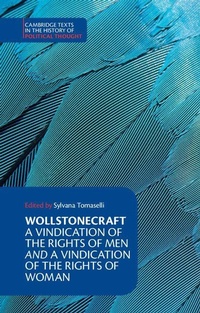
Wollstonecraft: A Vindication of the Rights of Men and a Vindication of the Rights of Woman and Hints
A Vindication of the Rights of Men and a Vindication of the Rights of Woman and Hints
Published on 6. July 1995
Book
Hardback
394 pages
978-0-521-43053-1 (ISBN)
Description
Mary Wollstonecraft, often described as the first major feminist, is remembered principally as the author of A Vindication of the Rights of Woman (1792), and there has been a tendency to view her most famous work in isolation. Yet Wollstonecraft's pronouncements about women grew out of her reflections about men, and her views on the female sex constituted an integral part of a wider moral and political critique of her times which she first fully formulated in A Vindication of the Rights of Men (1790). Written as a reply to Edmund Burke's Reflections on the Revolution in France (1790), this is an important text in its own right as well as a necessary tool for understanding Wollstonecraft's later work. This edition brings the two texts together and also includes Hints, the notes which Wollstonecraft made towards a second, never completed, volume of A Vindication of the Rights of Woman.
Reviews / Votes
'... a thoughtful, wide-ranging and important examination of Wollstonecraft's thought ... Wollstonecraft is skilfully considered in terms of radical Enlightenment thought, and the links between this and feminism are probed in a treatment that is alive to the diversity of this radicalism.' The Times Higher Education SupplementMore details
Series
Language
English
Place of publication
Cambridge
United Kingdom
Target group
College/higher education
Professional and scholarly
Illustrations
Worked examples or Exercises
Dimensions
Height: 222 mm
Width: 145 mm
Thickness: 27 mm
Weight
685 gr
ISBN-13
978-0-521-43053-1 (9780521430531)
Copyright in bibliographic data and cover images is held by Nielsen Book Services Limited or by the publishers or by their respective licensors: all rights reserved.
Schweitzer Classification
Other editions
Additional editions
Mary Wollstonecraft | Sylvana Tomaselli
Wollstonecraft: A Vindication of the Rights of Men and a Vindication of the Rights of Woman and Hints
A Vindication of the Rights of Men and a Vindication of the Rights of Woman and Hints
Book
07/1995
Cambridge University Press
€33.20
Shipment within 15-20 days
Mary Wollstonecraft | Sylvana Tomaselli
Wollstonecraft: A Vindication of the Rights of Men and a Vindication of the Rights of Woman and Hints
E-Book
07/1995
Cambridge University Press
€20.49
Available for download
Persons
Mary Wollstonecraft Shelley was an English novelist best known for her groundbreaking work, ""Frankenstein; or, The Modern Prometheus."" Born in 1797, she was the daughter of feminist writer Mary Wollstonecraft and political philosopher William Godwin. Shelley's literary career began in the early 19th century, and she became a prominent figure in the Romantic literary movement.
Her works often explore themes of creation, ambition, and the human condition, reflecting her interest in science and ethics. In addition to ""Frankenstein,"" she wrote several other novels, including ""The Last Man"" and ""Valperga; or, The Life and Adventures of Castruccio, Prince of Lucca."" Shelley's writing is characterized by its deep psychological insight and complex characters, particularly her portrayals of women navigating patriarchal societies. Shelley's influence extends beyond her lifetime, as her ideas and themes resonate in contemporary literature and discussions about gender, power, and morality. She remains a significant figure in both Gothic and science fiction literature.
Content
1. The rights and involved duties of mankind considered; 2. The prevailing opinion of a sexual character discussed; 3. The same subject continued; 4. Observations on the state of degradation to which woman is reduced by various causes; 5. Animadversions on some of the writers who have rendered women objects of pity, bordering on contempt; 6. The effect which an early association of ideas has upon the character; 7. Modesty - comprehensively considered, and not as a sexual virtue; 8. Morality undermined by sexual notions of the importance of a good reputation; 9. Of the pernicious effects which arise from the unnatural distinctions established in society; 10. Parental affection; 11. Duty to parents; 12. On national education; 13. Some instances of the folly which the ignorance of women generates; with concluding reflections on the moral improvement that a revolution in female manners might naturally be expected to produce.