

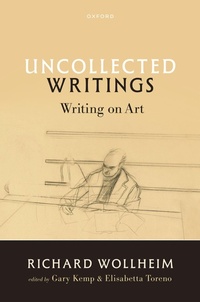
Uncollected Writings
Writing on Art
Published on 20. February 2025
Book
Hardback
368 pages
978-0-19-889012-6 (ISBN)
Description
Richard Wollheim's (1923-2003) was the leading voice in the philosophy of art in the Anglo-American tradition during the second half of the twentieth century. This volume serves two purposes. First, at the time of his death, Wollheim was composing a short book, comprising two lectures first delivered, respectively, at Barcelona and at Lawrence, Kansas--versions of which appeared in 1994 ('On Formalism and Its Kinds') and 2001 ('On Formalism and Pictorial Organisation')--plus substantial new material. The whole text is reproduced here for the first time. The material offers new considerations in favour of his psychological conception of pictorial art as against the semiotic conception, arguments for the inadequacy of formalism, and close and compelling analyses of pictures by Ruisdael, Monet, and others, using in novel ways his well-known ideas in pictorial aesthetics to arrive at a theory of pictorial organisation. Second, although Wollheim was well-served by various collections of his work to 1994, at that point some important articles and reviews had yet to be selected for republication--in some cases available only in locations difficult to access--as well as his having published further work after 1994. The present volume fills both gaps: it thus provides the final pieces for a complete collection of Wollheim's works in the philosophy of art.
This is one of three planned volumes of Wollheim's previously uncollected work for Oxford University Press. The others are Writing on Political Philosophy, edited by Jonathan Wolff; and Writing on Philosophy and the Mind, edited by Garry Hagberg.
This is one of three planned volumes of Wollheim's previously uncollected work for Oxford University Press. The others are Writing on Political Philosophy, edited by Jonathan Wolff; and Writing on Philosophy and the Mind, edited by Garry Hagberg.
More details
Language
English
Place of publication
Oxford
United Kingdom
Target group
Professional and scholarly
Product notice
sewn/stitched
Cloth over boards
Dimensions
Height: 229 mm
Width: 155 mm
Thickness: 33 mm
Weight
748 gr
ISBN-13
978-0-19-889012-6 (9780198890126)
Copyright in bibliographic data and cover images is held by Nielsen Book Services Limited or by the publishers or by their respective licensors: all rights reserved.
Schweitzer Classification
Other editions
Additional editions
E-Book
02/2025
OUP eBook
€104.99
Available for download
E-Book
01/2025
OUP eBook
€104.99
Available for download
Persons
Richard Wollheim (1923-2003)
Gary Kemp is Senior Lecturer at the University of Glasgow. He is the author of What Is This Thing called Philosophy of Language? (3rd edition, Routledge, 2024) and Quine versus Davidson: Truth, Reference, and Meaning (OUP, 2012).
Elisabetta Toreno is Lecturer at Open University. She is the author of Netherlandish and Italian Female Portraiture in the Fifteenth Century: Gender, Identity, and the Tradition of Power (Amsterdam University Press, 2022).
Gary Kemp is Senior Lecturer at the University of Glasgow. He is the author of What Is This Thing called Philosophy of Language? (3rd edition, Routledge, 2024) and Quine versus Davidson: Truth, Reference, and Meaning (OUP, 2012).
Elisabetta Toreno is Lecturer at Open University. She is the author of Netherlandish and Italian Female Portraiture in the Fifteenth Century: Gender, Identity, and the Tradition of Power (Amsterdam University Press, 2022).
Content
Introduction
Part I. Lectures
1: Pictorial Form and Pictorial Organization
Part II.
2: Style Now (1975)
3: Aesthetics, Anthropology and Style: Some Programmatic Remarks (1978)
4: Style in Painting (1995)
Part III. The Theory of Pictorial Representation
5: On Pictorial Representation (1998)
6: What Makes Representational Painting Truly Visual? (2003)
7: In Defense of Seeing-In (2003)
Part IV.
8: Forms, Elements and Modernity: Reply to Michael Podro (1966)
9: A Critic of Our Time (1959)
10: The Image in Form: Introduction (1972)
11: Imagination and Pictorial Understanding (1986)
12: A Note on Mimesis as Make-Believe (1991)
13: Danto's Gallery of Indiscernibles (1993)
14: Walter Pater: From Philosophy to Art (1995)
15: Review of Problems of Art, by Susanne K. Langer (1957)
16: Professor Gombrich [Review of Meditations on a Hobby Horse] (1964)
17: Wittgenstein on Art (1966)
Part V.
18: Sociological Explanations of the Arts (1956)
19: On Expression and Expressionism (1964)
20: Neurosis and the Artist (1975)
21: On the Question 'Why Is Painting an Art?' (1984)
22: Art, Interpretation, and the Creative Process (1984)
23: The Core of Aesthetics (1991)
24: Why Is Drawing Interesting? (2005)
Part I. Lectures
1: Pictorial Form and Pictorial Organization
Part II.
2: Style Now (1975)
3: Aesthetics, Anthropology and Style: Some Programmatic Remarks (1978)
4: Style in Painting (1995)
Part III. The Theory of Pictorial Representation
5: On Pictorial Representation (1998)
6: What Makes Representational Painting Truly Visual? (2003)
7: In Defense of Seeing-In (2003)
Part IV.
8: Forms, Elements and Modernity: Reply to Michael Podro (1966)
9: A Critic of Our Time (1959)
10: The Image in Form: Introduction (1972)
11: Imagination and Pictorial Understanding (1986)
12: A Note on Mimesis as Make-Believe (1991)
13: Danto's Gallery of Indiscernibles (1993)
14: Walter Pater: From Philosophy to Art (1995)
15: Review of Problems of Art, by Susanne K. Langer (1957)
16: Professor Gombrich [Review of Meditations on a Hobby Horse] (1964)
17: Wittgenstein on Art (1966)
Part V.
18: Sociological Explanations of the Arts (1956)
19: On Expression and Expressionism (1964)
20: Neurosis and the Artist (1975)
21: On the Question 'Why Is Painting an Art?' (1984)
22: Art, Interpretation, and the Creative Process (1984)
23: The Core of Aesthetics (1991)
24: Why Is Drawing Interesting? (2005)