

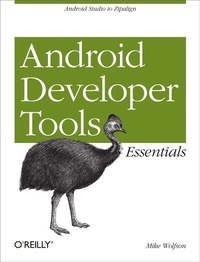
Android Developer Tools Essentials
Android Studio to Zipalign
1st Edition
Published on 24. September 2013
Book
Paperback/Softback
248 pages
978-1-4493-2821-4 (ISBN)
Description
Android development can be challenging, but through the effective use of Android Developer Tools (ADT), you can make the process easier and improve the quality of your code. This concise guide demonstrates how to build apps with ADT for a device family that features several screen sizes, different hardware capabilities, and a varying number of resources.
With examples in Windows, Linux, and Mac OS X, you'll learn how to set up an Android development environment and use ADT with the Eclipse IDE. Also, contributor Donn Felker introduces Android Studio, a Google IDE that will eventually replace Eclipse.
* Learn how to use Eclipse and ADT together to develop Android code
* Create emulators of various sizes and configurations to test your code
* Master Eclipse tools, or explore the new Android Studio
* Use Logcat, Lint, and other ADT tools to test and debug your code
* Simulate real-world events, including location, sensors, and telephony
* Create dynamic and efficient UIs, using Graphical Layout tools
* Monitor and optimize you application performance using DDMS, HierarchyViewer, and the Android Monitor tool
* Use Wizards and shortcuts to generate code and image assets
* Compile and package Android code with Ant and Gradle
More details
Other editions
Additional editions
E-Book
08/2013
O'Reilly
€10.49
Available for download
E-Book
08/2013
O'Reilly
€0.00
Available for download
Persons
Mike is a passionate mobile designer/developer working out of Phoenix, AZ. He has been working in the software field for over 15 years, and with Android since its introduction. Currently, he runs his own consultancy group, developing Android applications for a variety of customers. He has written a variety of successful apps, and is probably best known for the ""Droid Of The Day"" App. Mike has spent his career helping others learn technology. He currently runs the local Google Technology Users Group, and has been a lifelong supporter of a variety of other group learning activities. Mike has spoken about Android and mobile development at a variety of conferences and user groups. When he is not geeking out about phones, he enjoys the outdoors (snowboarding, hiking, scuba diving), collecting PEZ dispensers, and chasing his young (but quick) daughter.
Content
Preface;
Requirements for Android Developer Tools;
Development Process for Android Developer Tools;
Development on a Variety of OS Platforms;
Conventions Used in This Book;
Using Code Examples;
Safari® Books Online;
How to Contact Us;
Acknowledgments;
Chapter 1: Getting Started;
1.1 Minimum Requirements;
1.2 Installing Java;
1.3 Installing the Android Software Development Kit;
1.4 Developing Without Eclipse;
1.5 Configuring a Device for Development;
Chapter 2: Essential Tools;
2.1 SDK Manager;
2.2 Android Debug Bridge (ADB);
Chapter 3: Configuring Devices and Emulators;
3.1 Using a Physical Device for Development;
3.2 Using an Emulator for Development;
3.3 Android Virtual Devices;
3.4 Advanced Emulator Configuration;
Chapter 4: Using Devices and Emulators;
4.1 Using the Emulator;
4.2 File Explorer;
4.3 Developer Tools Application;
Chapter 5: Developing with Eclipse;
5.1 Anatomy of the Eclipse Workspace;
5.2 Code Templates;
5.3 Properties Editors;
5.4 XML Formatter;
5.5 The Android Key;
5.6 Quick Outline for XML;
5.7 Other Essential Eclipse Shortcuts;
5.8 Refactor Menu;
Chapter 6: Developing with Android Studio;
6.1 Installing Android Studio;
6.2 Anatomy of the Android Studio IDE;
6.3 The New Structure of an Android Project;
6.4 Creating New Android Components;
6.5 Layout Designer and Layout Preview;
6.6 Generating an APK;
6.7 Interacting with Maven and Gradle;
6.8 Version Control Integration;
6.9 Migrating from Eclipse;
6.10 Android Studio Tips and Tricks;
Chapter 7: Testing Your Code;
7.1 Logcat;
7.2 Debugging;
7.3 Lint;
Chapter 8: Simulating Events;
8.1 Simulating Location and Routes;
8.2 Simulating Telephony Operations;
8.3 Changing Networking Parameters;
8.4 Using a Device with Sensor Emulation;
8.5 Advanced Sensor Testing;
8.6 Developer Options Menu;
Chapter 9: Build Tools;
9.1 Compiling Your Code;
9.2 Packaging an APK for Release;
9.3 Building from the Command Line Using Ant;
9.4 Advanced Packaging Steps;
9.5 Gradle-Based Build Tools;
9.6 Using the Maven Tools;
Chapter 10: Monitoring System Resources;
10.1 Memory Usage in Android;
10.2 Dalvik Debug Monitor Server (DDMS);
10.3 Memory Analyzer Tool (MAT);
Chapter 11: Working with the User Interface;
11.1 Android Layout Basic Concepts;
11.2 Editing XML Files Directly;
11.3 Working with Graphics;
Chapter 12: Using the Graphical Editor;
12.1 Generating Layouts Using the Graphical Layout Editor;
12.2 Palette;
12.3 Canvas;
12.4 Outline View;
12.5 Properties Editor;
12.6 Configuration Chooser;
Chapter 13: Optimizing the User Interface;
13.1 Introduction to UI Performance;
13.2 Hierarchy Viewer;
13.3 Fixing Problems Using Lint;
13.4 Application Exerciser Monkey;
13.5 Monkeyrunner;
13.6 Thanks for Reading!;
Colophon;