

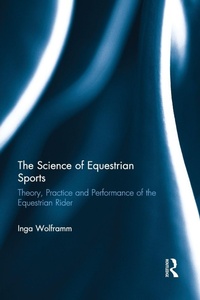
The Science of Equestrian Sports
Theory, Practice and Performance of the Equestrian Rider
1st Edition
Published on 4. March 2015
Book
Paperback/Softback
208 pages
978-1-138-86039-1 (ISBN)
Description
The Science of Equestrian Sports is a comprehensive study of the theory and practice of the equestrian rider in sport. While most scholarship to date has focused on the horse in competition, this is the first book to collate current data relating specifically to riders. It provides valuable insight into improving sporting performance and maintaining the safety of both the horse and the rider.
Drawing on the latest scientific research, and covering every equestrian discipline from horseracing to eventing, the book systematically explores core subjects such as:
physiology of the rider
sport psychology in equestrian sport
preventing injury
biomechanics and kinematics
coaching equestrian sport
This book is a holistic and scientific examination of the role of the rider in equine sports. It is essential reading for sport science students with an interest in equestrian sport and equitation. Furthermore, it will be an invaluable resource for instructors, coaches, sport psychologists, or physiologists working with equestrian athletes.
Drawing on the latest scientific research, and covering every equestrian discipline from horseracing to eventing, the book systematically explores core subjects such as:
physiology of the rider
sport psychology in equestrian sport
preventing injury
biomechanics and kinematics
coaching equestrian sport
This book is a holistic and scientific examination of the role of the rider in equine sports. It is essential reading for sport science students with an interest in equestrian sport and equitation. Furthermore, it will be an invaluable resource for instructors, coaches, sport psychologists, or physiologists working with equestrian athletes.
Reviews / Votes
"This is a landmark text for all riders, if they are truly committed to do the best for their horses rather than simply pay lip service to the notion of excellence in training and riding. Every horse deserves a rider who has read this book!"Dr Andrew McLean, Director Australian Equine Behaviour Centre & Equitation Science International and President of the International Society for Equitation Science.
More details
Language
English
Place of publication
London
United Kingdom
Publishing group
Taylor & Francis Ltd
Target group
College/higher education
Illustrations
6 s/w Tabellen
6 Tables, black and white
Dimensions
Height: 234 mm
Width: 156 mm
Thickness: 11 mm
Weight
324 gr
ISBN-13
978-1-138-86039-1 (9781138860391)
Copyright in bibliographic data and cover images is held by Nielsen Book Services Limited or by the publishers or by their respective licensors: all rights reserved.
Schweitzer Classification
Other editions
Additional editions
Inga Wolframm
The Science of Equestrian Sports
Theory, Practice and Performance of the Equestrian Rider
E-Book
07/2013
Routledge
€64.49
Available for download
Inga Wolframm
The Science of Equestrian Sports
Theory, Practice and Performance of the Equestrian Rider
E-Book
07/2013
1st Edition
Routledge
€64.49
Available for download
Inga Wolframm
The Science of Equestrian Sports
Theory, Practice and Performance of the Equestrian Rider
Book
07/2013
1st Edition
Routledge
€231.50
Shipment within 15-20 days
Person
Inga Wolframm is a Senior Lecturer at the University of Applied Sciences Van Hall Larenstein, the Netherlands, an accredited sport psychologist and a Council member of the International Society for Equitation Science (ISES). Her research interests focus on psychological, physiological and social processes in the rider, including horse-rider interactions.
Content
Introduction Chapter 1: Motor Control of the Rider: On moving and being moved Chapter 2: Performance Physiology and Rider Fitness: Riders are athletes too! Chapter 3: Sport Psychology in Equestrian Sport: merely mind games? Chapter 4: Coaching Riders: From a different perspective Chapter 5: Injuries in Equestrian Sport: Dealing with it or part of the deal? Chapter 6: Horse-Human Interactions: Art or science? In Conclusion: Quo Vadis, Equestrian Science?