

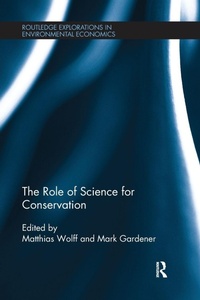
The Role of Science for Conservation
1st Edition
Published on 9. December 2016
Book
Paperback/Softback
302 pages
978-1-138-24386-6 (ISBN)
Description
The book integrates the knowledge and reflections of thirty scientists, of which many have dedicated a substantial part of their professional life to the Galapagos archipelago, to the conservation of its biodiversity and to the sustainable management of its resources. The book can be considered a milestone on the way to the successful conservation and sustainable development of this unique world heritage site.
More details
Series
Language
English
Place of publication
London
United Kingdom
Publishing group
Taylor & Francis Ltd
Target group
College/higher education
Illustrations
79 s/w Abbildungen, 24 s/w Photographien bzw. Rasterbilder, 55 s/w Zeichnungen, 13 s/w Tabellen
13 Tables, black and white; 55 Line drawings, black and white; 24 Halftones, black and white; 79 Illustrations, black and white
Dimensions
Height: 234 mm
Width: 156 mm
Weight
453 gr
ISBN-13
978-1-138-24386-6 (9781138243866)
Copyright in bibliographic data and cover images is held by Nielsen Book Services Limited or by the publishers or by their respective licensors: all rights reserved.
Schweitzer Classification
Other editions
Additional editions
Matthias Wolff | Mark Gardener
The Role of Science for Conservation
E-Book
12/2012
Routledge
€69.99
Available for download
Matthias Wolff | Mark Gardener
The Role of Science for Conservation
E-Book
12/2012
1st Edition
Routledge
€69.99
Available for download
Matthias Wolff | Mark Gardener
The Role of Science for Conservation
Book
02/2012
1st Edition
Routledge
€215.41
Shipment within 15-20 days
Persons
Matthias Wolff is Director of Marine and Coastal Sciences at the Charles Darwin Foundation, Puerto Ayora, Ecuador.
Mark Gardener is Director of Terrestrial Science at the Charles Darwin Foundation, Puerto Ayora, Ecuador.
Mark Gardener is Director of Terrestrial Science at the Charles Darwin Foundation, Puerto Ayora, Ecuador.
Content
Part 1: The Evolutionary Context 1.1. What Darwin Found Convincing in Galapagos William Durham 1.2. Research on Evolutionary Principles in Galapagos: Research on Evolutionary Principles in Galapagos: An Overview of the Past 50 Years Carloss Valle and Patricia G. Parker 1.3. Evolution of Pathogens and Parasites on the Galapagos Islands Patricia G. Parker and Noah K. Whiteman 1.4. Turning Points in the Evolution of Vertebrates Eibl-Eibesfeld 1.5. The Boat, the Bay, and the Museum: Significance of the 1905-1906: Galapogos Expedition of the California Academy of Sciences Matthew James 1.6. Chapter Summary Part 2: Biodiversity Assessment and Monitoring of Change 2.1. Monitoring the Galapagos Ecosystem: Challenges, Pitfalls and a Vision for the Future James P. Gibbs and Bryan Milstead 2.2. The Neglected Majority - Biodiversity Inventories as an Integral Part of Conservation Biology Frank Bungartz 2.3. The Power of Long-Term Monitoring to Understand Mechanisms of Ecosystem Change: the Case of the Galapagos Marine Reserve Stuart Banks, Rodrigo Bustamante, Diego Ruiz, Natalia Tirado, Mariana Vera and Franz Smith 2.4. Wildlife Health Monitoringand Disease Management Protecting the Biodiversity of Galapagos Patricia G. Parker and Sharon L. Deem 2.5. Chapter Summary Part 3: A Systemic Approach: Modeling and Restoration 3.1. A Review of 40 Years of Eradication Programs in Galapagos: Impacts on the Whole Ecosystem Rachel Atkinson, Mark Gardener, Grant Harper and Victor Carrion 3.2. Food Web Structure of the Galapogas Pelagic Econosystem after a Decade of Protective Insights from Trophic Modelling Matthias Wolff and Cesar Penaherrera 3.3. Mediated Modelling: A System Dynamics Approach To Environmental Consensus Building for the Galapagos Marjan van den Belt 3.4. Chapter Summary Part 4: Reconciliation of the Conservation with Socio-Economic Development 4.1. The Value of Ecosystem Services and Biodiversity Conservation: A Challenge for the Galapagos Robert Costanza