

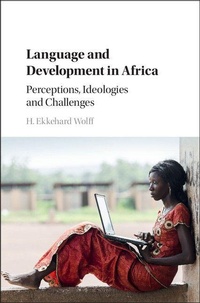
Language and Development in Africa
Perceptions, Ideologies and Challenges
Published on 26. May 2016
Book
Hardback
376 pages
978-1-107-08855-9 (ISBN)
Description
Development is based on communication through language. With more than two thousand languages being used in Africa, language becomes a highly relevant factor in all sectors of political, social, cultural and economic life. This important sociolinguistic dimension hitherto remains underrated and under-researched in 'Western' mainstream development studies. The book discusses the resourcefulness of languages, both local and global, in view of the ongoing transformation of African societies as much as for economic development. From a novel 'applied African sociolinguistics' perspective it analyses the continuing effects of linguistic imperialism on postcolonial African societies, in particular regarding the educational sector, through imposed hegemonic languages such as Arabic and the ex-colonial languages of European provenance. It offers a broad interdisciplinary scientific approach to the linguistic dimensions of sociocultural modernisation and economic development in Africa, written for both the non-linguistically trained reader as much as for the linguistically trained researcher and language practitioner.
Reviews / Votes
'Language and Development in Africa is generally a very straightforward, practical guide to broaching the complex linguistic situation across the continent. Because all but one of the chapters are grounded in the twenty themes established in the introductory chapter, the reader remains constantly aware of the overarching goals of this book, viz. to improve and widen understanding of the complexity of language usage and policies in Africa, and also to effect change on the continent as it concerns the interaction of language and development ... the extensive maps, figures, and tables serve as effective illustrations of the longer, textual explanations. Most surprisingly, two other sections are provided to share with the reader additional scholarly sources for consultation and an exhaustive glossary of all linguistic terms referenced in the text.' Troy E. Spier, LINGUIST List (https://linguistlist.org)More details
Language
English
Place of publication
Cambridge
United Kingdom
Target group
Professional and scholarly
Illustrations
10 Tables, black and white; 13 Maps; 1 Halftones, unspecified; 1 Halftones, black and white; 8 Line drawings, black and white
Dimensions
Height: 235 mm
Width: 157 mm
Thickness: 25 mm
Weight
694 gr
ISBN-13
978-1-107-08855-9 (9781107088559)
Copyright in bibliographic data and cover images is held by Nielsen Book Services Limited or by the publishers or by their respective licensors: all rights reserved.
Schweitzer Classification
Other editions
Additional editions
Book
03/2019
Cambridge University Press
€55.40
Shipment within 15-20 days
E-Book
06/2016
Cambridge University Press
€29.49
Available for download
E-Book
05/2016
Cambridge University Press
€24.49
Available for download
Person
H. Ekkehard Wolff has taught at universities in Germany, Finland, Nigeria, Niger, Ethiopia and South Africa. His research encompasses both major African languages and endangered languages and he was awarded the traditional title Midala Lamang by the Emir of Gwoza in 1992. He has written extensively on language policies and their implementation in Africa, in particular with regard to the politics of language in education.
Content
1. Introduction: approach, questions and themes; 2. Background: Africa and the 'West' - a difficult relationship; 3. Perception: between ignorance, half knowledge and distortion; 4. De-marginalisation: the cradle of mankind and home of human language; 5. Re-conceptualisation: the overdue linguistic turn in development discourse; 6. Challenges: linguistic plurality and diversity - problem or resource?; 7. Future: synopsis and options for language planning; 8. Agenda: arguments and steps; 9. Basic sociolinguistic facts: 'languages', 'dialects', numbers of speakers.