

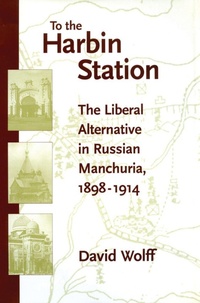
To the Harbin Station
The Liberal Alternative in Russian Manchuria, 1898-1914
Published on 1. May 1999
Book
Hardback
276 pages
978-0-8047-3266-6 (ISBN)
Description
In 1898, near the projected intersection of the Chinese Eastern Railroad (the last leg of the Trans-Siberian) and China's Sungari River, Russian engineers founded the city of Harbin. Between the survey of the site and the profound dislocations of the 1917 revolution, Harbin grew into a bustling multiethnic urban center with over 100,000 inhabitants. In this area of great natural wealth, Russian, Chinese, Japanese, Korean, and American ambitions competed and converged, and sometimes precipitated vicious hostilities.
Drawing on the archives, both central and local, of seven countries, this history of Harbin presents multiple perspectives on Imperial Russia's only colony. The Russian authorities at Harbin and their superiors in St. Petersburg intentionally created an urban environment that was tolerant not only toward their Chinese host, but also toward different kinds of "Russians." For example, in no other city of the Russian Empire were Jews and Poles, who were numerous in Harbin, encouraged to participate in municipal government. The book reveals how this liberal Russian policy changed the face and fate of Harbin.
As the history of Harbin unfolds, the narrative covers a wide range of historiographic concerns from several national histories. These include: the role of the Russian finance minister Witte, the building of the Trans-Siberian Railroad, the origins of Stolypin's reforms, the development of Siberia and the Russian Far East, the 1905 Revolution, the use of ethnicity as a tool of empire, civil-military conflict, strategic area studies, Chinese nationalism, the Japanese decision for war against the Russians, Korean nationalism in exile, and the rise of the soybean as an international commodity. In all these concerns, Harbin was a vibrant source of creative, unorthodox policy and turbulent economic and political claims.
Drawing on the archives, both central and local, of seven countries, this history of Harbin presents multiple perspectives on Imperial Russia's only colony. The Russian authorities at Harbin and their superiors in St. Petersburg intentionally created an urban environment that was tolerant not only toward their Chinese host, but also toward different kinds of "Russians." For example, in no other city of the Russian Empire were Jews and Poles, who were numerous in Harbin, encouraged to participate in municipal government. The book reveals how this liberal Russian policy changed the face and fate of Harbin.
As the history of Harbin unfolds, the narrative covers a wide range of historiographic concerns from several national histories. These include: the role of the Russian finance minister Witte, the building of the Trans-Siberian Railroad, the origins of Stolypin's reforms, the development of Siberia and the Russian Far East, the 1905 Revolution, the use of ethnicity as a tool of empire, civil-military conflict, strategic area studies, Chinese nationalism, the Japanese decision for war against the Russians, Korean nationalism in exile, and the rise of the soybean as an international commodity. In all these concerns, Harbin was a vibrant source of creative, unorthodox policy and turbulent economic and political claims.
Reviews / Votes
"This outstanding work, the first scholarly history of the formative years of the city of Harbin, is much more than urban or regional history. It responds to a need to understand...a unique experience, where local, national, and world cultures, economies, and politics intersected."-Thomas Lahusen, Duke UniversityMore details
Edition
New edition
Language
English
Place of publication
Palo Alto
United States
Target group
College/higher education
Professional and scholarly
Edition type
New edition
Product notice
Cloth
Illustrations
22 illustrations, 4 tables
Dimensions
Height: 238 mm
Width: 159 mm
Thickness: 25 mm
Weight
518 gr
ISBN-13
978-0-8047-3266-6 (9780804732666)
Copyright in bibliographic data and cover images is held by Nielsen Book Services Limited or by the publishers or by their respective licensors: all rights reserved.
Schweitzer Classification
Persons
David Wolff is the co-editor, with Stephen Kotkin, of Rediscovering Russia in Asia and editor of the Cold War International History Project Bulletin.
Content
Contents Riasanovsky Nicholas V. 1. 2. 3. 4. 5.