

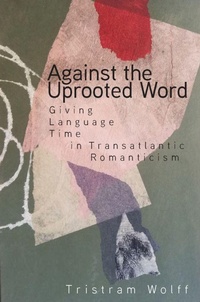
Against the Uprooted Word
Giving Language Time in Transatlantic Romanticism
Published on 11. October 2022
Book
Hardback
338 pages
978-1-5036-3276-9 (ISBN)
Description
In this revisionist account of romantic-era poetry and language philosophy, Tristram Wolff recovers vibrant ways of thinking language and nature together.
Wolff argues that well-known writers including Phillis Wheatley Peters, William Blake, William Wordsworth, and Henry David Thoreau offer a radical chronopolitics in reaction to the "uprooted word," or the formal analytic used to classify languages in progressive time according to a primitivist timeline of history and a hierarchy of civilization. Before the bad naturalisms of nineteenth-century race science could harden language into place as a metric of social difference, poets and thinkers try to soften, thicken, deepen, and dissolve it. This naturalizing tendency makes language more difficult to uproot from its active formation in the lives of its speakers. And its "gray romanticism" simultaneously gives language different kinds of time-most strikingly, the deep time of geologic form-to forestall the hardening of time into progress.
Reorienting romantic studies to consider colonialism's pervasive effects on theories of language origin, Wolff shows us the ambivalent position of romantics in this history. His reparative reading makes visible language's ability to reimagine social forms.
Wolff argues that well-known writers including Phillis Wheatley Peters, William Blake, William Wordsworth, and Henry David Thoreau offer a radical chronopolitics in reaction to the "uprooted word," or the formal analytic used to classify languages in progressive time according to a primitivist timeline of history and a hierarchy of civilization. Before the bad naturalisms of nineteenth-century race science could harden language into place as a metric of social difference, poets and thinkers try to soften, thicken, deepen, and dissolve it. This naturalizing tendency makes language more difficult to uproot from its active formation in the lives of its speakers. And its "gray romanticism" simultaneously gives language different kinds of time-most strikingly, the deep time of geologic form-to forestall the hardening of time into progress.
Reorienting romantic studies to consider colonialism's pervasive effects on theories of language origin, Wolff shows us the ambivalent position of romantics in this history. His reparative reading makes visible language's ability to reimagine social forms.
Reviews / Votes
"Against the Uprooted Word is a splendid piece of scholarship. It will be a welcome arrival to students across disciplines (including language studies and anthropology) in addition to charting the future of the literary field-romanticism-in which it is most immediately grounded."-William Galperin, author of The History of Missed Opportunities "Wolff reclaims the literary imaginary as a rich archive for rethinking linguistics and philology. This erudite, ranging, and provocative book has helped me to learn-and unlearn-a lot."-Maureen McLane, author of My Poets "The compelling conjunctions of imaginative literature and linguistic, philological, and proto-anthropological theories that [Against the Uprooted Word] presents make the most convincing case for the discrepant force of Romantic-era writing, and Wolff is an impressively erudite guide to this richly comparative, interdisciplinary, and trans-Atlantic Romanticism."-Nancy Yousef, European Romantic Review "The book's arguments are extraordinarily complex and nuanced. Wolff marshals an impressive erudition, an original theoretical synthesis (drawing on thinkers from Denise Ferreira da Silva to Valentin Voloshinov), and a fine sensitivity to minute inflections and reverberations of linguistic and poetic form."-Joseph Albernaz, Nineteenth-Century Contexts "Against the Uprooted Word is an original, incisive study, a perceptive weaving together of various threads in recent Romanticist scholarship that revisits the familiar terrain of Romantic language theory in a consequential, disorienting, and ultimately hopeful way."-Jacob Risinger, Modern PhilologyMore details
Edition
New edition
Language
English
Place of publication
Palo Alto
United States
Target group
Professional and scholarly
Edition type
New edition
Product notice
Cloth
Illustrations
3 halftones
Dimensions
Height: 231 mm
Width: 155 mm
Thickness: 25 mm
Weight
621 gr
ISBN-13
978-1-5036-3276-9 (9781503632769)
Copyright in bibliographic data and cover images is held by Nielsen Book Services Limited or by the publishers or by their respective licensors: all rights reserved.
Schweitzer Classification
Other editions
Additional editions
E-Book
10/2022
Stanford University Press
€139.99
Available for download
Person
Tristram Wolff is Assistant Professor of English and Comparative Literary Studies at Northwestern University.
Content
Introduction: Pulling Roots
1. Giving Language Time
2. The Transported Word: Wheatley's Part
3. Voices of the Ground: Blake's Language in Deep Time
4. Radical Diversions: Wordsworth's Overgrowth
5. The Primitive Today: Thoreau in the Wild
Conclusion: Deracination
1. Giving Language Time
2. The Transported Word: Wheatley's Part
3. Voices of the Ground: Blake's Language in Deep Time
4. Radical Diversions: Wordsworth's Overgrowth
5. The Primitive Today: Thoreau in the Wild
Conclusion: Deracination