

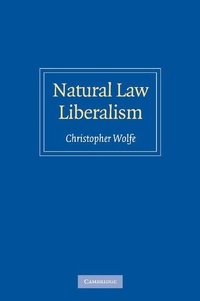
Natural Law Liberalism
Published on 31. July 2009
Book
Paperback/Softback
280 pages
978-0-521-14060-7 (ISBN)
Description
Liberal political philosophy and natural law theory are not contradictory, but - properly understood - mutually reinforcing. Contemporary liberalism (as represented by Rawls, Guttman and Thompson, Dworkin, Raz, and Macedo) rejects natural law and seeks to diminish its historical contribution to the liberal political tradition, but it is only one, defective variant of liberalism. A careful analysis of the history of liberalism, identifying its core principles, and a similar examination of classical natural law theory (as represented by Thomas Aquinas and his intellectual descendants), show that a natural law liberalism is possible and desirable. Natural law theory embraces the key principles of liberalism, and it also provides balance in resisting some of its problematic tendencies. Natural law liberalism is the soundest basis for American public philosophy, and it is a potentially more attractive and persuasive form of liberalism for nations that have tended to resist it.
Reviews / Votes
"Wolfe's writing is often spirited, consistently incisive, and unfailingly clear. He does not stoop to caricature, is uninterested in partisan wrangling, and confines his argument to the most important issues and problems of the day. Like the interlocutors he criticizes, Wolfe is primarily interested in the future health of liberalism, and he treats those with whome he disagrees with the kind of carefulness and seriousness that bespeaks genuine respect. Although he often expresses appreciation for thir efforts and the concerns that underlie them, he does not dilute his criticisms and is frank in pointing to their failures. The result is a bracing engagement that is refreshingly direct without being combative." - Aristide Tessitore, Furman University Perspectives on Politics "This book is a necessary beginning for conversation over 'natural law liberalism.'" -ChoiceMore details
Language
English
Place of publication
Cambridge
United Kingdom
Target group
Professional and scholarly
Product notice
Paperback (trade)
Illustrations
Worked examples or Exercises
Dimensions
Height: 229 mm
Width: 152 mm
Thickness: 15 mm
Weight
410 gr
ISBN-13
978-0-521-14060-7 (9780521140607)
Copyright in bibliographic data and cover images is held by Nielsen Book Services Limited or by the publishers or by their respective licensors: all rights reserved.
Schweitzer Classification
Other editions
Additional editions
Christopher Wolfe
Natural Law Liberalism
E-Book
09/2006
1st Edition
Cambridge University Press
€38.49
Available for download
Person
Christopher Wolfe is Professor of Political Science at Marquette University. He received his PhD from Boston College and has been teaching at Marquette University since 1978. His published books include The Rise of Modern Judicial Review (1986), Judicial Activism (1991), How to Read the Constitution (1996), Liberalism at the Crossroads (1994), and Natural Law and Public Reason (2000). His edited volumes include That Eminent Tribunal (2004), The Family, Civil Society, and the State (1998), Homosexuality and American Public Life (1999), and Same-Sex Matters (2000). Dr Wolfe has published articles in First Things, book reviews, and various opinion pieces. He is the founder and President of the American Public Philosophy Institute.
Content
Part I. Contemporary Liberalism: 1. Contemporary liberal exclusionism I: John Rawls's antiperfectionist liberalism; 2. Contemporary liberal exclusionism II: Rawls, Macedo, and 'Neutral' Liberal Public Reason; 3. Contemporary liberal exclusionism III: Gutmann and Thompson on 'Reciprocity'; 4. Contemporary liberalism and autonomy I: Ronald Dworkin on Paternalism; 5. Contemporary liberalism and autonomy II: Joseph Raz on trust and citizenship; 6. 'Offensive liberalism': Macedo and 'liberal education'; Part II. Liberalism and Natural Law: 7. Understanding liberalism: a broader vision; 8. Understanding natural law; 9. Liberalism and natural law; 10. 'Cashing out' natural law liberalism: the case of religious liberty; 11. A natural law public philosophy.