

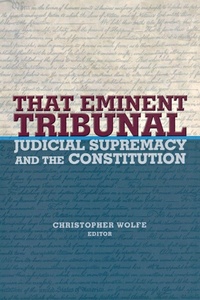
That Eminent Tribunal
Judicial Supremacy and the Constitution
Will be published approx. on 5. September 2004
Book
Paperback/Softback
256 pages
978-0-691-11668-6 (ISBN)
Description
The role of the United States Supreme Court has been deeply controversial throughout American history. Should the Court undertake the task of guarding a wide variety of controversial and often unenumerated rights? Or should it confine itself to enforcing specific constitutional provisions, leaving other issues (even those of rights) to the democratic process? That Eminent Tribunal brings together a distinguished group of legal scholars and political scientists who argue that the Court's power has exceeded its appropriate bounds, and that sound republican principles require greater limits on that power. They reach this conclusion by an interesting variety of paths, and despite varied political convictions. Some of the essays debate the explicit claims to constitutional authority laid out by the Supreme Court itself in Planned Parenthood v. Casey and similar cases, and others focus on the defenses of judicial authority found commonly in legal scholarship (e.g., the allegedly superior moral reasoning of judges, or judges' supposed track record of superior political decision making).
The authors find these arguments wanting and contend that the principles of republicanism and the contemporary form of judicial review exercised by the Supreme Court are fundamentally incompatible. The contributors include Hadley Arkes, Gerard V. Bradley, George Liebmann, Michael McConnell, Robert F. Nagel, Jack Wade Nowlin, Steven D. Smith, Jeremy Waldron, Keith E. Whittington, Christopher Wolfe, and Michael P. Zuckert.
The authors find these arguments wanting and contend that the principles of republicanism and the contemporary form of judicial review exercised by the Supreme Court are fundamentally incompatible. The contributors include Hadley Arkes, Gerard V. Bradley, George Liebmann, Michael McConnell, Robert F. Nagel, Jack Wade Nowlin, Steven D. Smith, Jeremy Waldron, Keith E. Whittington, Christopher Wolfe, and Michael P. Zuckert.
Reviews / Votes
"This is a very impressive collection of essays by a group of scholars who are at, or entering, the peak of their careers - and stars and superstars they are." - James R. Stoner, Jr., Louisiana State University, author of Common-Law Liberty: Rethinking American Constitutionalism; "This is one of the few academic books that leave the reader asking for more rather than less. It is by a group of leading scholars who lament the judicial activism of federal courts over the past half-century, and particularly since Roe v. Wade. The variety and trenchancy of its arguments make it a significant contribution to the scholarly, and popular, debate over judicial power." - Charles R. Kesler, Claremont Institute, Editor of the Claremont Review of Books"More details
Series
Language
English
Place of publication
New Jersey
United States
Target group
Professional and scholarly
College/higher education
Product notice
Paperback (trade)
Dimensions
Height: 234 mm
Width: 156 mm
Thickness: 15 mm
Weight
432 gr
ISBN-13
978-0-691-11668-6 (9780691116686)
Copyright in bibliographic data and cover images is held by Nielsen Book Services Limited or by the publishers or by their respective licensors: all rights reserved.
Schweitzer Classification
Other editions
Additional editions
E-Book
02/2009
1st Edition
Princeton University Press
from
€161.95
Available for download
Person
Christopher Wolfe is Professor of Political Science at Marquette University. He is the author of "How to Interpret the Constitution, Judicial Activism", and "The Rise of Modern Judicial Review".
Content
*FrontMatter, pg. i*Contents, pg. v*Contributors, pg. vii*Introduction, pg. 1*Chapter 1. Is the Constitution Whatever the Winners Say It Is?, pg. 10*Chapter 2. Nationhood and Judicial Supremacy, pg. 20*Chapter 3. "Casey at the Bat"-Taking Another Swing at Planned Parenthood v. Casey, pg. 37*Chapter 4. Antijural Jurisprudence: The Vices of the Judges Enter a New Stage, pg. 59*Chapter 5. Judicial Power and the Withering of Civil Society, pg. 85*Chapter 6. The Academy, the Courts, and the Culture of Rationalism, pg. 97*Chapter 7. Judicial Moral Expertise and Real-World Constraints on Judicial Moral Reasoning, pg. 118*Chapter 8. Toward a More Balanced History of the Supreme Court, pg. 141*Chapter 9. Judicial Review and Republican Government, pg. 159*Chapter 10. The Casey Five versus the Federalism Five: Supreme Legislator or Prudent Umpire?, pg. 181*Chapter 11. The Rehnquist Court and "Conservative Judicial Activism", pg. 199*Index, pg. 225