

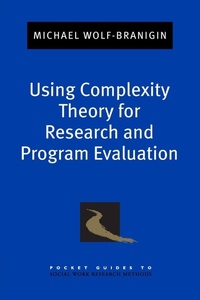
Using Complexity Theory for Research and Program Evaluation
Published on 7. March 2013
Book
Paperback/Softback
212 pages
978-0-19-982946-0 (ISBN)
Description
Complexity as a paradigm has been underutilized by social work, but this cutting-edge pocket guide makes a convincing argument for its use. Every agency worker has been faced with a deluge of records, making it difficult to grasp onto structures and trends undergirding behavior. Complexity theory studies the interactions of competitive and cooperative tendencies of agents such as individuals, families, groups, or communities, making the case that there is a hidden order in things that are seemingly chaotic. Exploring their interactions involves identifying a set of simple rules that the agents follow, revealing patterns that emerge without a predetermined template.
Readers will learn how to frame their research using the components found in complex systems by using their existing knowledge of research methods and applying basic mathematical concepts. Concepts such as bordering between chaos and equilibrium, diverse perspectives, diverse heuristics, robustness, and wisdom of crowds are considered and applied to social work research studies. Basic introductions on game theory, graph theory, Boolean logic, decision theory, and network science provide the necessary mathematical background for understanding interconnectedness and networking.
The next part of the book is a hands-on guide to the agent-based modeling software NetLogo. By inputting initial parameters and rules, the outputted models provide valuable information for visualizing unintended consequences, including how conflict can foster cooperation and how threats to a social network can improve the network's robustness and resiliency. The result is both a user-friendly introduction to using complexity theory in a socio-environmental context and a framework that provides an overarching structure for investigating process, outcomes, and the collective behavior of groups.
Readers will learn how to frame their research using the components found in complex systems by using their existing knowledge of research methods and applying basic mathematical concepts. Concepts such as bordering between chaos and equilibrium, diverse perspectives, diverse heuristics, robustness, and wisdom of crowds are considered and applied to social work research studies. Basic introductions on game theory, graph theory, Boolean logic, decision theory, and network science provide the necessary mathematical background for understanding interconnectedness and networking.
The next part of the book is a hands-on guide to the agent-based modeling software NetLogo. By inputting initial parameters and rules, the outputted models provide valuable information for visualizing unintended consequences, including how conflict can foster cooperation and how threats to a social network can improve the network's robustness and resiliency. The result is both a user-friendly introduction to using complexity theory in a socio-environmental context and a framework that provides an overarching structure for investigating process, outcomes, and the collective behavior of groups.
More details
Series
Language
English
Place of publication
New York
United States
Target group
College/higher education
Professional and scholarly
Illustrations
8 line-cuts and 9 half-tones
Dimensions
Height: 210 mm
Width: 140 mm
Thickness: 12 mm
Weight
268 gr
ISBN-13
978-0-19-982946-0 (9780199829460)
Copyright in bibliographic data and cover images is held by Nielsen Book Services Limited or by the publishers or by their respective licensors: all rights reserved.
Schweitzer Classification
Other editions
Additional editions
Michael Wolf-Branigin
Using Complexity Theory for Research and Program Evaluation
E-Book
01/2013
1st Edition
OUP eBook
€21.99
Available for download
Person
Michael Wolf-Branigin, PhD, is Associate Professor of Social Work at George Mason University.
Content
Preface ; 1. Introduction: The History and Theory of Complexity ; 2. Framing Social Services as Complex Systems ; 3. Research and Evaluation Methods for Complexity ; 4. Shifting from a Metaphorical to a Mathematical Approach ; 5. Social Work Applications of Complexity ; 6. Introduction to Agent-based Modeling ; 7. Developing Agent-based Models ; 8. Concluding Remarks and Proposed Research Agenda ; Appendix A. Code for Example One ; Appendix B. Code for Example Two ; Appendix C. Example of an Agent-Based Model Report ; Appendix D. Additional Resources ; Glossary ; Notes ; References ; Index