

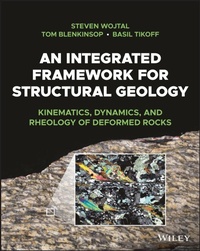
An Integrated Framework for Structural Geology
Kinematics, Dynamics, and Rheology of Deformed Rocks
1st Edition
Published on 30. June 2022
Book
Paperback/Softback
576 pages
978-1-4051-0684-9 (ISBN)
Description
A modern and practice-oriented approach to structural geology
In Structural Geology An Integrated Framework: Kinematics, Dynamics, and Rheology of Deformed Rocks, three experienced geologists deliver a comprehensive exploration of the core principles of rock deformation. The text offers a quantitative foundation for three-dimensional rock geometry, its kinematic evolution, deformation dynamics, and explains the rheology of geological materials.
The authors have been careful to separate observations from the inferences drawn based on those observations and follow the scientific methodology used by practitioners of structural geology. They've also included two, fully worked out practical examples of structural geology field observation and laboratory analysis, as well as hundreds of detailed, two-color illustrations including many microstructural photographs.
Readers will also find:
A thorough introduction to structural geology, including empirical and theoretical approaches, as well as continuum mechanics and its applications to structural geology
In-depth treatments of structures produced by deformation, microstructures, and displacements
Comprehensive explorations of strain, stress, and deformation mechanisms
Illuminating case studies of rock deformation and rheology
Written for graduate and advanced undergraduate students in geology, Structural Geology An Integrated Framework will also earn a place in the libraries of practicing geologists with an interest in a one-stop resource on structural geology.
In Structural Geology An Integrated Framework: Kinematics, Dynamics, and Rheology of Deformed Rocks, three experienced geologists deliver a comprehensive exploration of the core principles of rock deformation. The text offers a quantitative foundation for three-dimensional rock geometry, its kinematic evolution, deformation dynamics, and explains the rheology of geological materials.
The authors have been careful to separate observations from the inferences drawn based on those observations and follow the scientific methodology used by practitioners of structural geology. They've also included two, fully worked out practical examples of structural geology field observation and laboratory analysis, as well as hundreds of detailed, two-color illustrations including many microstructural photographs.
Readers will also find:
A thorough introduction to structural geology, including empirical and theoretical approaches, as well as continuum mechanics and its applications to structural geology
In-depth treatments of structures produced by deformation, microstructures, and displacements
Comprehensive explorations of strain, stress, and deformation mechanisms
Illuminating case studies of rock deformation and rheology
Written for graduate and advanced undergraduate students in geology, Structural Geology An Integrated Framework will also earn a place in the libraries of practicing geologists with an interest in a one-stop resource on structural geology.
More details
Language
English
Place of publication
Chicester
United Kingdom
Publishing group
John Wiley and Sons Ltd
Target group
College/higher education
Professional and scholarly
Dimensions
Height: 233 mm
Width: 186 mm
Thickness: 31 mm
Weight
1214 gr
ISBN-13
978-1-4051-0684-9 (9781405106849)
Copyright in bibliographic data is held by Nielsen Book Services Limited or its licensors: all rights reserved.
Schweitzer Classification
Other editions
Additional editions
Steven Wojtal | Tom Blenkinsop | Basil Tikoff
An Integrated Framework for Structural Geology
Kinematics, Dynamics, and Rheology of Deformed Rocks
E-Book
06/2022
1st Edition
Wiley
€39.99
Available for download
Steven Wojtal | Tom Blenkinsop | Basil Tikoff
An Integrated Framework for Structural Geology
Kinematics, Dynamics, and Rheology of Deformed Rocks
E-Book
06/2022
1st Edition
Wiley
€39.99
Available for download
Persons
Steven Wojtal is Professor of Geology at Oberlin College in Oberlin, Ohio, United States.
Tom Blenkinsop is Professor in Earth Science at Cardiff University, United Kingdom.
Basil Tikoff is Professor in Geoscience at the University of Wisconsin, United States.
Tom Blenkinsop is Professor in Earth Science at Cardiff University, United Kingdom.
Basil Tikoff is Professor in Geoscience at the University of Wisconsin, United States.
Content
1. Introduction
1.1 Deformation
1.2 Empirical vs. Theoretical Approaches
1.3 Continuum Mechanics and Its Applicability to Structural Geology
1.4 How to Use This Book
2. Structures Produced by Deformation
2.1 Geological Structures
2.2 Additional Considerations
3. Microstructures
3.1 Introduction
3.2 Fractures
3.3 Fault Rocks
3.4 Overgrowths, Pressure Shadows and Fringes, and Veins
3.5 Indenting, Truncating and Interpenetrating Grain Contacts, Strain Caps, and Stylolites
3.6 Aligned Grain Boundaries, T Grain Boundaries, and Foam Texture
3.7 Undulose Extinction, Subgrains, Deformation and Kink Bands, Deformation Lamellae, Grain Boundary Bulges, Core-and-Mantle Microstructure
3.8 Deformation Twins
3.9 Grain Shape Fabrics, Ribbon Grains, and Gneissic Banding
3.10 Porphyroblasts
3.11 Crystallographic Fabrics (Crystallographic Preferred Orientations)
3.12 Shear Sense Indicators, Mylonites, and Porphyroclasts
3.13. Collecting Orientated Samples and Relating Sample to Geographic Frames of Reference
4 Displacements
4.1 Overview
4.2 Chapter Organization
4.3 Displacements: Conceptual Foundation
- Specifying Displacements for Individual Particles
- Particle Paths and Velocities
- Displacements of Collections of Particles A Displacement Fields
- Components of Displacement Fields: Translation, Rotation, & Pure Strain
- Idealized, Two-Dimensional Displacement Fields
- Idealized, Three-Dimensional Displacement Fields
- Summary
4.4 Displacements: Comprehensive Treatment
- Specifying Displacements for Individual Particles
- Particle Paths and Velocities
- Displacements of Collections of Particles A Displacement Fields
- The Displacement Gradient Tensor A Relating Position and Displacement Vectors
- Idealized, Two-Dimensional Displacement Fields
- Idealized, Three-Dimensional Displacement Fields
- Summary
5 Strain
5.1. Overview
5.2 Chapter Organization
5.3 Strain: Conceptual Foundation
- Specifying Strain in Deformed Rocks
- One-Dimensional Manifestations of Strain
- Two-Dimensional Manifestations of Strain
- Relating Strain to Displacements
- Homogeneous and Inhomogeneous Strain
- Finite Strain Ellipse and Finite Strain Ellipsoid
- States of Strain and Strain Paths
- Instantaneous Strains and Strain Rates
- Infinitesimal Strains
- Summary
- Practical Methods for Measuring Strain
5.4 Strain: Comprehensive Treatment
- Relating Strain to Displacements
- Homogeneous and Inhomogeneous Deformation
- Finite Strain Ellipse and Finite Strain Ellipsoid
- States of Strain and Strain Paths
- Vorticity
- Summary
6. Stress
6.1 Overview
6.2 Stress: Conceptual Foundation
- Forces, Tractions, and Stress
- Characteristics of Stress in Two Dimensions
- State of Stress in Two Dimensions
- Stress in Three Dimensions
- Pore-Fluid Pressure and Effective Stress
- Three-Dimensional States of Stress
- The State of Stress in Earth
- Change of Stress: Paleostress, Path, and History
- Comparison of Displacements, Strain and Stress
- Summary
- Practical Methods for Measuring Stress
6.4 Stress: Comprehensive Treatment
- Force, Traction, and Stress Vectors
7. Rheology
7.1 Overview
7.2 Rheology: Conceptual Foundations
- Moving Beyond Equilibrium
- Models of Rock Deformation
- Summary
7.3 Rheology: Comprehensive Treatment
- Combining Deformation Models to Describe Rock Properties
- Rock Deformation Modes
8. Deformation Mechanisms
8.1 Overview
8.2 Deformation Mechanisms: Conceptual Foundations
- Elastic Distortion
- Cataclastic Deformation Mechanisms
- Diffusional Deformation Mechanisms
- Dislocational Deformation Mechanisms
- Diffusion- and/or Dislocation-Accommodated Grain Boundary Sliding
- Deformation Mechanism Maps
- Summary
8.3 Deformation Mechanisms: Comprehensive Treatment
- Cataclastic Deformation Mechanisms
- Diffusional Deformation Mechanisms
- Dislocational Deformation Mechanisms
- Grain Boundary Sliding and Superplasticity
9. Case Studies of Deformation and Rheology
9.1 Overview
9.2 Integrating Structural Geology and Geochronology: Ruby Gap Duplex, Redbank Thrust Zone, Australia
9.3 The Interplay of Deformation Mechanisms and Rheologies in the Mid-Crust: Copper Creek Thrust Sheet, Appalachian Valley and Ridge, Tennessee, USA
9.4 Induced Seismicity
9.5 Using Case Studies to Assess Lithospheric Strength Profiles
9.6 Broader Horizons
1.1 Deformation
1.2 Empirical vs. Theoretical Approaches
1.3 Continuum Mechanics and Its Applicability to Structural Geology
1.4 How to Use This Book
2. Structures Produced by Deformation
2.1 Geological Structures
2.2 Additional Considerations
3. Microstructures
3.1 Introduction
3.2 Fractures
3.3 Fault Rocks
3.4 Overgrowths, Pressure Shadows and Fringes, and Veins
3.5 Indenting, Truncating and Interpenetrating Grain Contacts, Strain Caps, and Stylolites
3.6 Aligned Grain Boundaries, T Grain Boundaries, and Foam Texture
3.7 Undulose Extinction, Subgrains, Deformation and Kink Bands, Deformation Lamellae, Grain Boundary Bulges, Core-and-Mantle Microstructure
3.8 Deformation Twins
3.9 Grain Shape Fabrics, Ribbon Grains, and Gneissic Banding
3.10 Porphyroblasts
3.11 Crystallographic Fabrics (Crystallographic Preferred Orientations)
3.12 Shear Sense Indicators, Mylonites, and Porphyroclasts
3.13. Collecting Orientated Samples and Relating Sample to Geographic Frames of Reference
4 Displacements
4.1 Overview
4.2 Chapter Organization
4.3 Displacements: Conceptual Foundation
- Specifying Displacements for Individual Particles
- Particle Paths and Velocities
- Displacements of Collections of Particles A Displacement Fields
- Components of Displacement Fields: Translation, Rotation, & Pure Strain
- Idealized, Two-Dimensional Displacement Fields
- Idealized, Three-Dimensional Displacement Fields
- Summary
4.4 Displacements: Comprehensive Treatment
- Specifying Displacements for Individual Particles
- Particle Paths and Velocities
- Displacements of Collections of Particles A Displacement Fields
- The Displacement Gradient Tensor A Relating Position and Displacement Vectors
- Idealized, Two-Dimensional Displacement Fields
- Idealized, Three-Dimensional Displacement Fields
- Summary
5 Strain
5.1. Overview
5.2 Chapter Organization
5.3 Strain: Conceptual Foundation
- Specifying Strain in Deformed Rocks
- One-Dimensional Manifestations of Strain
- Two-Dimensional Manifestations of Strain
- Relating Strain to Displacements
- Homogeneous and Inhomogeneous Strain
- Finite Strain Ellipse and Finite Strain Ellipsoid
- States of Strain and Strain Paths
- Instantaneous Strains and Strain Rates
- Infinitesimal Strains
- Summary
- Practical Methods for Measuring Strain
5.4 Strain: Comprehensive Treatment
- Relating Strain to Displacements
- Homogeneous and Inhomogeneous Deformation
- Finite Strain Ellipse and Finite Strain Ellipsoid
- States of Strain and Strain Paths
- Vorticity
- Summary
6. Stress
6.1 Overview
6.2 Stress: Conceptual Foundation
- Forces, Tractions, and Stress
- Characteristics of Stress in Two Dimensions
- State of Stress in Two Dimensions
- Stress in Three Dimensions
- Pore-Fluid Pressure and Effective Stress
- Three-Dimensional States of Stress
- The State of Stress in Earth
- Change of Stress: Paleostress, Path, and History
- Comparison of Displacements, Strain and Stress
- Summary
- Practical Methods for Measuring Stress
6.4 Stress: Comprehensive Treatment
- Force, Traction, and Stress Vectors
7. Rheology
7.1 Overview
7.2 Rheology: Conceptual Foundations
- Moving Beyond Equilibrium
- Models of Rock Deformation
- Summary
7.3 Rheology: Comprehensive Treatment
- Combining Deformation Models to Describe Rock Properties
- Rock Deformation Modes
8. Deformation Mechanisms
8.1 Overview
8.2 Deformation Mechanisms: Conceptual Foundations
- Elastic Distortion
- Cataclastic Deformation Mechanisms
- Diffusional Deformation Mechanisms
- Dislocational Deformation Mechanisms
- Diffusion- and/or Dislocation-Accommodated Grain Boundary Sliding
- Deformation Mechanism Maps
- Summary
8.3 Deformation Mechanisms: Comprehensive Treatment
- Cataclastic Deformation Mechanisms
- Diffusional Deformation Mechanisms
- Dislocational Deformation Mechanisms
- Grain Boundary Sliding and Superplasticity
9. Case Studies of Deformation and Rheology
9.1 Overview
9.2 Integrating Structural Geology and Geochronology: Ruby Gap Duplex, Redbank Thrust Zone, Australia
9.3 The Interplay of Deformation Mechanisms and Rheologies in the Mid-Crust: Copper Creek Thrust Sheet, Appalachian Valley and Ridge, Tennessee, USA
9.4 Induced Seismicity
9.5 Using Case Studies to Assess Lithospheric Strength Profiles
9.6 Broader Horizons