

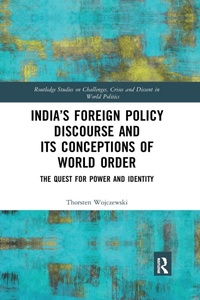
India's Foreign Policy Discourse and its Conceptions of World Order
The Quest for Power and Identity
1st Edition
Published on 14. August 2020
Book
Paperback/Softback
222 pages
978-0-367-58945-5 (ISBN)
Description
Given India's growing power and aspirations in world politics, there has been increasing interest among practitioners and scholars of international relations (IR) in how India views the world.
This book offers the first systematic investigation of the world order models in India's foreign policy discourse. By examining how the signifier 'world order' is endowed with meaning in the discourse, it moves beyond Western-centric IR and sheds light on how a state located outside the Western 'core' conceptualizes world order. Drawing on poststructuralism and discourse theory, the book proposes a novel analytical framework for studying foreign policy discourses and understanding the changes and continuities in India's post-cold war foreign policy. It shows that foreign policy and world order have been crucial sites for the (re)production of India's identity by drawing a political frontier between the Self and a set of Others and placing India into a system of differences that constitutes 'what India is'.
This text will be of key interest to scholars and students of Indian foreign policy, foreign policy analysis, South Asian studies, IR and IR theory, international political thought and global order studies.
This book offers the first systematic investigation of the world order models in India's foreign policy discourse. By examining how the signifier 'world order' is endowed with meaning in the discourse, it moves beyond Western-centric IR and sheds light on how a state located outside the Western 'core' conceptualizes world order. Drawing on poststructuralism and discourse theory, the book proposes a novel analytical framework for studying foreign policy discourses and understanding the changes and continuities in India's post-cold war foreign policy. It shows that foreign policy and world order have been crucial sites for the (re)production of India's identity by drawing a political frontier between the Self and a set of Others and placing India into a system of differences that constitutes 'what India is'.
This text will be of key interest to scholars and students of Indian foreign policy, foreign policy analysis, South Asian studies, IR and IR theory, international political thought and global order studies.
More details
Series
Language
English
Place of publication
London
United Kingdom
Publishing group
Taylor & Francis Ltd
Target group
College/higher education
Postgraduate and Undergraduate
Dimensions
Height: 234 mm
Width: 156 mm
Thickness: 13 mm
Weight
357 gr
ISBN-13
978-0-367-58945-5 (9780367589455)
Copyright in bibliographic data and cover images is held by Nielsen Book Services Limited or by the publishers or by their respective licensors: all rights reserved.
Schweitzer Classification
Other editions
Additional editions
Thorsten Wojczewski
India's Foreign Policy Discourse and its Conceptions of World Order
The Quest for Power and Identity
Book
06/2018
1st Edition
Routledge
€215.41
Shipment within 10-20 days
Thorsten Wojczewski
India's Foreign Policy Discourse and its Conceptions of World Order
The Quest for Power and Identity
E-Book
06/2018
1st Edition
Routledge
€59.49
Available for download
Thorsten Wojczewski
India's Foreign Policy Discourse and its Conceptions of World Order
The Quest for Power and Identity
E-Book
06/2018
1st Edition
Routledge
€59.49
Available for download
Person
Thorsten Wojczewski is a Teaching Fellow and Postdoctoral Researcher at the India Institute, King's College London, UK.
Content
1. Introduction 2. Discourse, Foreign Policy and Identity 3. Global Power Shifts and World Order: The Contestation of 'Western' Discursive Hegemony 4. The Evolution and Dislocation of the Nehruvian Foreign Policy Discourse 5. Post-Nehruvianism: India's Hegemonic Foreign Policy Discourse in the Post-Cold War Era 6. The Hyper-Nationalist Discourse: Making India Strong 7. Conclusion