

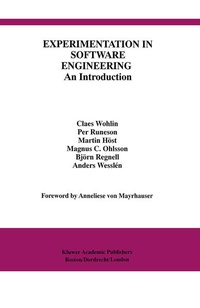
Experimentation in Software Engineering
An Introduction
Published on 28. October 2012
Book
Paperback/Softback
XX, 204 pages
978-1-4613-7091-8 (ISBN)
Description
It is my belief that software engineers not only need to know software engineering methods and processes, but that they also should know how to assess them. Conse quently, I have taught principles of experimentation and empirical studies as part of the software engineering curriculum. Until now, this meant selecting a text from another discipline, usually psychology, and augmenting it with journal or confer ence papers that provide students with software engineering examples of experi ments and empirical studies. This book fills an important gap in the software engineering literature: it pro vides a concise, comprehensive look at an important aspect of software engineer ing: experimental analysis of how well software engineering methods, methodologies, and processes work. Since all of these change so rapidly in our field, it is important to know how to evaluate new ones. This book teaches how to go about doing this and thus is valuable not only for the software engineering stu dent, but also for the practicing software engineering professional who will be able to Evaluate software engineering techniques. Determine the value (or lack thereof) of claims made about a software engineer ing method or process in published studies. Finally, this book serves as a valuable resource for the software engineering researcher.
Reviews / Votes
` This is a well written and concise book, which provides the reader with the essentials necessary to design, conduct and analyse a software engineering experiment. Its value lies in that it is specifically written for the software engineering field, and has surveyed the major contributions by a number of leading researchers in this area. A `how to' book is always welcome, both as a useful starting point to the inexperienced and as a helpful reference and reminder of best practice to others. 'Software Testing Verification and Reliability, 11 (2001)
More details
Series
Edition
Softcover reprint of the original 1st ed. 2000
Language
English
Place of publication
New York
United States
Target group
Professional and scholarly
Research
Illustrations
XX, 204 p.
Dimensions
Height: 235 mm
Width: 155 mm
Thickness: 13 mm
Weight
353 gr
ISBN-13
978-1-4613-7091-8 (9781461370918)
DOI
10.1007/978-1-4615-4625-2
Schweitzer Classification
Other editions
Additional editions
Claes Wohlin | Per Runeson | Martin Höst
Experimentation in Software Engineering: An Introduction
An Introduction
Book
12/1999
1st Edition
Kluwer Academic Publishers
€96.00
Article exhausted; check different version
Persons
CLAES WOHLIN is Professor Emeritus of software engineering at Blekinge Institute of Technology. He has been conducting empirical research, together with his PhD students, with industrial partners for 35 years. His research focuses on empirical methods in software engineering, software processes and software quality. He served as Editor-in-Chief for the Journal of Information and Software Technology for 14 years. In 2011, he was elected as a member of the Royal Swedish Academy of Engineering Sciences.
PER RUNESON is a professor of software engineering at Lund University. He has more than 25 years of experience in conducting empirical research with PhD students, and leading industry-academia collaboration programs, aiming to understand and improve practice. His research interests embrace cross-disciplinary approaches and include empirical studies on software testing and ecosystems for open data and software, in industrial software and AI engineering. He has advanced the research field through methodology guidebooks on experimentation and case studies.
MARTIN HÖST is a professor of software engineering at Malmö University, where he is dean of the Faculty of Technology and Society. He has about 30 years of experience in empirical research in software engineering, often conducted in collaboration with industry. His research interests include software quality and open source software, as well as empirical research methods in software engineering research.
MAGNUS C. OHLSSON has focused on the development and quality assurance of software for almost 25 years, and today, he is a Quality Strategist and Evangelist at System Verification, specialising in process improvement. He has experience in several different technical areas such as embedded systems, medical devices, mobile network signalling and ERP systems. He is also an appreciated lecturer at different universities and when providing presentations at various conferences.
BJÖRN REGNELL is Professor of software engineering at Lund University. He has over 30 years of experience in software engineering with focus on empirical research in software requirements engineering. He served as Vice Dean of Research at the Faculty of Engineering with focus on quality of graduate level education. He is a member of the editorial board of the Requirements Engineering journal (Springer-Nature). He is also engaged in the governing committee of the Scala open-source programming language.
ANDERS WESSLÉN is an expert at Ericsson in Lund. He has more than 20 years of experience working with system development for both mobile phones and radio base stations. His focus is system-wide architectures and future computing platforms.
Content
1 Introduction.- 1.1 Software engineering context.- 1.2 Science and software engineering.- 2 Empirical strategies.- 2.1 Overview of empirical strategies.- 2.2 Surveys.- 2.3 Case studies.- 2.4 Experiments.- 2.5 Empirical strategies comparison.- 2.6 Empiricism in a software engineering context.- 3 Measurement.- 3.1 Basic concepts.- 3.2 Measurements in software engineering.- 4 Experiment process.- 4.1 Variables, treatments, objects and subjects.- 4.2 Process.- 5 Definition.- 5.1 Define experiment.- 5.2 Example.- 5.3 Summary.- 6 Planning.- 6.1 Context selection.- 6.2 Hypothesis formulation.- 6.3 Variables selection.- 6.4 Selection of subjects.- 6.5 Experiment design.- 6.6 Instrumentation.- 6.7 Validity evaluation.- 6.8 Detailed description of validity threats.- 6.9 Priority among types of validity threats.- 7 Operation.- 7.1 Preparation.- 7.2 Execution.- 7.3 Data validation.- 8 Analysis and interpretation.- 8.1 Descriptive statistics.- 8.2 Data set reduction.- 8.3 Hypothesis testing.- 9 Presentation and package.- 9.1 An experiment report outline.- 10 Literature survey.- 10.1 Inspection experiments.- 10.2 Other experiments in Software Engineering.- 10.3 Resources.- 11 Example: Experiment process.- 11.1 Definition.- 11.2 Planning.- 11.3 Operation.- 11.4 Analysis and interpretation.- 11.5 Summary and conclusions.- 12 Example: C versus C++.- 12.1 Introduction and problem statement.- 12.2 Experiment planning.- 12.3 Analysis and interpretation.- 12.4 Conclusions and further work.- 13 Exercises.- 13.1 Understanding.- 13.2 Training.- 13.3 Reviewing.- 13.4 Assignments.- Appendix A: Statistical tables.- Appendix B: Experiment process overview.- References.- About the authors.