

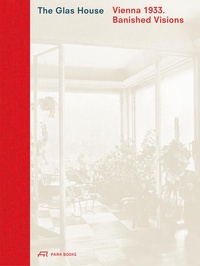
The Glas House
Description
In 1933, when Hans Glas designed the villa for physicians Annie and Philipp Rezek on Wilbrandtgasse in Vienna, in the Austrian capital's 18th district, it was one of the city's most visionary buildings of its kind. The "Glas House," as the Rezek family called their home, is a quintessential example of modern architecture and the associated philosophy of living in 1930s Vienna. Viennese architect Hans Glas (1892-1969), a student of Adolf Loos, has today largely fallen into oblivion in Austria.
This book describes the Villa Rezek in detail, illustrated with numerous historical and new photographs by Stefan Oláh, plans, and historic documents. It also sheds light on entirely novel aspects of Vienna's architectural history of the 1930s and tells the stories of both the architect and his clients, all of whom were forced to emigrate due to their Jewish heritage following the annexation of Austria by Nazi Germany in 1938.
The Rezek family fled to the US. Hans Glas went to Calcutta, where he was able to successfully continue his career as an architect. Forced emigrations like these not only implied human tragedies. 1938 also brought an abrupt end to the flourishing of Vienna's modern architecture and living culture. Yet Glas's ideas and design principles are more relevant today than ever.
More details
Persons
Caroline Wohlgemuth lebt und arbeitet als Autorin in Wien. In ihren Publikationen und Vorträgen geht es um die Lebensgeschichten vertriebener und vergessener Künstler:innen, Architekt:innen und Designer:innen sowie um Flucht, Vertreibung und Exil in der Kunst, der Architektur und im Design.
Maximilian Eisenköck arbeitet als freischaffender Architekt in Wien. Neben aussergewöhnlichen Neubauten liegt ein Schwerpunkt seiner Tätigkeit auf dem Erhalt und der Sanierung von Bauwerken des 20. Jahrhunderts, darunter die Villa Rezek von 1933 in Wien.
Stefan Oláh arbeitet als Fotograf in Wien und am Attersee. Er konzipiert und fotografiert Bildserien für verschiedenste Kunst-, Kultur- und Wissenschafts-Institutionen. Ausserdem widmet er sich an der Schnittstelle von Kunst, Design, Architektur und Zeitgeschichte der Abbildung von unterschiedlichen Architektur-, Lebens- und Kulturräumen.