

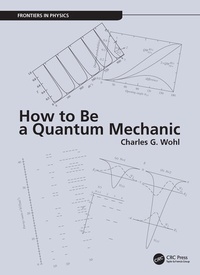
How to Be a Quantum Mechanic
1st Edition
Published on 25. October 2022
Book
Hardback
396 pages
978-1-032-25603-0 (ISBN)
Description
How to Be a Quantum Mechanic is an introduction to quantum mechanics at the upper-division level. It begins with wave-particle duality and ends with a brief introduction to the Dirac equation. Two attitudes went into its writing: Examples are the best way to get into a subject, and numbers and equations alone do not always sum to understanding. The author taught for 40 years at the University of California, Berkeley. He earned his Ph.D. at Berkeley, in experimental elementary-particle physics in the group led by Luis Alvarez.
More details
Series
Language
English
Place of publication
London
United Kingdom
Publishing group
Taylor & Francis Ltd
Target group
College/higher education
Undergraduate Advanced
Product notice
sewn/stitched
Cloth over boards
Illustrations
131 s/w Abbildungen, 131 s/w Zeichnungen, 24 s/w Tabellen
24 Tables, black and white; 131 Line drawings, black and white; 131 Illustrations, black and white
Dimensions
Height: 279 mm
Width: 216 mm
Weight
2060 gr
ISBN-13
978-1-032-25603-0 (9781032256030)
Copyright in bibliographic data and cover images is held by Nielsen Book Services Limited or by the publishers or by their respective licensors: all rights reserved.
Schweitzer Classification
Other editions
Additional editions
Charles G. Wohl
How to Be a Quantum Mechanic
E-Book
10/2022
1st Edition
CRC Press
€64.49
Available for download
Charles G. Wohl
How to Be a Quantum Mechanic
Book
10/2022
1st Edition
CRC Press
€70.10
Shipment within 10-20 days
Person
Charles G. Wohl taught for 40 years at the University of California, Berkeley. He earned his Ph.D. at Berkeley, in experimental elementary-particle physics in the group led by Luis Alvarez.
Content
1. Strangest things 2. The Schrodinger Equation. Bound States 3. Simple Approximations for Bound States 4. Scattering in One Dimension 5. Mathematical Formalism 6. The Harmonic Oscillator 7. Uncertainty Relations. Simultaneous Eigenstates 8. Angular Momentum 9. Hydrogen. The Isotropic Oscillator 10. Spin 1/2 Particles 11. Hyperfine Splitting. Two Angular Momenta. Isospin 12. Cryptography. The EPR Argument. Bell's Inequality 13. Time-Independent Perturbation Theory 14. Identical Particles 15. Time-Dependent Perturbations. Planck and Einstein 16. Scattering in Three Dimensions 17. The Dirac Equation