

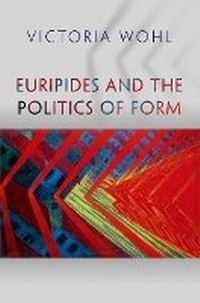
Euripides and the Politics of Form
Published on 30. June 2015
Book
Hardback
224 pages
978-0-691-16650-6 (ISBN)
Description
How can we make sense of the innovative structure of Euripidean drama? And what political role did tragedy play in the democracy of classical Athens? These questions are usually considered to be mutually exclusive, but this book shows that they can only be properly answered together. Providing a new approach to the aesthetics and politics of Greek tragedy, Victoria Wohl argues that the poetic form of Euripides' drama constitutes a mode of political thought. Through readings of select plays, she explores the politics of Euripides' radical aesthetics, showing how formal innovation generates political passions with real-world consequences. Euripides' plays have long perplexed readers. With their disjointed plots, comic touches, and frequent happy endings, they seem to stretch the boundaries of tragedy. But the plays' formal traits--from their exorbitantly beautiful lyrics to their arousal and resolution of suspense--shape the audience's political sensibilities and ideological attachments. Engendering civic passions, the plays enact as well as express political ideas.
Wohl draws out the political implications of Euripidean aesthetics by exploring such topics as narrative and ideological desire, the politics of pathos, realism and its utopian possibilities, the logic of political allegory, and tragedy's relation to its historical moment. Breaking through the impasse between formalist and historicist interpretations of Greek tragedy, Euripides and the Politics of Form demonstrates that aesthetic structure and political meaning are mutually implicated--and that to read the plays poetically is necessarily to read them politically.
Wohl draws out the political implications of Euripidean aesthetics by exploring such topics as narrative and ideological desire, the politics of pathos, realism and its utopian possibilities, the logic of political allegory, and tragedy's relation to its historical moment. Breaking through the impasse between formalist and historicist interpretations of Greek tragedy, Euripides and the Politics of Form demonstrates that aesthetic structure and political meaning are mutually implicated--and that to read the plays poetically is necessarily to read them politically.
Reviews / Votes
"Wohl is a careful reader of Euripides and she advances cogent observations and arguments, many about more than just the formal aspects of his plays."--Choice "An important and thoughtful analysis of the relationship between politics and aesthetic form in a select number of Euripidean plays... An insightful study that is accessible to students and rewarding for scholars. It makes a major contribution to the study of Euripidean drama and offers a productive model for rethinking how tragedy worked through aesthetic form."--David Kawalko Roselli, Bryn Mawr Classical ReviewMore details
Series
Language
English
Place of publication
New Jersey
United States
Target group
College/higher education
Professional and scholarly
Product notice
Trade binding
Dimensions
Height: 235 mm
Width: 152 mm
Weight
510 gr
ISBN-13
978-0-691-16650-6 (9780691166506)
Copyright in bibliographic data and cover images is held by Nielsen Book Services Limited or by the publishers or by their respective licensors: all rights reserved.
Schweitzer Classification
Other editions
Additional editions
Victoria Wohl
Euripides and the Politics of Form
E-Book
07/2015
1st Edition
Princeton University Press
from
€133.95
Available for download
Person
Victoria Wohl is professor of classics at the University of Toronto. She is the author of Intimate Commerce: Exchange, Gender, and Subjectivity in Greek Tragedy, Love among the Ruins: The Erotics of Democracy in Classical Athens (Princeton), and Law's Cosmos: Juridical Discourse in Athenian Forensic Oratory. She is also the editor of Probabilities, Hypotheticals, and Counterfactuals in Ancient Greek Thought.
Content
Preface ix Acknowledgments xv Introduction. The Politics of Form 1 Chapter 1. Dramatic Means and Ideological Ends 19 Chapter 2. Beautiful Tears 39 Chapter 3. Recognition and Realism 63 Chapter 4. The Politics of Political Allegory 89 Chapter 5. Broken Plays for a Broken World 110 Conclusion. Content of the Form 132 Notes 143 Bibliography 171 Index 193