

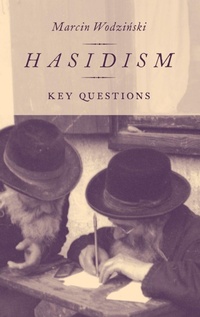
Hasidism
Key Questions
Published on 12. July 2018
Book
Hardback
368 pages
978-0-19-063126-0 (ISBN)
Description
Hasidism is one of the most important religious and social movements to have developed in Eastern Europe, and the most significant phenomenon in the religious, social and cultural life of the Jewish population in Eastern Europe from the eighteenth century up to the present day. Innovative and multidisciplinary in its approach, Hasidism: Key Questions discusses the most cardinal features of any social or religious movement: definition, gender, leadership, demographic size, geography, economy, and decline. This is the first attempt to respond those central questions in one book.
Recognizing the major limitations of the existing research on Hasidism, Marcin Wodzinski's Hasidism offers four important corrections. First, it offers anti-elitist corrective attempting to investigate Hasidism beyond its leaders into the masses of the rank-and-file followers. Second, it introduces new types of sources, rarely or never used in research on Hasidism, including archival documents, Jewish memorial books, petitionary notes, quantitative and visual materials. Third, it covers the whole classic period of Hasidism from its institutional maturation at the end of the eighteenth century to its major crisis and decline in wake of the First World War. Finally, instead of focusing on intellectual history, the book offers a multi-disciplinary approach with the modern methodologies of the corresponding disciplines: sociology and anthropology of religion, demography, historical geography and more.
By combining some oldest, central questions with radically new sources, perspectives, and methodologies, Hasidism: Key Questions will provide a radically new look at many central issues in historiography of Hasidism, one of the most important religious movements of modern Eastern Europe.
Recognizing the major limitations of the existing research on Hasidism, Marcin Wodzinski's Hasidism offers four important corrections. First, it offers anti-elitist corrective attempting to investigate Hasidism beyond its leaders into the masses of the rank-and-file followers. Second, it introduces new types of sources, rarely or never used in research on Hasidism, including archival documents, Jewish memorial books, petitionary notes, quantitative and visual materials. Third, it covers the whole classic period of Hasidism from its institutional maturation at the end of the eighteenth century to its major crisis and decline in wake of the First World War. Finally, instead of focusing on intellectual history, the book offers a multi-disciplinary approach with the modern methodologies of the corresponding disciplines: sociology and anthropology of religion, demography, historical geography and more.
By combining some oldest, central questions with radically new sources, perspectives, and methodologies, Hasidism: Key Questions will provide a radically new look at many central issues in historiography of Hasidism, one of the most important religious movements of modern Eastern Europe.
Reviews / Votes
This is an excellent and comprehensive teaching tool for Jewish studies and religion programs ... Highly recommended. * S. T. Katz, CHOICE * Overall, it is a work that can be read without special knowledge of Judaism. Whoever deals with the Jewish history of Central and Eastern Europe should not only read it, but read it - since it is not only methodologically innovative, but also calls for a number of new perspectives to be discussed. * Susanne Talabardon, University of Bamberg, Sehepunkte * A path-breaking and extremely important volume. * H-Judaic * In Key Questions, Wodzinski presents us with a highly reflective and methodical application of the tools of social history to Hasidism, primarily in its "golden era" of the 19th century * Zvi Leshem, Tradition * Wodzinski asks seven questions that challenge the conventional images and notions of what Hasidism is. Drawing on a fresh behavioral perspective, an unprecedented range of sources, and established quantitative and social science methods, he fractures the 'founding stereotypes' of Hasidic scholarship, creating a whole new framework for understanding this legendary and influential religious movement. * Moshe Rosman, Bar Ilan University * Marcin Wodzinski is one of the most incisive scholars of Hasidism, especially in the nineteenth century. His books on Hasidism and Haskalah and on Hasidism and Politics have become essential texts. This important new volume addresses some of the key questions about Hasidism in its golden age: its definition, the role of women, the figure of the tsaddik, the Hasidic economy, and more. * David Biale, lead author of Hasidism: A New History * Marcin Wodzinski's book insightfully addresses a series of neglected topics in Hasidism, dealing with subjects that are more mundane, concrete, and at the same time central to the daily life of the various Hasidic denominations. Unlike the more conceptually-oriented approach, which prefers to focus on spiritual life, and the historical one, which is more oriented to major events that shaped Hasidism, this book offers a fresh approach to neglected aspects such as economics, the vicissitudes of history during WWI, and the self-identity of both men and women in Hasidism. * Moshe Idel, author of Hasidism: Between Ecstasy and Magic *More details
Language
English
Place of publication
New York
United States
Target group
Professional and scholarly
Dimensions
Height: 240 mm
Width: 161 mm
Thickness: 26 mm
Weight
787 gr
ISBN-13
978-0-19-063126-0 (9780190631260)
Copyright in bibliographic data and cover images is held by Nielsen Book Services Limited or by the publishers or by their respective licensors: all rights reserved.
Schweitzer Classification
Other editions
Person
Marcin Wodzinski is professor of Jewish history and literature at the University of Wroclaw, Poland. His special fields of interest are Jewish material culture and the social history of Jews in nineteenth-century Eastern Europe, especially the history of Hasidism and Haskalah. His books include: Hebrew Inscriptions in Silesia 13th-18th c. (Pol., 1996), Haskalah and Hasidism (2005), Hasidism and Politics (2013), and Historical Atlas of Hasidism (2018).
Content
Acknowledgments
Note on Transcription and Place Names
Introduction
Chapter 1: A Definition
Chapter 2: Women
Chapter 3: Leadership
Chapter 4: Demography
Chapter 5: Geography
Chapter 6: Economy
Chapter 7: The End and the Beginning
Conclusion
Bibliography
List of Figures and Tables
Index
Note on Transcription and Place Names
Introduction
Chapter 1: A Definition
Chapter 2: Women
Chapter 3: Leadership
Chapter 4: Demography
Chapter 5: Geography
Chapter 6: Economy
Chapter 7: The End and the Beginning
Conclusion
Bibliography
List of Figures and Tables
Index