

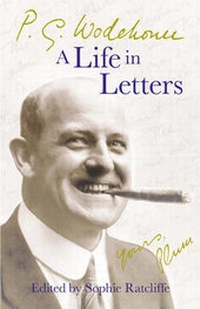
P.G. Wodehouse: A Life in Letters
Published on 3. November 2011
Book
Hardback
624 pages
978-0-09-179634-1 (ISBN)
Description
This is the definitive edition of P.G. Wodehouse's letters, edited with a commentary by Oxford academic Sophie Ratcliffe.
One of the funniest and most admired writers of the twentieth century, P. G. Wodehouse always shied away from the idea of a biography. A quiet, retiring man, he expressed himself through the written word. His letters - collected and expertly edited here - provide an illuminating biographical accompaniment to legendary comic creations such as Jeeves, Bertie Wooster, Psmith and the Empress of Blandings.
Drawing on hitherto unpublished sources, these letters give an unrivalled insight into Wodehouse, covering his schooldays at Dulwich College, the family's financial reverses which saw his hopes of university dashed, life in New York working in musical comedy with Jerome Kern and George and Ira Gershwin, the years of fame as a novelist, and the unhappy episode in 1940 where he was interned by the Germans and later erroneously accused of broadcasting pro-Nazi propaganda.
It is a book every lover of Wodehouse will want to possess.
One of the funniest and most admired writers of the twentieth century, P. G. Wodehouse always shied away from the idea of a biography. A quiet, retiring man, he expressed himself through the written word. His letters - collected and expertly edited here - provide an illuminating biographical accompaniment to legendary comic creations such as Jeeves, Bertie Wooster, Psmith and the Empress of Blandings.
Drawing on hitherto unpublished sources, these letters give an unrivalled insight into Wodehouse, covering his schooldays at Dulwich College, the family's financial reverses which saw his hopes of university dashed, life in New York working in musical comedy with Jerome Kern and George and Ira Gershwin, the years of fame as a novelist, and the unhappy episode in 1940 where he was interned by the Germans and later erroneously accused of broadcasting pro-Nazi propaganda.
It is a book every lover of Wodehouse will want to possess.
Reviews / Votes
Wodehouse said letters make "a wonderful oblique form for an autobiography," and Sophie Ratcliffe's expertly edited collection amply proves the point. * Spectator * Anybody requiring evidence of how much work PG Wodehouse put into his comic prose should read his letters. In her introduction to this definitive compendium of Wodehouse's correspondence, Sophie Ratcliffe warns that [the letters] display only on occasions the extraordinary stylistic elan that one finds in fiction. Indeed they do, although when the extraordinary elan bubbles briefly to the surface, it is worth waiting for. But Wodehouse was a dedicated craftsman. He wanted his published words to make people laugh, and he devoted hour after hour to making them fit that purpose. One suspects his personal epistles were often a happy relief from that discipline. * Scotland on Sunday * The great catastrophe of his life was of course, his broadcasting from Berlin in 1941, a slur on his reputation that never quite went goes away however often it is expunged. The whole saga is unravelled again here in Sophie Ratcliffe's excellent linking narrative. * Daily Mail * Filtered by some excellent editing, [these letters] are full of interest * Mail on Sunday * Sophie Ratcliffe has done an exemplary job in editing these letters * Sunday Telegraph *More details
Language
English
Place of publication
London
United Kingdom
Publishing group
Cornerstone
Dimensions
Height: 240 mm
Width: 162 mm
Thickness: 53 mm
Weight
1058 gr
ISBN-13
978-0-09-179634-1 (9780091796341)
Copyright in bibliographic data and cover images is held by Nielsen Book Services Limited or by the publishers or by their respective licensors: all rights reserved.
Schweitzer Classification
Persons
Pelham Grenville Wodehouse (always known as 'Plum') wrote about seventy novels and some three hundred short stories over seventy-three years. He is widely recognised as the greatest 20th-century writer of humour in the English language.
Perhaps best known for the escapades of Bertie Wooster and Jeeves, Wodehouse also created the world of Blandings Castle, home to Lord Emsworth and his cherished pig, the Empress of Blandings. His stories include gems concerning the irrepressible and disreputable Ukridge; Psmith, the elegant socialist; the ever-so-slightly-unscrupulous Fifth Earl of Ickenham, better known as Uncle Fred; and those related by Mr Mulliner, the charming raconteur of The Angler's Rest, and the Oldest Member at the Golf Club.
In 1936 he was awarded the Mark Twain Prize for 'having made an outstanding and lasting contribution to the happiness of the world'. He was made a Doctor of Letters by Oxford University in 1939 and in 1975, aged ninety-three, he was knighted by Queen Elizabeth II. He died shortly afterwards, on St Valentine's Day.
Perhaps best known for the escapades of Bertie Wooster and Jeeves, Wodehouse also created the world of Blandings Castle, home to Lord Emsworth and his cherished pig, the Empress of Blandings. His stories include gems concerning the irrepressible and disreputable Ukridge; Psmith, the elegant socialist; the ever-so-slightly-unscrupulous Fifth Earl of Ickenham, better known as Uncle Fred; and those related by Mr Mulliner, the charming raconteur of The Angler's Rest, and the Oldest Member at the Golf Club.
In 1936 he was awarded the Mark Twain Prize for 'having made an outstanding and lasting contribution to the happiness of the world'. He was made a Doctor of Letters by Oxford University in 1939 and in 1975, aged ninety-three, he was knighted by Queen Elizabeth II. He died shortly afterwards, on St Valentine's Day.