

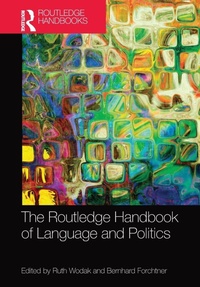
The Routledge Handbook of Language and Politics
1st Edition
Published on 30. June 2021
Book
Paperback/Softback
738 pages
978-1-032-09648-3 (ISBN)
Description
The Routledge Handbook of Language and Politics provides a comprehensive overview of this important and dynamic area of study and research. Language is indispensable to initiating, justifying, legitimatising and coordinating action as well as negotiating conflict and, as such, is intrinsically linked to the area of politics. With 45 chapters written by leading scholars from around the world, this Handbook covers the following key areas:
Overviews of the most influential theoretical approaches, including Bourdieu, Foucault, Habermas and Marx;
Methodological approaches to language and politics, covering - among others - content analysis, conversation analysis, multimodal analysis and narrative analysis;
Genres of political action from speech-making and policy to national anthems and billboards;
Cutting-edge case studies about hot-topic socio-political phenomena, such as ageing, social class, gendered politics and populism.
The Routledge Handbook of Language and Politics is a vibrant survey of this key field and is essential reading for advanced students and researchers studying language and politics.
Overviews of the most influential theoretical approaches, including Bourdieu, Foucault, Habermas and Marx;
Methodological approaches to language and politics, covering - among others - content analysis, conversation analysis, multimodal analysis and narrative analysis;
Genres of political action from speech-making and policy to national anthems and billboards;
Cutting-edge case studies about hot-topic socio-political phenomena, such as ageing, social class, gendered politics and populism.
The Routledge Handbook of Language and Politics is a vibrant survey of this key field and is essential reading for advanced students and researchers studying language and politics.
Reviews / Votes
'The book is of immense value to young researchers as well as undergraduates. All the chapters are well referenced and the relevance of the approach is illustrated with case studies in Parts IV and V. (...) The book is a model of inter-disciplinary research and should be read closely by those interested in language and politics.'- Georgi Asatryan, Plekhanov Russian University of Economics, John Benjamins Publishing Company
More details
Series
Language
English
Place of publication
London
United Kingdom
Publishing group
Taylor & Francis Ltd
Target group
College/higher education
Postgraduate and Undergraduate
Illustrations
38 s/w Abbildungen
38 Illustrations, black and white
Dimensions
Height: 244 mm
Width: 170 mm
Thickness: 39 mm
Weight
1253 gr
ISBN-13
978-1-032-09648-3 (9781032096483)
Copyright in bibliographic data and cover images is held by Nielsen Book Services Limited or by the publishers or by their respective licensors: all rights reserved.
Schweitzer Classification
Other editions
Additional editions
Ruth Wodak | Bernhard Forchtner
The Routledge Handbook of Language and Politics
E-Book
08/2017
Routledge
€65.99
Available for download
Ruth Wodak | Bernhard Forchtner
The Routledge Handbook of Language and Politics
E-Book
08/2017
Routledge
€65.99
Available for download
Ruth Wodak | Bernhard Forchtner
The Routledge Handbook of Language and Politics
Book
08/2017
1st Edition
Routledge
€364.31
Shipment within 10-20 days
Persons
Ruth Wodak is Emerita Distinguished Professor of Discourse Studies at Lancaster University, UK; she remains affiliated to the University of Vienna, Austria.
Bernhard Forchtner is a Lecturer at the School of Media, Communication and Sociology, University of Leicester, UK.
Advisory Board
Adam Jaworski, Hong Kong University
Barbara Johnstone, Carnegie Mellon University, USA
Deborah Stone, Brandeis University, USA
Teun van Dijk, Pompeu Fabra University, Spain
Bernhard Forchtner is a Lecturer at the School of Media, Communication and Sociology, University of Leicester, UK.
Advisory Board
Adam Jaworski, Hong Kong University
Barbara Johnstone, Carnegie Mellon University, USA
Deborah Stone, Brandeis University, USA
Teun van Dijk, Pompeu Fabra University, Spain
Content
Introduction: Introducing the language-politics nexus (Ruth Wodak and Bernhard Forchtner) Part I: Theoretical approaches to language and politics Chapter 1: Rhetoric as a civic art from antiquity to the beginning of modernity (Sara Rubinelli) Chapter 2: From Karl Marx to Antonio Gramsci and Louis Althusser (Bob Jessop) Chapter 3: Juergen Habermas: between democratic deliberation and deliberative democracy (Simon Susen) Chapter 4: Michel Foucault:discourse, power/knowledge and deliberative democracy (Reiner Keller) Chapter 5: Jacques Lacan: negotiating the pychosocial in and beyond language (Yannis Stavrakakis) Chapter 6: The discourse theory of Ernesto Laclau (Christoffer Kolvraa) Chapter 7: Pierre Bourdieu: ally or foe of discourse analysis? (Andrew Sayer) Chapter 8: Conceptual history: the history of basic concepts (Jan Ifversen) Chapter 9: Critical discourse Studies: a critical approach to the study of language and communication (Bernhard Forchtner and Ruth Wodak) Part II: Methodical approaches to language and politicsChapter 10: Content analysis (Roberto Franzosi) Chapter 11: Corpus analysis (Amelie Kutter) Chapter 12: Cognitive linguistic Critical Discourse Studies: connecting language and image (Christopher Hart) Chapter 13: Competition metaphors and ideology: life as a race (Jonathan Charteris-Black) Chapter 14: Legitimation and multimodality (Theo van Leeuwen) Chapter 15: Narrative analysis (Anna de Fina) Chapter 16: Rhetorical analysis (Claudia Posch) Chapter 17: Understanding political issues through argumentation analysis (Ruth Amossy) Chapter 18: Conversation analysis and the study of language and politics (Steven E. Clayman and Laura Loeb).../part contents