

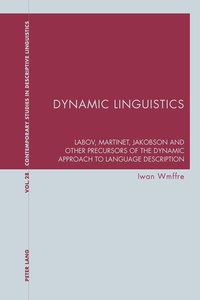
Dynamic Linguistics
Labov, Martinet, Jakobson and other Precursors of the Dynamic Approach to Language Description
1st Edition
Published on 25. October 2013
Book
Paperback/Softback
XXVI, 594 pages
978-3-0343-1705-4 (ISBN)
Description
Analysis of language as a combination of both a structural and a lexical component overlooks a third all-encompassing aspect: dynamics.
Dynamic Linguistics
approaches the description of the complex phenomenon that is human language by focusing on this important but often neglected aspect.
This book charts the belated recognition of the importance of dynamic synchrony in twentieth-century linguistics and discusses two other key concepts in some detail: speech community and language structure . Because of their vital role in the development of a dynamic approach to linguistics, the three linguists William Labov, André Martinet and Roman Jakobson are featured, in particular Martinet in whose later writings - neglected in the English-speaking world - the fullest appreciation of the dynamics of language to date are found. A sustained attempt is also made to chronicle precursors, between the nineteenth century and the 1970s, who provided inspiration for these three scholars in the development of a dynamic approach to linguistic description and analysis.
The dynamic approach to linguistics is intended to help consolidate functional structuralists, geolinguists, sociolinguists and all other empirically minded linguists within a broader theoretical framework as well as playing a part in reversing the overformalism of the simplistic structuralist framework which has dominated, and continues to dominate, present-day linguistic description.
This book charts the belated recognition of the importance of dynamic synchrony in twentieth-century linguistics and discusses two other key concepts in some detail: speech community and language structure . Because of their vital role in the development of a dynamic approach to linguistics, the three linguists William Labov, André Martinet and Roman Jakobson are featured, in particular Martinet in whose later writings - neglected in the English-speaking world - the fullest appreciation of the dynamics of language to date are found. A sustained attempt is also made to chronicle precursors, between the nineteenth century and the 1970s, who provided inspiration for these three scholars in the development of a dynamic approach to linguistic description and analysis.
The dynamic approach to linguistics is intended to help consolidate functional structuralists, geolinguists, sociolinguists and all other empirically minded linguists within a broader theoretical framework as well as playing a part in reversing the overformalism of the simplistic structuralist framework which has dominated, and continues to dominate, present-day linguistic description.
More details
Persons
Iwan Wmffre is Lecturer of Celtic at the University of Ulster, Northern Ireland. He is a specialist in the Celtic languages, especially the Brittonic branch, and general linguistics, especially descriptive and phonetic issues. Recent publications include
Breton Orthographies and Dialects: The Twentieth-Century Orthography War in Brittany
(2007), and the forthcoming
A Dynamic Description of Lampeter Welsh: The Traditional Language
and
A Practical Phonetic Description of Ulster Irish Gaelic
, both to be published in 2013.
Content
Contents: Structuralism's neglect of dynamics - Labov's contribution to dynamics - Martinet's contribution to dynamics - The Prague School and Jakobson's contribution to dynamics - Problems of definition of concepts and terms relevant to dynamic linguistics - Martinet and Labov - Dynamics: Martinet's precursors - Some problems of reification in linguistics - What is dynamics in language and dynamic linguistics? - Principles of a dynamic description of language.