

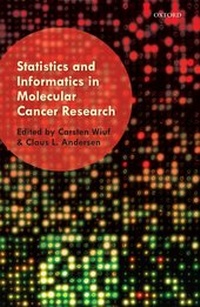
Statistics and Informatics in Molecular Cancer Research
Published on 18. June 2009
Book
Hardback
218 pages
978-0-19-953287-2 (ISBN)
Description
Molecular understanding of cancer and cancer progression is at the forefront of many research programs today. High-throughput array technologies and other modern molecular techniques produce a wealth of molecular data about the structure, and function of cells, tissues, and organisms. Correctly analyzed and interpreted these data hold the promise of bringing new markers for prognostic and diagnostic use, for new treatment schemes, and of gaining new biological insight into the evolution of cancer and its molecular, pathological, and clinical consequences.
Aimed at graduates and researchers, this book discusses novel advances in informatics and statistics in molecular cancer research. Through eight chapters from carefully chosen experts it brings the reader up to date with specific topics in cancer research, how the topics give rise to development of new informatics and statistics tools, and how the tools can be applied. The focus of the book is to give the reader an understanding of key concepts and tools, rather than focusing on technical issues.
A main theme is the extensive use of array technologies in modern cancer research - gene expression and exon arrays, SNP and copy number arrays, and methylation arrays - to derive quantitative and qualitative statements about cancer, its progression and aetiology, and to understand how these technologies on one hand allow us learn about cancer tissue as a complex system and on the other hand allow us to pinpoint key genes and events as crucial for the development of the disease.
Aimed at graduates and researchers, this book discusses novel advances in informatics and statistics in molecular cancer research. Through eight chapters from carefully chosen experts it brings the reader up to date with specific topics in cancer research, how the topics give rise to development of new informatics and statistics tools, and how the tools can be applied. The focus of the book is to give the reader an understanding of key concepts and tools, rather than focusing on technical issues.
A main theme is the extensive use of array technologies in modern cancer research - gene expression and exon arrays, SNP and copy number arrays, and methylation arrays - to derive quantitative and qualitative statements about cancer, its progression and aetiology, and to understand how these technologies on one hand allow us learn about cancer tissue as a complex system and on the other hand allow us to pinpoint key genes and events as crucial for the development of the disease.
More details
Language
English
Place of publication
Oxford
United Kingdom
Target group
College/higher education
Illustrations
54 line illustrations
Dimensions
Height: 240 mm
Width: 159 mm
Thickness: 16 mm
Weight
442 gr
ISBN-13
978-0-19-953287-2 (9780199532872)
Copyright in bibliographic data and cover images is held by Nielsen Book Services Limited or by the publishers or by their respective licensors: all rights reserved.
Schweitzer Classification
Other editions
Additional editions
Carsten Wiuf | Claus L. Andersen
Statistics and Informatics in Molecular Cancer Research
E-Book
06/2009
OUP eBook
€48.49
Available for download
Persons
Carsten Wiuf obtained his PhD in mathematical biology from the University of Aarhus in 1998. Afterwards he spent 4 years in Oxford at the Department of Statistics before joining a biotech company in Boston. In 2003 he became Professor of Bioinformatics at the University of Aarhus. He has co-authored the book Gene Genealogies, Variation and Evolution (OUP).
Claus L. Andersen earned his PhD in cancer biology from the University of Aarhus in 2002. In 2002 he became an assistant professor at the University of Aarhus and later in 2005 an associated professor. Today he is heading the colorectal cancer research group at the Molecular Diagnostic Laboratory, Aarhus University Hospital.
Both have worked on informatics approaches to the analysis of molecular cancer data and have practical as well as theoretical experience with development of bioinformatics and statistical methods for analysis of molecular data.
Claus L. Andersen earned his PhD in cancer biology from the University of Aarhus in 2002. In 2002 he became an assistant professor at the University of Aarhus and later in 2005 an associated professor. Today he is heading the colorectal cancer research group at the Molecular Diagnostic Laboratory, Aarhus University Hospital.
Both have worked on informatics approaches to the analysis of molecular cancer data and have practical as well as theoretical experience with development of bioinformatics and statistical methods for analysis of molecular data.
Content
PREFACE ; 1. Association Studies ; 2. Methods for DNA Copy Number Derivations ; 3. Methods for Derivation of LOH and Allelic Copy Numbers Using SNP Arrays ; 4. Bioinformatics of gene expression and copy number data integration ; 5. Analysis of DNA Methylation in Cancer ; 6. Pathway Analysis: Pathway Signatures and Classification ; 7. Two Methods for Comparing Genomic Data Across Independent Studies in Cancer Research: Meta-analysis and Oncomine Concepts Map ; 8. Bioinformatic Approaches to the Analysis of Alternative Splicing Variants in Cancer Biology ; INDEX