

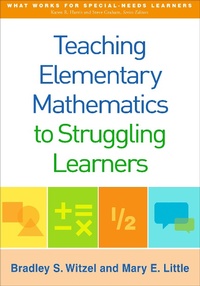
Teaching Elementary Mathematics to Struggling Learners
1st Edition
Published on 27. January 2016
Book
Hardback
180 pages
978-1-4625-2312-2 (ISBN)
Description
Packed with effective instructional strategies, this book explores why certain K-5 students struggle with math and provides a framework for helping these learners succeed. The authors present empirically validated practices for supporting students with disabilities and others experiencing difficulties in specific areas of math, including problem solving, early numeracy, whole-number operations, fractions, geometry, and algebra. Concrete examples, easy-to-implement lesson-planning ideas, and connections to state standards, in particular the Common Core standards, enhance the book's utility. Also provided is invaluable guidance on planning and delivering multi-tiered instruction and intervention.
Reviews / Votes
"This book is a welcome addition to the literature. The authors include many helpful examples of research-supported assessment and instructional practices for making mathematics accessible to students with learning difficulties, and explain why these difficulties occur. The book provides in-depth discussions of critical mathematical content and practices that every elementary school teacher needs to master in order to meet all students' needs. It would be an excellent text for undergraduate- or master's-level general or special education courses."--David H. Allsopp, PhD, Department of Teaching and Learning, University of South Florida"Wow! It is nice to go into a new school year with fresh ideas--this book will definitely influence my teaching. It makes a lot of eye-opening points, backed by solid research. The book offers strategies for teaching and reinforcing math vocabulary and fluency from an early age. It presents a variety of games and activities for each specific math skill, which I can't wait to implement in the classroom."--Brooke Niemann, special education teacher and math coach, The Pathway School, Jeffersonville, Pennsylvania
"An excellent, timely, teacher-friendly resource. Witzel and Little do a wonderful job of blending research-based practices with instructional recommendations that teachers can implement immediately. This book is a 'must have' in today's inclusive mathematics classroom."--Paul J. Riccomini, PhD, Department of Educational Psychology, Counseling, and Special Education, The Pennsylvania State University
"This book provides essential knowledge for general and special educators and coaches, guiding them to present simple to complex mathematical concepts through language-rich instruction. Teachers will gain a better understanding of what students struggle with, as well as why. I plan to use this book as a text in my methods course for teacher candidates in special education. It has great potential for giving preservice teachers a stronger foundation in math and helping them make instruction accessible and meaningful to struggling learners."--Sharlene A. Kiuhara, PhD, Department of Special Education, The University of Utah
"An ideal guide for educators. The book outlines the progression of math learning and provides strategies for supporting all students, particularly at-risk students and those with disabilities. Any preservice or inservice teacher would benefit from the ideas and tools that Witzel and Little present."--Mabra H. Wayman, math instructional coach and interventionist, Rock Hill School District, South Carolina -It is amazing how much solid information has been shoehorned into this rather thin volume. Witzel and Little provide myriad references to research-based studies, unambiguous examples of mathematical difficulties that students encounter, and a broad spectrum of instructional strategies and intervention techniques....The content is appropriate for those instructing students of all levels of ability and needs....This book will be a valuable resource for both preservice teachers and seasoned professionals....Highly recommended. Upper-division undergraduates, graduate students, researchers, and practitioners.--Choice Reviews, 10/1/2016 "This book is a welcome addition to the literature. The authors include many helpful examples of research-supported assessment and instructional practices for making mathematics accessible to students with learning difficulties, and explain why these difficulties occur. The book provides in-depth discussions of critical mathematical content and practices that every elementary school teacher needs to master in order to meet all students' needs. It would be an excellent text for undergraduate- or master's-level general or special education courses."--David H. Allsopp, PhD, Department of Teaching and Learning, University of South Florida
"Wow! It is nice to go into a new school year with fresh ideas--this book will definitely influence my teaching. It makes a lot of eye-opening points, backed by solid research. The book offers strategies for teaching and reinforcing math vocabulary and fluency from an early age. It presents a variety of games and activities for each specific math skill, which I can't wait to implement in the classroom."--Brooke Niemann, special education teacher and math coach, The Pathway School, Jeffersonville, Pennsylvania
"An excellent, timely, teacher-friendly resource. Witzel and Little do a wonderful job of blending research-based practices with instructional recommendations that teachers can implement immediately. This book is a 'must have' in today's inclusive mathematics classroom."--Paul J. Riccomini, PhD, Department of Educational Psychology, Counseling, and Special Education, The Pennsylvania State University
"This book provides essential knowledge for general and special educators and coaches, guiding them to present simple to complex mathematical concepts through language-rich instruction. Teachers will gain a better understanding of what students struggle with, as well as why. I plan to use this book as a text in my methods course for teacher candidates in special education. It has great potential for giving preservice teachers a stronger foundation in math and helping them make instruction accessible and meaningful to struggling learners."--Sharlene A. Kiuhara, PhD, Department of Special Education, The University of Utah
"An ideal guide for educators. The book outlines the progression of math learning and provides strategies for supporting all students, particularly at-risk students and those with disabilities. Any preservice or inservice teacher would benefit from the ideas and tools that Witzel and Little present."--Mabra H. Wayman, math instructional coach and interventionist, Rock Hill School District, South Carolina -It is amazing how much solid information has been shoehorned into this rather thin volume. Witzel and Little provide myriad references to research-based studies, unambiguous examples of mathematical difficulties that students encounter, and a broad spectrum of instructional strategies and intervention techniquesaEUR|.The content is appropriate for those instructing students of all levels of ability and needsaEUR|.This book will be a valuable resource for both preservice teachers and seasoned professionalsaEUR|.Highly recommended. Upper-division undergraduates, graduate students, researchers, and practitioners.--Choice Reviews, 10/1/2016
More details
Series
Language
English
Place of publication
New York
United States
Publishing group
Guilford Publications
Target group
Professional and scholarly
Professional and Professional Practice & Development
Product notice
sewn/stitched
Cloth over boards
Dimensions
Height: 251 mm
Width: 183 mm
Thickness: 18 mm
Weight
544 gr
ISBN-13
978-1-4625-2312-2 (9781462523122)
Copyright in bibliographic data and cover images is held by Nielsen Book Services Limited or by the publishers or by their respective licensors: all rights reserved.
Schweitzer Classification
Other editions
Additional editions
Bradley S. Witzel | Mary E. Little
Teaching Elementary Mathematics to Struggling Learners
Book
03/2016
1st Edition
Guilford Press
€37.00
Shipment within 15-20 days
Persons
Bradley S. Witzel, PhD, is Professor and Special Education Program Coordinator in the College of Education at Winthrop University in South Carolina. As a classroom teacher (and before that as a paraeducator), he worked in multiple settings, teaching mainly math and science to high-achieving students with disabilities and learning difficulties. Dr. Witzel has authored several dozen research and practitioner articles and several books, including Building Number Sense through the Common Core. He has developed and presented a dozen educational videos, and he has also delivered several hundred workshops and conference presentations. A governing board member of the Southeast Regional Educational Laboratory and a member of multiple state-level governing boards for multi-tiered systems of support and response to intervention, Dr. Witzel currently serves as editor of Focus on Inclusive Education through the Association of Childhood Education International.
Mary E. Little, PhD, is Professor and Coordinator of Graduate Programs in Exceptional Student Education at the University of Central Florida. She has worked in K-12 schools as a secondary teacher, co-teacher, program coordinator, and principal. Dr. Little serves as Principal Investigator for a research and development project designed to enhance the existing graduate programs at the university to ensure highly qualified special education teachers in the content areas of mathematics and science, especially within diverse urban schools. She is the author of numerous articles, chapters, and books, including RTI and Mathematics: Practical Tools for Teachers in K-8 Classrooms.Her interests include evidence-based instructional practices, interventions, teacher efficacy, and student learning related to teacher learning.
Mary E. Little, PhD, is Professor and Coordinator of Graduate Programs in Exceptional Student Education at the University of Central Florida. She has worked in K-12 schools as a secondary teacher, co-teacher, program coordinator, and principal. Dr. Little serves as Principal Investigator for a research and development project designed to enhance the existing graduate programs at the university to ensure highly qualified special education teachers in the content areas of mathematics and science, especially within diverse urban schools. She is the author of numerous articles, chapters, and books, including RTI and Mathematics: Practical Tools for Teachers in K-8 Classrooms.Her interests include evidence-based instructional practices, interventions, teacher efficacy, and student learning related to teacher learning.
Content
Introduction
1. Foundations of Mathematics Education
2. The Critical Importance of Instruction
3. The Language of Mathematics
4. Number Sense
5. Whole-Number Operations
6: Rational-Number Concepts and Computation
7. Geometry and Measurement
8. Algebra
9. Multi-Tiered Systems of Supports in Mathematics
1. Foundations of Mathematics Education
2. The Critical Importance of Instruction
3. The Language of Mathematics
4. Number Sense
5. Whole-Number Operations
6: Rational-Number Concepts and Computation
7. Geometry and Measurement
8. Algebra
9. Multi-Tiered Systems of Supports in Mathematics