

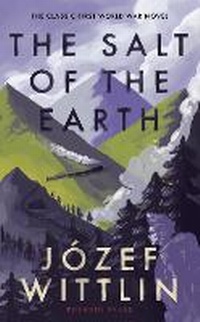
The Salt of the Earth
Published on 29. November 2018
Book
Hardback
352 pages
978-1-78227-470-4 (ISBN)
Description
'Only the villages are asleep, the eternal reservoir of all kinds of soldiery, the inexhaustible source of physical strength'
At the beginning of the twentieth century the villagers of the Carpathian mountains lead a simple life, much as they have always done. The modern world has yet to reach the inhabitants of this isolated and remote region of the Habsburg Empire. Among them is Piotr, a bandy-legged peasant, who wants nothing more from life than an official railway cap, a cottage with a mouse-trap and cheese, and a bride with a dowry.
But then the First World War comes to the mountains, and Piotr is drafted into the army. All the weight of imperial authority is used to mould him into an unthinking fighting machine, so that the bewildered peasant can be forced to fight a war he does not understand, for interests other than his own.
The Salt of the Earth is a classic war novel, a powerful pacifist tale about the consequences of war on ordinary men.
At the beginning of the twentieth century the villagers of the Carpathian mountains lead a simple life, much as they have always done. The modern world has yet to reach the inhabitants of this isolated and remote region of the Habsburg Empire. Among them is Piotr, a bandy-legged peasant, who wants nothing more from life than an official railway cap, a cottage with a mouse-trap and cheese, and a bride with a dowry.
But then the First World War comes to the mountains, and Piotr is drafted into the army. All the weight of imperial authority is used to mould him into an unthinking fighting machine, so that the bewildered peasant can be forced to fight a war he does not understand, for interests other than his own.
The Salt of the Earth is a classic war novel, a powerful pacifist tale about the consequences of war on ordinary men.
Reviews / Votes
Lively, faithful, and sensitive to the cultural nuances that make the novel such a rich tapestry of the Austrian-Hungarian monarchy prior to World War I * World Literature Today * One of the great Central European war stories, on a par with the works of Jaroslav Hasek * Los Angeles Review of Books * Wittlin's... irony and quiet fury are those of the idealistic ascetic steeped in the Old Testament and the Odyssey. His compassion for the ignorant and lowly of the earth, breathed into his work, imparts to it a glowing poetic quality and a sublimity of soul... It is a volume to be read again and again. It has the satisfying quality of good music. * Virginia Quarterly Review * One of the small number of contemporary works which extend into the sphere of the mythical and epical * Thomas Mann * A captivating read. I loved the narrative prose style and adored the characters * Nicki J. Marcus (blog) * Cocteau's Thomas the Imposter meets Brecht's Mother Courage and Erich Maria Remarque's All Quiet on the Western Front... The dark tragedy of a world war, the collapse and eradication of an entire topos of history, humanity and culture becomes a tensely rhythmed black comedy * Bookanista *More details
Language
English
Place of publication
London
United Kingdom
Dimensions
Height: 216 mm
Width: 135 mm
ISBN-13
978-1-78227-470-4 (9781782274704)
Copyright in bibliographic data and cover images is held by Nielsen Book Services Limited or by the publishers or by their respective licensors: all rights reserved.
Schweitzer Classification
Other editions
Additional editions
Persons
Jozef Wittlin, born in 1896, was a major Polish poet, novelist, essayist and translator. He studied in Vienna, where he met Joseph Roth and Rainer Maria Rilke, before serving in the Austro-Hungarian army in the First World War. His experiences during that war inspired him to write The Salt of the Earth, which was first published in 1935. It was awarded the Polish National Academy Prize, won Wittlin a nomination for the Nobel Prize, and has since been translated into 14 languages. Jozef Wittlin also translated Homer's Odyssey into Polish, published several collections of poetry, many of which were strongly pacifist, and penned numerous essays including 'My Lwow', which is included in City of Lions, also published by Pushkin Press. With the outbreak of the Second World War he fled to France and then to New York, where he died in 1976.