

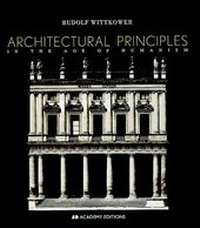
Architectural Principles
In the Age of Humanism
5th Edition
Published on 2. October 1998
Book
Paperback/Softback
160 pages
978-0-471-97763-6 (ISBN)
Description
"Professor Wittkower's.studies of humanist architecture are masterpieces of scholarship."-Sir Kenneth Clark, Architectural Review.
A fourth edition of the forty-year-old classic.
Focusing on the principal architects of that time-from Alberti to Palladio-this bestselling classic explains the true significance of certain architectural forms, bringing to light the connections between the architecture and culture of the period. With publication scheduled to coincide with that of Architectonics of Humanism, this important reference is superbly reproduced in a new, large square format.
The late RUDOLF WITTKOWER was a college professor and eminent scholar residing in London, England.
More details
Product info
PB
Edition
5., Auflage
Language
English
Place of publication
United States
Publishing group
John Wiley & Sons Inc
Target group
College/higher education
Professional and scholarly
Edition type
New edition
Dimensions
Height: 229 mm
Width: 235 mm
Thickness: 14 mm
Weight
598 gr
ISBN-13
978-0-471-97763-6 (9780471977636)
Schweitzer Classification
Other editions
Previous edition

Rudolf Wittkower | Andreas Papadakis
Architectural Principles in the Age of Humanism
Book
06/1991
4th Edition
Wiley
€44.75
Article exhausted; check for reprint
Person
Rudolf Wittkower was born in Berlin in 1901. Leaving Germany when the Nazis came to power, he was one of the animators of the Warburg Institute of London. In 1941 he organized, with Fritz Saxl, the exhibition British Art and the Mediterranean, the publication of which (1948) forms an important document of the aims and methods of the Warburg Institute. A great scholar of Italian Renaissance and Baroque art, Wittkower taught at both the University of London and Columbia University. His books, all important works of scholarship, include Die Zeichnungen des Gian Lorenzo Bernini (with H. Bruer, 1931), The Drawings of the Carracci at Windsor Castle (1952), Gian Lorenzo Bernini, the Sculptor of Roman Baroque (1955), Art and Architecture in Italy, 1600-1750 (1958), Born under Saturn (with Margot Wittkower, 1963), and Divine Michelangelo: The Florentine Academy's Homage on His Death in 1564 (with Margot Wittkower, 1964). In addition, he was a frequent contributor to the Journal of the Warbung and Courtauld Institute, the Art Bulletin, Burlington Magazine and the Journal of the Society of Architectural Historians, among others.
Content
THE CENTRALLY PLANNED CHURCH AND THE RENAISSANCE.
Alberti's Programme of the Ideal Church.
Centralized Churches in Later Architectural Theory.
Building Practice: S Maria delle Carceri.
Bramante and Palladio.
The Religious Symbolism of Centrally Planned Churches.
ALBERTI'S APPROACH TO ANTIQUITY IN ARCHITECTURE.
The Column in Alberti's Theory and Practice.
S. Francesco at Rimini.
S. Maria Novella.
S. Sebastiano and S. Andrea at Mantua.
The Change in Alberti's Interpretation of Classical Architecture.
PRINCIPLES OF PALLADIO'S ARCHITECTURE.
The Architect as 'uomo universale': Palladio, Trissino and Barbaro.
Palladio's Geometry: The Villas.
Palladio and Classical Architecture: Palaces and Public Buildings.
The Genesis of an Idea: Palladio's Church Façades.
Palladio's Optical and Psychological Concepts: II Redentore.
THE PROBLEM OF HARMONIC PROPORTION IN ARCHITECTURE.
Francesco Giorgi's Platonic Programme for S. Francesco della Vigna.
The Mean Proportionals and Architecture.
Alberti's Generation of Ratios.
Musical Consonances and the Visual Arts.
Palladio's 'fugal' System of Proportion.
Palladio's Ratios and the Development of Sixteenth-Century Musical Theory.
The Break-away from the Laws of Harmonic Porportion Architecture.
Appendices.
Index.