

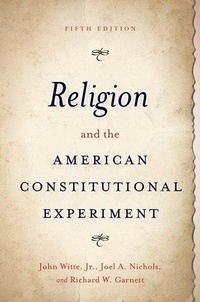
Religion and the American Constitutional Experiment
5th Edition
Published on 10. August 2022
Book
Paperback/Softback
464 pages
978-0-19-758762-1 (ISBN)
Description
This accessible and authoritative introduction tells the American story of religious liberty from its colonial beginnings to the latest Supreme Court cases. The authors analyze closely the formation of the First Amendment religion clauses and describe the unique and enduring principles of the American experiment in religious freedom - liberty of conscience, free exercise of religion, religious equality, religious pluralism, separation of church and state, and no establishment of religion. Successive chapters map all of the 240+ Supreme Court cases on religious freedom - covering the free exercise of religion; the roles of government and religion in education; the place of religion in public life; and the interaction of religious organizations and the state. The concluding reflections argue that protecting religious freedom is critical for democratic order and constitutional rule of law, even if it needs judicious balancing with other fundamental rights and state interests.
Clear, comprehensive, multidisciplinary, and balanced, this classic volume is an ideal classroom text. This new 5th edition addresses fully the new hot-button issues and cases on religious freedom versus sexual liberty; religious worship in the time of COVID; freedom of conscience and exemption claims; state aid to religion; religious monuments and ceremonies in public life; and the rights and limits of religious groups.
Clear, comprehensive, multidisciplinary, and balanced, this classic volume is an ideal classroom text. This new 5th edition addresses fully the new hot-button issues and cases on religious freedom versus sexual liberty; religious worship in the time of COVID; freedom of conscience and exemption claims; state aid to religion; religious monuments and ceremonies in public life; and the rights and limits of religious groups.
Reviews / Votes
This magisterial revision of Religion and the American Constitutional Experiment is an accessible and authoritative guide through the remarkable but tortuous history of America's unique approach to religious freedom. Clear without over-simplification, comprehensive without pedantry, it portrays a system that enabled the United States to become a society where members of all religions and no religion could not only live together in relative harmony but flourish. * Mary Ann Glendon, Learned Hand Professor of Law emerita, Harvard University * This book by John Witte and Joel Nichols is probably the best combination that exists of historical background, theoretical understanding, and legal doctrines of the religion clauses. It allows scholars, students, and other citizens to grasp the history behind the clauses without undertaking full-scale research on their own. The book is also a superb source to understand modern controversies and how courts are dealing with them. * Kent Greenawalt, University Professor, Columbia Law School* In evenhanded and clear prose, Witte and Nichols provide a clear and comprehensive history of religious liberty in the United States. Broad in scope, updated with the latest developments, and supplemented with impressive appendices that catalog state constitutional provisions and Supreme Court decisions, this text offers cogent analysis from leading scholars of law and religion. Already a trusted and valuable classroom resource, this book will also enlighten those seeking a deeper understanding of the contours of this important topic. * Amy E. Black, Professor of Political Science, Wheaton College
* The authors provide clear description of complicated case law and public policy for students and citizens. They reveal patterns and principles on a subject often caricatured by wild generalizations and widespread confusion. Academics and experts across a range of fields and professions will appreciate their fine analysis and comprehensive scholarship. The authors refute a weak postmodernist critique of religious freedom and offer a provocative perspective on the history of liberty of conscience. * Reading Religion * In the inevitably contentious field of church-state constitutional issues in America, it is rare to find a volume that is as accessible, thoughtful, and measured as Religion and the American Constitutional Experiment by John Witte, Jr. and Joel A. Nichols. Their remarkable ability to create order in the midst of the chaos of the ever-changing constitutional law of religious liberty makes this an ideal volume for classroom use, and this new fourth edition updates the church-state story through the US Supreme Court s 2015
decisions. * Journal of Church and State *
More details
Edition
5th Revised edition
Language
English
Place of publication
New York
United States
Target group
Professional and scholarly
Edition type
Revised edition
Product notice
Paperback (trade)
Unsewn / adhesive bound
Dimensions
Height: 235 mm
Width: 158 mm
Thickness: 27 mm
Weight
676 gr
ISBN-13
978-0-19-758762-1 (9780197587621)
Copyright in bibliographic data and cover images is held by Nielsen Book Services Limited or by the publishers or by their respective licensors: all rights reserved.
Schweitzer Classification
Other editions
Additional editions
John Witte | Joel A. Nichols | Richard W. Garnett
Religion and the American Constitutional Experiment
Book
05/2022
5th Edition
Oxford University Press Inc
€148.56
Shipment within 15-20 days
John Witte | Joel A. Nichols | Richard W. Garnett
Religion and the American Constitutional Experiment
E-Book
05/2022
5th Edition
OUP eBook
€22.99
Available for download
John Witte | Joel A. Nichols | Richard W. Garnett
Religion and the American Constitutional Experiment
E-Book
05/2022
5th Edition
OUP eBook
€22.99
Available for download
Persons
John Witte, Jr. is Woodruff University Professor, McDonald Distinguished Professor, and Director of the Center for the Study of Law and Religion at Emory University. A leading scholar of legal history, human rights, and law and religion, he has published 300 articles and 40 books, in 15 languages, including The Reformation of Rights; Christianity and Human Rights; Religion and Human Rights; No Establishment of Religion; Church, State, and Family; Faith, Freedom, and Family; and The Blessings of Liberty.
Joel A. Nichols is Interim Dean and Mengler Chair in Law at the University of St. Thomas (MN). His work draws upon his degrees and expertise in both law and theology. He has published three books and more than two dozen articles, typically on the intersection of law and religion.
Richard W. Garnett is Paul J. Schierl/Fort Howard Corporation Professor of Law, Concurrent Professor of Political Science, and Director of the Program on Church, State, and Society at the University of Notre Dame, where he teaches and writes about religious freedom, constitutional and criminal law, and other matters.
Joel A. Nichols is Interim Dean and Mengler Chair in Law at the University of St. Thomas (MN). His work draws upon his degrees and expertise in both law and theology. He has published three books and more than two dozen articles, typically on the intersection of law and religion.
Richard W. Garnett is Paul J. Schierl/Fort Howard Corporation Professor of Law, Concurrent Professor of Political Science, and Director of the Program on Church, State, and Society at the University of Notre Dame, where he teaches and writes about religious freedom, constitutional and criminal law, and other matters.
Author
Woodruff University Professor, McDonald Distinguished Professor, and Director of the Center for the Study of Law and ReligionWoodruff University Professor, McDonald Distinguished Professor, and Director of the Center for the Study of Law and Religion, Emory University
Interim Dean and Mengler Chair in LawInterim Dean and Mengler Chair in Law, University of St. Thomas
Paul J. Schierl/Fort Howard Corporation Professor of Law, Concurrent Professor of Political Science, and Director of the Program on Church, State, and SocietyPaul J. Schierl/Fort Howard Corporation Professor of Law, Concurrent Professor of Political Science, and Director of the Program on Church, State, and Society, Notre Dame
Content
List of Tables ix
Preface xi
Introduction
1 The American Experiment in Historical Context
The First Millennium
The Papal Revolution
The Protestant Reformation
Religious Establishment versus Religious Freedom in Europe
Colonization and Experimentation
2 The Theology and Politics of the Religion Clauses
Puritan Views
Evangelical Views
Enlightenment Views
Civic Republican Views
Summary and Conclusions
3 The Essential Rights and Liberties of Religion
Liberty of Conscience
Free Exercise of Religion
Religious Pluralism
Religious Equality
Separation of Church and State
Disestablishment of Religion
Summary and Conclusions
4 Forging the First Amendment Religion Clauses
Religion and the Continental Congress
The 1787 Constitutional Convention
Ratification and Proposed Amendments
Drafting the First Amendment Religion Clauses
"Original Intent": Interpreting the Final Text
Summary and Conclusions
5 The Free Exercise of Religion: Mapping the Doctrinal Terrain
Bringing a Free Exercise Case
Factual Clusters of Free Exercise Cases
Shifting Standards of Review in Free Exercise Cases
vi Contents
6 First Amendment Religious Exercise, Expression, and Exemption
Free Exercise and Polygamy (1879- 1890)
Free Exercise and Conscientious Objection (1918- 1971)
Freedom and Equality of Religious Expression (1940- 2015)
Liberty of Conscience and Free Exercise Exemptions (1943- 1989)
Summary and Conclusions
7 The Free Exercise of Religion: Neutrality, Nondiscrimination, and Statutory Rights
Neutralizing the Free Exercise Clause (1982- 1990)
Neutrality and No State Discrimination Against Religion (1993- )
Neutrality and Nondiscrimination in State Aid to Religious Education
Neutrality and Nondiscrimination in the Time of Covid
State Neutrality in Balancing Religious Liberty and Sexual Liberty
Free Exercise of Religion as a Statutory Right (1993- )
RFRA Cases in the Supreme Court
RLUIPA Cases in the Supreme Court
Summary and Conclusions
8 Modern Establishment Law: Mapping the Doctrinal Terrain
Bringing an Establishment Clause Case
Mapping the Establishment Clause Cases
Separationism
Accommodationism
Neutrality and the Lemon Test
Endorsement
No Coercion
Equal Treatment/ Equal Access
History and Tradition
Summary and Conclusions
9 Religion and Public Education: No Establishment of Religion, But Equal Access for Religion
Separationist Cases (1948- 2000)
Equal Access Cases (1981- )
Limits on Equal Access?
Summary and Conclusions
10 Government and Religious Education: From Accommodation to Separation to Equality
Accommodationist Cases (1908- 1977)
Separationist Cases (1971- 1985)
Equal Treatment Cases (1983- 2002)
Statutes, Free Exercise, and Equal Access Rights (2004- )
Summary and Conclusions
11 Religion and Public Life
Sabbath Day Rules 282
Legislative Chaplains and Prayers
Religious Symbols
Patterns and Principles
Summary and Conclusions
12 The Freedoms of Religious Organizations
Religious Polity and Structures
Religious Structures
Legal Structures
Religious Property Disputes
Standard Legal Principles (1815- 1914)
Deference (1872- 1976)
Neutral Principles (1979- )
Labor and Employment
Social Services and Taxation
Social Services
Taxation
Summary and Conclusions
Concluding Reflections
Signs of Trouble
Enduring Principles, New Applications
Appendix 1: Drafts of Federal Religion Clauses (1787- 1789)
Appendix 2: United States Supreme Court Decisions Relating to Religious Liberty (1815- 2021)
Index
Preface xi
Introduction
1 The American Experiment in Historical Context
The First Millennium
The Papal Revolution
The Protestant Reformation
Religious Establishment versus Religious Freedom in Europe
Colonization and Experimentation
2 The Theology and Politics of the Religion Clauses
Puritan Views
Evangelical Views
Enlightenment Views
Civic Republican Views
Summary and Conclusions
3 The Essential Rights and Liberties of Religion
Liberty of Conscience
Free Exercise of Religion
Religious Pluralism
Religious Equality
Separation of Church and State
Disestablishment of Religion
Summary and Conclusions
4 Forging the First Amendment Religion Clauses
Religion and the Continental Congress
The 1787 Constitutional Convention
Ratification and Proposed Amendments
Drafting the First Amendment Religion Clauses
"Original Intent": Interpreting the Final Text
Summary and Conclusions
5 The Free Exercise of Religion: Mapping the Doctrinal Terrain
Bringing a Free Exercise Case
Factual Clusters of Free Exercise Cases
Shifting Standards of Review in Free Exercise Cases
vi Contents
6 First Amendment Religious Exercise, Expression, and Exemption
Free Exercise and Polygamy (1879- 1890)
Free Exercise and Conscientious Objection (1918- 1971)
Freedom and Equality of Religious Expression (1940- 2015)
Liberty of Conscience and Free Exercise Exemptions (1943- 1989)
Summary and Conclusions
7 The Free Exercise of Religion: Neutrality, Nondiscrimination, and Statutory Rights
Neutralizing the Free Exercise Clause (1982- 1990)
Neutrality and No State Discrimination Against Religion (1993- )
Neutrality and Nondiscrimination in State Aid to Religious Education
Neutrality and Nondiscrimination in the Time of Covid
State Neutrality in Balancing Religious Liberty and Sexual Liberty
Free Exercise of Religion as a Statutory Right (1993- )
RFRA Cases in the Supreme Court
RLUIPA Cases in the Supreme Court
Summary and Conclusions
8 Modern Establishment Law: Mapping the Doctrinal Terrain
Bringing an Establishment Clause Case
Mapping the Establishment Clause Cases
Separationism
Accommodationism
Neutrality and the Lemon Test
Endorsement
No Coercion
Equal Treatment/ Equal Access
History and Tradition
Summary and Conclusions
9 Religion and Public Education: No Establishment of Religion, But Equal Access for Religion
Separationist Cases (1948- 2000)
Equal Access Cases (1981- )
Limits on Equal Access?
Summary and Conclusions
10 Government and Religious Education: From Accommodation to Separation to Equality
Accommodationist Cases (1908- 1977)
Separationist Cases (1971- 1985)
Equal Treatment Cases (1983- 2002)
Statutes, Free Exercise, and Equal Access Rights (2004- )
Summary and Conclusions
11 Religion and Public Life
Sabbath Day Rules 282
Legislative Chaplains and Prayers
Religious Symbols
Patterns and Principles
Summary and Conclusions
12 The Freedoms of Religious Organizations
Religious Polity and Structures
Religious Structures
Legal Structures
Religious Property Disputes
Standard Legal Principles (1815- 1914)
Deference (1872- 1976)
Neutral Principles (1979- )
Labor and Employment
Social Services and Taxation
Social Services
Taxation
Summary and Conclusions
Concluding Reflections
Signs of Trouble
Enduring Principles, New Applications
Appendix 1: Drafts of Federal Religion Clauses (1787- 1789)
Appendix 2: United States Supreme Court Decisions Relating to Religious Liberty (1815- 2021)
Index